Great Curassow (male)
Crax rubra
Quick Facts
- Scientific Name: Crax rubra
- Spanish Name: Pavón grande
- Family: Cracidae
- Known Nicknames: Mexican Curassow, Pavo de monte, Greater Curassow
- Average Length: 78–100 cm / 31–39 in
- Average Weight: 3.1–4.8 kg / 6.8–10.6 lb
- Wingspan: 116–137 cm / 46–54 in
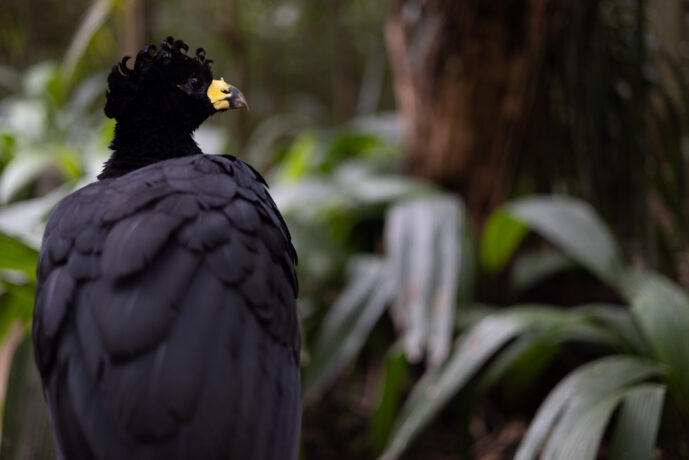
- Key Feature: Recurved crest of curly black feathers and a bright yellow bulbous cere at the base of the bill
- Primary Diet: Omnivore (Primarily Frugivore; also consumes seeds, insects, and small vertebrates)
- Range: Eastern Mexico through Central America to Western Colombia and Northwest Ecuador
- Habitat: Lowland tropical rainforests and evergreen forests
- Social Structure: Pairs or small family groups
- Nesting/Breeding: Shallow platform nests of twigs and leaves in trees
- Conservation Status: Vulnerable (VU)
- Population Trend: Decreasing
The male Great Curassow (*Crax rubra*) is a majestic, pheasant-like bird that stands out as one of the largest and most striking residents of the Neotropical rainforests. Draped in glossy, jet-black plumage that contrasts sharply with a snowy-white underbelly, its most distinctive feature is a vibrant, bulbous yellow knob at the base of its bill, known as a cere. Adding to its regal appearance is a unique crest of stiff, forward-curling feathers atop its head, which gives the bird a textured, almost whimsical silhouette. Primarily a ground-dweller that forages for fallen fruit, the male is also famous for its deep, low-frequency booming calls that can resonate through the dense jungle undergrowth, signaling its presence with a sound as powerful as its physical stature.
Faits amusants
Male Great Curassows sport a distinctive "perm" of curly black feathers on their heads which they can raise or lower to communicate their emotional state. They are easily recognized by the bright yellow, bulbous knob on their beaks, a fleshy ornament that serves as a vibrant signal of health and status to potential mates. These birds are famous for their deep, low-frequency "booming" calls that resonate through the forest like a distant foghorn, a sound produced using a specialized, elongated windpipe. During courtship, males display a gentlemanly side by engaging in "nuptial gifting," where they carefully select and present fallen fruits or insects to females to win their favor.
Habitats et répartition
This species is distributed across the Neotropical region, ranging from eastern Mexico through Central America to the northwestern reaches of South America, specifically western Colombia and Ecuador. It primarily occupies lowland areas, though it can be found at elevations up to approximately 1,900 meters in certain mountainous parts of its range. The preferred habitat consists of dense, undisturbed humid evergreen forests, although the bird also frequents tropical deciduous forests and coastal mangroves. While it spends a significant amount of time foraging on the forest floor, it relies on mature, high-canopy tree cover for nesting and roosting, making it particularly vulnerable to habitat loss and fragmentation.
Comportements & Reproduction
Males are highly territorial and use low-frequency, booming vocalizations to signal their presence to rivals and attract mates. They typically form monogamous pairs, though they may also be seen in small family groups while foraging on the forest floor. During courtship, the male performs elaborate displays, including raising his distinctive curly crest and engaging in nuptial feeding, where he offers specific food items to the female to establish and reinforce their pair bond. The male actively participates in the nesting process by helping to select a site and gathering materials for a platform nest located high in the trees. Once the eggs are laid, he remains nearby to defend the territory and the female from potential predators. A key reproductive strategy is the precocial development of the chicks; shortly after hatching, the young are capable of leaping from the high nest to the ground, where they immediately begin following their parents to forage in the dense undergrowth.
Alimentation
The male Great Curassow is primarily a frugivore, spending much of its time foraging on the forest floor for fallen fruits, berries, and seeds. Although its diet is predominantly plant-based, it is technically an omnivore and will occasionally supplement its nutrition by consuming insects, small lizards, and frogs discovered among the leaf litter. An intriguing aspect of their feeding strategy is their tendency to follow troops of arboreal monkeys, scavenging the fruit scraps and seeds that the primates accidentally drop from the high canopy. Furthermore, these birds serve as essential seed dispersers within tropical ecosystems, as they often swallow fruits whole and transport the seeds across significant distances before depositing them, which helps facilitate the natural regeneration of the forest.
Couleurs
The male Great Curassow features a predominantly glossy black plumage that contrasts sharply with its stark white belly and undertail coverts. Its most distinctive markings include a prominent crest of forward-curving curly black feathers and a bulbous, bright yellow cere at the base of its bill. This dark coloration provides effective camouflage within the deep shadows of the tropical forest floor.