Greater Sac-winged Bat
Saccopteryx bilineata
Quick Facts
- Scientific Name: Saccopteryx bilineata
- Spanish Name: Murciélago de sacos alares mayor
- Family: Emballonuridae
- Known Nicknames: Greater White-lined Bat, Two-lined Bat
- Average Length: 6.3–8.2 cm / 2.5–3.2 in
- Average Weight: 6–9 g / 0.21–0.32 oz
- Wingspan: 20–25 cm / 7.9–9.8 in
- Key Feature: Two white longitudinal wavy stripes on the back and glandular wing sacs used for pheromone display
- Primary Diet: Insectivore
- Range: Southern Mexico through Central America to Brazil, Bolivia, and Trinidad
- Habitat: Lowland Tropical Rainforests, forest edges, and riparian areas
- Social Structure: Harem-based social system with territorial males
- Nesting/Breeding: Tree buttresses, hollow trees, and occasionally buildings
- Statut de conservation : Préoccupation mineure (LC)
- Population Trend: Stable
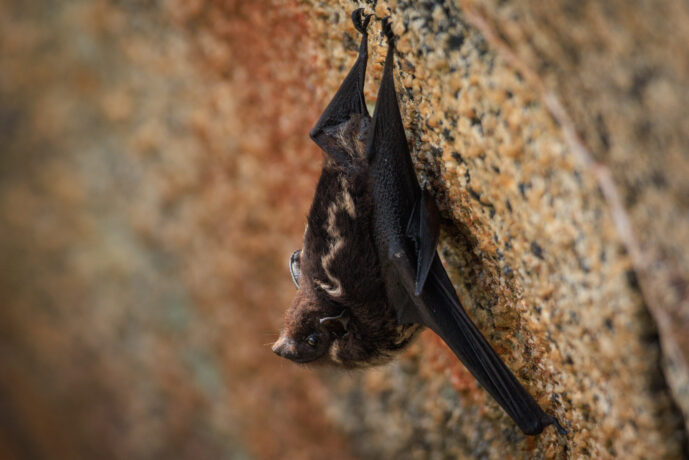
The Greater Sac-winged Bat (*Saccopteryx bilineata*) is a fascinating neotropical species easily recognized by its dark, chocolate-brown fur marked by two distinctive, wavy white stripes running down its back. Its most remarkable feature, and the source of its name, is the presence of glandular wing sacs located near the elbows, which males use to perform complex "scent-salting" displays by hovering before females and shaking a cocktail of pheromones at them. Beyond their unique chemical communication, these bats are renowned for their sophisticated vocal repertoire; they are one of the few non-human mammals known to exhibit "babbling" behavior in infancy, where pups practice intricate songs to mirror adult calls. Often found roosting in relatively well-lit areas like tree buttresses or the exterior of buildings, this species stands out as a highly social and communicative marvel of the bat world.
Faits amusants
The Greater Sac-winged Bat is a master of olfactory seduction, as males utilize specialized pouches on their wings to brew a unique "perfume" composed of saliva, urine, and glandular secretions, which they flick toward females during hover displays. Beyond their chemical signaling, these bats are one of the few mammalian species where males perform complex, bird-like songs to defend territories and attract mates. This vocal complexity begins early in life, with pups engaging in a "babbling" phase remarkably similar to human infants, practicing their vocalizations to master the intricate repertoire required for adult social life.
Habitats et répartition
This species occupies a broad geographical range across the Neotropics, extending from southern Mexico through Central America into South America. Its distribution reaches as far south as central Brazil, eastern Peru, and northern Bolivia, and it is also commonly found on the islands of Trinidad and Tobago. It is primarily a lowland species, typically occurring at elevations below 500 meters, though it can occasionally be found in higher terrains. It predominantly inhabits humid, multi-layered tropical rainforests, as well as deciduous and evergreen forests, often in close proximity to streams or other water sources. Unlike many other bat species, it prefers relatively well-lit roosting sites, frequently utilizing the large buttresses of canopy trees, hollow logs, or the shaded exteriors of man-made structures like buildings and bridges. These habitats provide the necessary vertical surfaces for its characteristic social displays and territorial maintenance.
Comportements & Reproduction
These bats exhibit a complex harem-based social structure where dominant males defend specific roosting territories, such as tree trunks or cave walls, to gain access to groups of females. To maintain these harems, males perform elaborate courtship displays using specialized wing sacs located near their elbows. They fill these sacs with a mixture of urine and glandular secretions, then hover in front of females while flapping their wings to "salt" them with their unique scent. This olfactory signaling is paired with sophisticated vocalizations; males "sing" complex songs to defend their territory and attract mates, making them one of the few mammalian species known to engage in vocal learning. Reproduction is seasonal, typically resulting in the birth of a single pup. Despite the stable harem structure, females frequently engage in extra-harem matings, which promotes genetic diversity within the colony. Pups are notable for their "babbling" behavior, a rare trait where they mimic the vocalizations of adults to learn the intricate songs necessary for future reproductive success. This combination of territorial defense, chemical signaling, and acoustic complexity represents one of the most sophisticated reproductive strategies found among temperate and tropical bats.
Alimentation
The Greater Sac-winged Bat is an insectivorous species that primarily feeds on a variety of small flying insects, including beetles, flies, and moths. These bats are aerial hawkers, meaning they capture their prey while in flight, often patrolling specific foraging territories along forest edges or over water bodies. An intriguing aspect of their feeding behavior is their high level of site fidelity, as individuals frequently return to the same hunting grounds night after night. To locate their prey in the dark, they employ sophisticated echolocation, which allows them to track and intercept insects with incredible precision. Interestingly, their diet and hunting patterns are influenced by their social structure, as males often defend territories that provide access to both food resources and potential mates, ensuring they have consistent access to the high-protein intake necessary to sustain their active nocturnal lifestyle.
Couleurs
The Greater Sac-winged Bat features dark brown to blackish fur accented by two prominent, wavy white stripes running longitudinally down its back. These pale markings provide disruptive camouflage, breaking up the bat's silhouette against the textured bark of trees where it roosts in relatively open areas. Its underside is typically a lighter grayish-brown, further aiding in concealment within forest shadows.