Grey Pileated Finch
Coryphospingus pileatus
Quick Facts
- Scientific Name: Coryphospingus pileatus
- Spanish Name: Granatillo gris
- Family: Thraupidae
- Known Nicknames: Pileated Finch, Grey-pileated Finch
- Average Length: 13 cm / 5.1 in
- Average Weight: 12–18 g / 0.4–0.6 oz
- Wingspan: 18–21 cm / 7.1–8.3 in
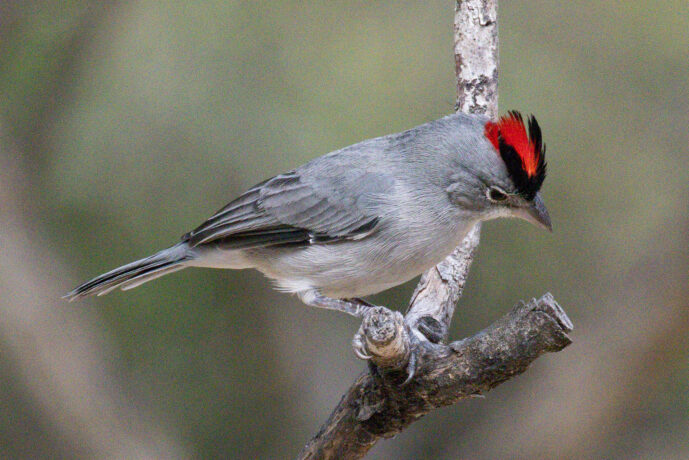
- Key Feature: Concealable bright scarlet-red crown crest contrasting with overall grey plumage
- Primary Diet: Omnivore (primarily granivorous, feeding on seeds and small insects)
- Range: Northern South America (Colombia, Venezuela) and East-Central Brazil
- Habitat: Tropical dry forest, Caatinga, scrubland, and degraded former forest
- Social Structure: Typically found in pairs or small family groups; occasionally forms larger flocks outside breeding season
- Nesting/Breeding: Small, neat cup-shaped nest built in low shrubs or trees
- Statut de conservation : Préoccupation mineure (LC)
- Population Trend: Stable
The Grey Pileated Finch (*Coryphospingus pileatus*) is a small, sophisticated songbird primarily found in the dry scrublands and deciduous forests of South America. It is most easily identified by its sleek, ashy-grey upperparts and contrasting pale underbelly, but its most captivating feature is the brilliant, flame-red crest adorning the male's head. This "pileated" crown is typically held flat, appearing as a dark streak, until the bird becomes excited or engaged in courtship, at which point it flares into a vivid, fan-like display of scarlet. While females possess a more understated, brownish-grey palette without the fiery cap, both sexes are agile foragers often seen hopping through the undergrowth. This blend of subtle camouflage and sudden, dramatic bursts of color makes the Grey Pileated Finch a fascinating highlight of its semi-arid habitat.
Faits amusants
The Grey Pileated Finch is best known for its "hidden" talent: the male possesses a brilliant scarlet crest that remains tucked away until he is excited or defending territory, at which point it flares up like a sudden flash of fire against his muted plumage. These birds are energetic ground-foragers that use a distinctive double-scratching technique to uncover seeds, often appearing to "dance" as they kick back leaf litter with both feet simultaneously. They are also remarkably social and frequently engage in "allopreening," where pair members meticulously groom each other's head feathers to strengthen their bond. Despite their small size, they are surprisingly bold and vocal, producing a rhythmic, metallic song that is often compared to the steady, rapid ticking of a miniature sewing machine.
Habitats et répartition
This species is primarily found in South America, with a distribution that spans across northern Colombia, northern Venezuela, and large portions of central, eastern, and northeastern Brazil. Its range is notably disjunct, with distinct populations occupying the dry regions of these countries rather than forming a single continuous territory. It favors semi-arid environments, particularly the Caatinga biome of Brazil and various dry tropical forests. Within these regions, it inhabits scrublands, deciduous woodlands, and dense bushy areas. It is also frequently observed in human-modified landscapes such as gardens, pastures, and the edges of agricultural fields, where it typically forages on or near the ground.
Comportements & Reproduction
This species exhibits a social structure that varies seasonally, often forming small, active flocks to forage for seeds and insects on the ground. During the breeding season, males become intensely territorial and use their striking, usually hidden, red crests as a visual signal to warn rivals and attract females. They are well-adapted to dry, scrubby environments, where they maintain a discreet presence within dense vegetation. Reproduction begins with a courtship display centered on the male’s vibrant crown. Once paired, the female builds a small, cup-shaped nest tucked away in low, thorny bushes to deter predators. A typical clutch consists of two to three eggs, which are primarily incubated by the female. Both parents participate in rearing the offspring, diligently foraging for insects to provide the high-protein diet necessary for the chicks' development until they are ready to fledge.
Alimentation
The Grey Pileated Finch maintains a diverse diet primarily consisting of various seeds and small grains found while foraging on the ground in its native dry forest and scrubland habitats. While largely granivorous, this species is also an opportunistic insectivore, frequently consuming small invertebrates, larvae, and spiders, particularly during the breeding season to provide essential protein for its developing chicks. An interesting aspect of its feeding behavior is its tendency to forage in pairs or small family groups, meticulously scratching through leaf litter and loose soil to uncover hidden food sources. Additionally, these birds supplement their intake with succulent small fruits and berries when available, making them important contributors to local seed dispersal within their ecosystem.
Couleurs
The Grey Pileated Finch is characterized by uniform ashy-grey plumage that provides effective camouflage within its dry scrub habitat. Males possess a striking, erectile scarlet crest typically bordered by black, while females feature a more muted, brownish-grey crown. Both sexes exhibit a distinct white orbital ring and a dark conical bill, contrasting with their neutral grey upperparts and slightly paler underparts.