Julia butterfly
Dryas iulia
Quick Facts
- Scientific Name: Dryas iulia
- Spanish Name: Julia
- Family: Nymphalidae
- Known Nicknames: Julia Heliconian, The Flame, Julia
- Average Length: 2.5–3.5 cm / 1.0–1.4 in
- Average Weight: 0.1–0.3 g / 0.0035–0.01 oz
- Wingspan: 8.2–9.2 cm / 3.2–3.6 in
- Key Feature: Elongated, bright orange wings with narrow black borders and a rapid, erratic flight pattern
- Primary Diet: Nectarivore (Primarily flower nectar; also consumes mineral-rich fluids such as caiman tears)
- Range: Southern United States (Texas, Florida) through Central America to Brazil
- Habitat: Tropical and subtropical rainforest edges, open woodlands, and gardens
- Social Structure: Solitary
- Nesting/Breeding: Passiflora (Passion flower) host plant leaves
- Conservation Status: Not Evaluated (NE)
- Population Trend: Stable
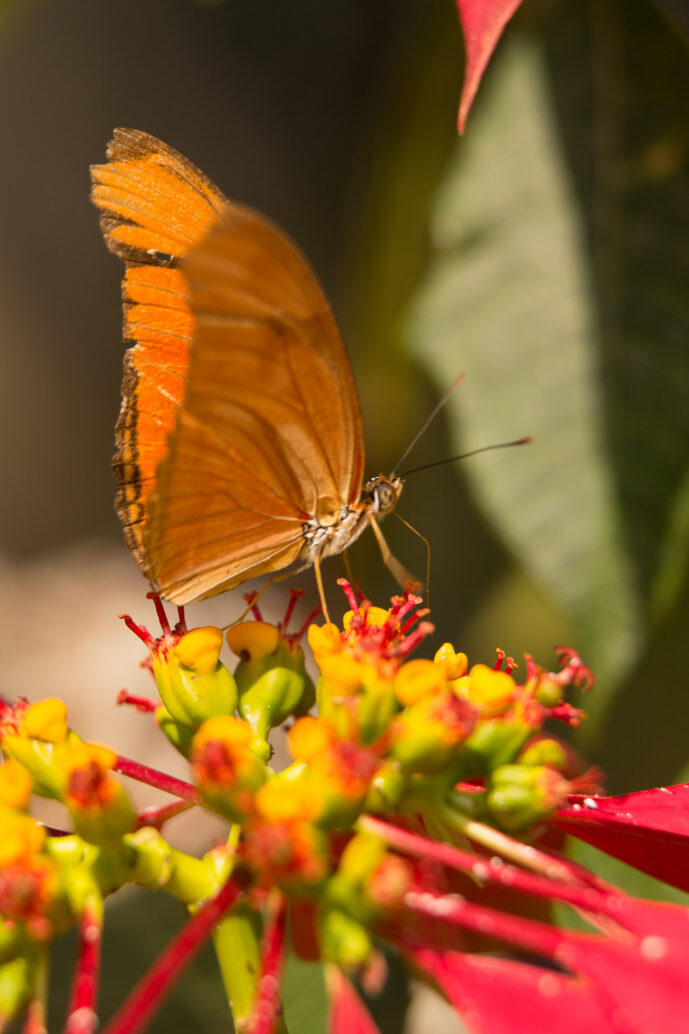
The Julia butterfly (*Dryas iulia*) is a striking member of the brush-footed butterfly family, instantly recognizable by its vibrant, flame-orange wings that are unusually long and narrow. This sleek, aerodynamic "longwing" shape allows it to be an exceptionally fast and agile flier, darting through the tropical landscapes of the Americas with impressive speed. While its brilliant coloration serves as a bold warning to predators of its unpalatability, the Julia is most famous for a bizarre and fascinating behavior known as lachryphagy; it is frequently observed delicately landing on the heads of basking turtles or caimans to drink their mineral-rich tears. Combining radiant beauty with such a unique method of nutrient collection, this butterfly is a captivating example of nature’s ingenuity.
Faits amusants
Julia butterflies exhibit a bizarre behavior called lachryphagy, where they land on the eyes of turtles and caimans to drink their tears for essential sodium and minerals. This species is remarkably long-lived, often surviving for several months because they can digest pollen to obtain life-extending amino acids, a rare trait among butterflies. They are exceptionally fast and agile flyers, capable of outmaneuvering predators while displaying a vibrant, shimmering orange blur in flight. Furthermore, these butterflies are chemically protected; as caterpillars, they consume passionflower vines to sequester toxins that make them unpalatable and dangerous to birds.
Habitats et répartition
This species is native to a broad geographical range that extends from southern Brazil through Central America and the Caribbean, reaching its northernmost permanent populations in southern Texas and Florida. While it thrives in these tropical and subtropical regions, individual strays are occasionally recorded further north in the United States during the warmer summer months. Within its range, it inhabits diverse environments including tropical rainforests, forest edges, open woodlands, and coastal scrub. It is also frequently found in human-altered landscapes such as suburban gardens and parks, especially where passion vines—its primary host plant—are present. These butterflies favor sunny, humid locations and are often seen near water sources or damp soil, where they congregate to drink and absorb essential minerals.
Comportements & Reproduction
These active insects are known for their rapid, erratic flight and a peculiar behavior called "lachryphagy," where they drink the tears of reptiles like caimans and turtles to obtain essential salts. While primarily solitary, they often gather in groups at mud-puddling sites to extract minerals from the damp earth. Males are highly territorial and spend much of the day patrolling sunlit clearings and forest edges, aggressively defending their space from rivals while searching for receptive females. During mating, the male transfers a nutrient-dense spermatophore to the female, which serves as both a sperm packet and a vital "nuptial gift" to boost her reproductive success. Females are highly selective when egg-laying, specifically targeting the tender new growth of passion vines (*Passiflora*) to ensure their larvae have immediate access to high-quality food. This species is capable of producing multiple generations per year, with a life cycle that progresses rapidly from egg to adult in favorable tropical conditions.
Alimentation
The Julia butterfly maintains a diet that transitions from specialist foliage consumption during its larval stage to a more varied nutritional intake as an adult. As caterpillars, they feed predominantly on the leaves of passion vines in the genus Passiflora, while the adult butterflies primarily seek out nectar from flowers such as Lantana and Shepherd's Needle. Beyond nectar, these butterflies exhibit remarkable feeding behaviors to acquire essential minerals; they are well-known for drinking the tears of caimans and turtles, a practice known as lachryphagy that provides them with necessary sodium and moisture. Furthermore, they are often seen "puddling" on damp ground or visiting bird droppings and decaying organic matter to supplement their diet with amino acids and salts required for successful mating and egg production.
Couleurs
The Julia butterfly is characterized by its long, narrow wings of a brilliant, solid orange or deep reddish-orange, edged with thin black margins and minimal dark markings. While the upperside is vibrantly colored, the underside displays a dull, mottled brown pattern that mimics a dead leaf for effective camouflage. This distinct contrast allows the butterfly to remain conspicuous in flight but nearly invisible to predators when resting with its wings closed.