Limpkin
Aramus guarauna
Quick Facts
- Scientific Name: Aramus guarauna
- Spanish Name: Carrao
- Family: Aramidae
- Known Nicknames: Crying bird, Courlan, Carau
- Average Length: 64–73 cm / 25–29 in
- Average Weight: 900–1,300 g / 2.0–2.9 lb
- Wingspan: 101–107 cm / 40–42 in
- Key Feature: Long, slightly decurved bill with a specialized lateral twist at the tip for extracting snails
- Primary Diet: Molluscivore (primarily Apple Snails)
- Range: Southeastern United States (Florida), Caribbean, Central America, and South America to northern Argentina
- Habitat: Freshwater marshes, wooded swamps, and margins of rivers and lakes
- Social Structure: Solitary or in pairs
- Nesting/Breeding: Shallow platforms of reeds and sticks in marshes or low trees/bushes near water
- Statut de conservation : Préoccupation mineure (LC)
- Population Trend: Increasing
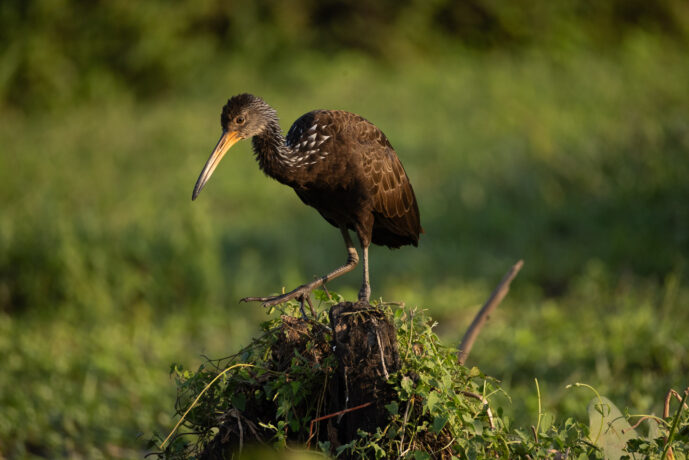
The Limpkin (*Aramus guarauna*) is a singular wading bird that stands as the sole living member of its taxonomic family, occupying a unique evolutionary space between cranes and rails. Draped in rich, chocolate-brown plumage heavily streaked with white teardrops, this medium-sized bird is most easily identified by its long, slightly decurved bill, which is perfectly specialized for extracting its primary prey—apple snails—from their coiled shells. Native to the wetlands of the Americas, the Limpkin is perhaps most famous for its haunting, piercing wail that echoes through marshes at night, a sound so distinctive it is often used as a cinematic sound effect for jungle atmospheres. While its name is derived from its peculiar, jerky "limping" gait, its specialized diet and eerie vocalizations make it an indispensable and charismatic icon of freshwater ecosystems.
Faits amusants
Limpkins are the only living members of their taxonomic family and are famous for a piercing, banshee-like wail that is frequently used as a stock sound effect in films to represent "haunted" tropical jungles. Their specialized bills are uniquely adapted for a diet consisting almost exclusively of apple snails; the tip of the beak curves slightly to the right and features a small gap, allowing it to function like a pair of tweezers to extract the snail without breaking the shell. Even their name is a nod to their quirky behavior, as they possess a distinctive, jerky gait that makes them appear as if they are walking with a perpetual limp.
Habitats et répartition
This species primarily inhabits freshwater wetlands, including wooded swamps, marshes, and the margins of slow-moving rivers and lakes. It is critically tied to environments that support its primary prey, the apple snail, often favoring shallow waters with emergent vegetation. While it thrives in open marshy areas, it also utilizes dense thickets and mangroves for nesting and shelter. The geographical range extends from the southeastern United States, particularly Florida, through the Caribbean and Central America into South America. In South America, it is widely distributed east of the Andes, reaching as far south as central Argentina. Recently, its range has been expanding further north into the coastal plains of the United States, likely in response to the proliferation of invasive snail populations.
Comportements & Reproduction
Limpkins are primarily solitary or found in small family groups, known for their haunting, wailing vocalizations used to defend territories and communicate. They are highly specialized hunters, using their slightly curved bills to extract apple snails from their shells. During the breeding season, these birds typically form monogamous pairs. Courtship is distinct; the male often performs courtship feeding, where he presents a de-shelled snail to the female to establish and reinforce a pair bond. Nesting occurs in various locations, ranging from floating vegetation to high in trees, depending on the environment. Both parents participate in building the shallow, cup-shaped nest and share the duties of incubating the three to eight eggs. The chicks are precocial, capable of leaving the nest shortly after hatching, yet they remain dependent on their parents for several weeks. A unique aspect of their reproductive strategy is the extended parental care period, where adults teach the young the specialized technique of extracting snails, a skill essential for their survival.
Alimentation
The Limpkin is a highly specialized predator whose diet consists almost exclusively of large freshwater apple snails of the genus Pomacea. While it may occasionally supplement its intake with mussels, crustaceans, insects, or small vertebrates like frogs, its survival is intricately linked to the presence of these specific gastropods. To facilitate this niche diet, the Limpkin possesses a uniquely adapted bill that is slightly decurved and features a distinct gap behind the tip, acting like a pair of surgical tweezers to extract the snail's body from its shell without shattering it. Interestingly, the bill often has a slight twist to the right at the tip, which perfectly fits the asymmetrical opening of the apple snail's shell, allowing the bird to deftly sever the columellar muscle and pull out the meat in one piece. This specialized feeding behavior often results in conspicuous piles of empty, undamaged shells left behind in shallow waters, serving as a telltale sign of the bird's presence in its wetland habitat.
Couleurs
The Limpkin features chocolate-brown plumage heavily adorned with white streaks and spots across its head, neck, and wing coverts. It possesses a long, yellowish bill with a dark tip, dark gray legs, and reddish-brown eyes. This speckled patterning provides excellent camouflage, allowing the bird to blend into the dappled light and shadows of its marshy wetland habitats.