Lineated Woodpecker
Dryocopus lineatus
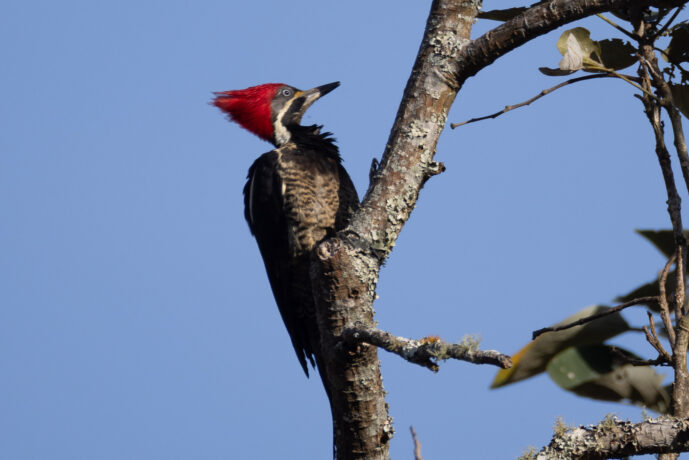
Quick Facts
- Scientific Name: Dryocopus lineatus
- Spanish Name: Carpintero lineado
- Family: Picidae
- Known Nicknames: Carpintero lineado, Black-bodied Woodpecker
- Average Length: 30–36 cm / 12–14 in
- Average Weight: 186–228 g / 6.5–8.0 oz
- Wingspan: 45–55 cm / 18–22 in
- Key Feature: Prominent red crest and distinct white facial stripe extending down the neck
- Primary Diet: Insectivore (primarily ants and beetle larvae)
- Range: Southern Mexico through Central America to Northern Argentina
- Habitat: Tropical lowland forests, forest edges, and mangroves
- Social Structure: Solitary or in pairs
- Nesting/Breeding: Excavated tree cavities in dead wood
- Statut de conservation : Préoccupation mineure (LC)
- Population Trend: Stable
The Lineated Woodpecker (*Dryocopus lineatus*) is a striking, large-bodied forest dweller found throughout the Neotropics, easily recognized by its bold black plumage and brilliant, flaming red crest. Often compared to the Pileated Woodpecker, this species is distinguished by the prominent white lines that streak across its face and converge into a sharp "V" on its back. While both sexes sport the iconic crimson crown, males are identified by an additional red malar stripe near the jaw. Equipped with a powerful, chisel-like beak and a specialized barbed tongue, this bird is a master of excavation, creating deep cavities in decaying wood to hunt for wood-boring insects. Beyond its visual flair, the Lineated Woodpecker is known for its resonant, rhythmic drumming and its piercing, laugh-like calls, making it a charismatic and vital architect of the tropical canopy.
Faits amusants
These birds are famous for their signature "double-tap" drumming, a rapid two-beat rhythm that sounds like a distinct heartbeat echoing through the forest. To survive their high-impact lifestyle, they possess a specialized shock-absorbing skull and a long, barbed tongue coated in sticky saliva for fishing larvae out of deep crevices. Acting as accidental ecosystem engineers, they excavate massive, rectangular cavities that provide essential housing for other forest creatures once abandoned. Unlike many solitary woodpeckers, Lineated Woodpeckers are surprisingly social, often maintaining monogamous pair bonds year-round and communicating through loud, rhythmic "laughing" calls.
Habitats et répartition
This species occupies an extensive geographical range that stretches from northern Mexico through Central America and deep into South America, reaching as far south as northern Argentina, Paraguay, and southern Brazil. It is widely distributed across the Neotropics, occurring in nearly every country within this span, including the Amazon Basin and coastal regions. It inhabits a diverse array of environments, primarily favoring humid lowland forests, deciduous woodlands, and forest edges. While it is often found in primary tropical forests, it is remarkably adaptable and frequently occupies semi-open areas, mangroves, and degraded habitats such as clearings with scattered large trees or secondary growth. It generally prefers elevations from sea level up to approximately 1,500 meters, though it can occasionally be found in higher montane forests.
Comportements & Reproduction
These birds typically live in monogamous pairs or small family groups, maintaining a diurnal lifestyle focused on foraging and territorial defense. They utilize powerful, rhythmic drumming and loud, resonant calls to communicate and establish boundaries within their habitat. Highly territorial, they will vigorously defend their chosen nesting and feeding sites from rivals through vocal displays and physical posturing. Reproduction involves a shared effort where both partners excavate a deep nesting cavity in a dead tree or palm, usually at a significant height. The female typically lays two to three eggs, and both parents participate in incubation, with the male specifically taking responsibility for the nest during the night. After hatching, the pair cooperatively feeds the young via regurgitation, continuing to protect and guide them until they reach independence.
Alimentation
The Lineated Woodpecker primarily subsists on a diet dominated by wood-boring insects, with a particular preference for beetle larvae, ants, and termites extracted from decaying timber. To reach its prey, this bird utilizes its powerful, chisel-like bill to excavate deep cavities into dead or dying trees, often leaving behind large, characteristic rectangular holes that serve as a testament to its foraging activity. An interesting aspect of its feeding biology is the use of an exceptionally long, barbed, and sticky tongue that can extend far beyond the tip of its bill to snare insects hiding deep within narrow crevices. While largely insectivorous, the species is opportunistic and frequently supplements its nutritional intake with various fruits, berries, and seeds, showcasing a dietary flexibility that helps it thrive across diverse neotropical habitats.
Couleurs
The Lineated Woodpecker features a brilliant red crest and black upperparts, highlighted by a sharp white line running from the bill down the neck to the shoulder. Its pale underparts are marked with dense black horizontal barring that mimics the shadows of tree bark for camouflage. Males are distinguished by a red malar stripe, while both sexes display stark white wing linings visible during flight.