Magnificient Frigatebird
Fregata magnificens
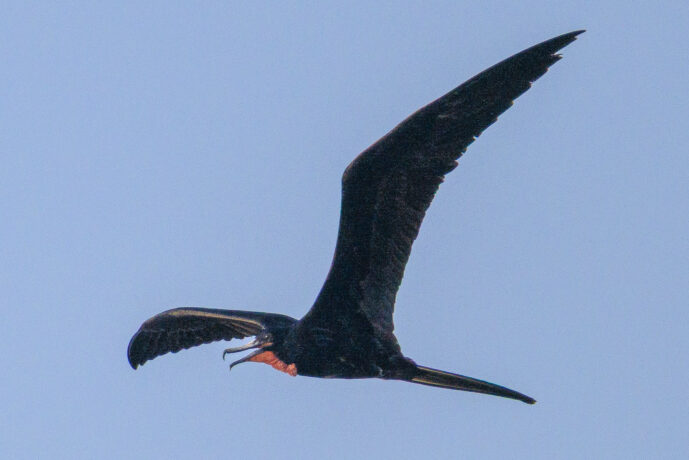
Quick Facts
- Scientific Name: Fregata magnificens
- Spanish Name: Fragata magnífica
- Family: Fregatidae
- Known Nicknames: Man-o'-war bird, Hurricane bird, Pirate bird
- Average Length: 89–114 cm / 35–45 in
- Average Weight: 1.1–1.6 kg / 2.4–3.5 lb
- Wingspan: 217–244 cm / 85–96 in
- Key Feature: Large, inflatable scarlet red gular sac (males) and deeply forked tail
- Primary Diet: Carnivore (Piscivore/Kleptoparasite)
- Range: Tropical and subtropical Atlantic and Pacific coasts of the Americas, including the Caribbean and Galápagos Islands
- Habitat: Coastal waters, mangroves, and offshore oceanic islands
- Social Structure: Highly Social (Colonial)
- Nesting/Breeding: Low trees, shrubs, or mangroves on coastal islands
- Statut de conservation : Préoccupation mineure (LC)
- Population Trend: Stable
The Magnificent Frigatebird (*Fregata magnificens*) is a striking seabird often referred to as the "pirate of the sky" due to its notorious habit of harassing other birds to steal their catch in mid-air. Boasting the largest wing-to-body-weight ratio of any bird, this master of the thermals features long, pointed wings and a deeply forked tail that allow it to soar effortlessly for weeks at a time without ever touching the ground or water. While both sexes possess iridescent black plumage, the male is most famous for his vibrant, scarlet gular sac, which he inflates like a giant, leathery balloon to attract mates during the breeding season. Remarkably, despite being a marine species, the Magnificent Frigatebird lacks waterproof feathers and cannot swim; instead, it relies on its incredible aerial agility and hooked beak to snatch prey from the ocean surface with surgical precision.
Faits amusants
Known as the "man-o'-war bird," this master of aerial piracy frequently harasses other seabirds until they regurgitate their catch, which the frigatebird snatches mid-air before it hits the waves. Despite spending months at sea, they lack waterproof plumage and cannot land on water, forcing them to stay aloft for weeks at a time and even sleep while soaring by shutting down one hemisphere of their brain. During courtship, males inflate a vibrant scarlet throat pouch into a massive, heart-shaped balloon that can take up to 20 minutes to fully expand. They also boast the largest wingspan-to-body-weight ratio of any bird, allowing them to glide effortlessly on thermal updrafts with minimal flapping.
Habitats et répartition
This species is primarily found in the tropical and subtropical waters of the Americas. Its range extends along the Atlantic coast from Florida and the Caribbean islands southward to southern Brazil, and along the Pacific coast from Baja California down to northern Peru, including the Galápagos Islands. While largely restricted to these regions, individuals are known to wander as far north as the northern United States and southern Canada during post-breeding dispersal. These birds inhabit coastal marine environments, frequently soaring over open oceans, lagoons, and coral reefs. Because their plumage is not waterproof, they avoid landing on the water and instead nest in mangroves, low trees, or scrubby vegetation on remote oceanic islands and along secluded coastlines. They prefer areas with steady trade winds that assist their constant flight and provide easy access to the surface-dwelling fish and squid upon which they prey.
Comportements & Reproduction
These highly social birds nest in dense colonies, typically situated in mangroves or low-lying coastal vegetation. They are famous for their kleptoparasitic tendencies, aggressively pursuing other seabirds to steal their prey in mid-air. Because their plumage lacks waterproofing, they are masters of aerial maneuvers, spending vast amounts of time soaring on thermal currents without ever landing on the ocean surface. Reproduction is defined by a spectacular courtship ritual where males congregate in groups and inflate their enormous, bright red gular sacs to attract females flying overhead. They accompany this visual display with wing-shaking and rhythmic drumming sounds. Once paired, the couple produces a single egg, but the species is notable for its unusually long period of parental investment. While both parents participate initially, the male typically abandons the nest after a few months, leaving the female to care for the slow-growing fledgling for nearly a year. This intensive commitment means females usually only breed every two years.
Alimentation
The Magnificent Frigatebird primarily consumes a diet of fish, particularly flying fish, along with squid, jellyfish, and crustaceans found near the ocean's surface. Because their feathers lack waterproof oils, these birds cannot dive or swim; instead, they skillfully snatch prey from the air or the water's surface while in flight. A particularly fascinating aspect of their feeding behavior is kleptoparasitism, where they relentlessly harass other seabirds, such as boobies and gulls, until the victims regurgitate their caught meals, which the frigatebird then catches mid-air. Additionally, they are known to follow fishing vessels to scavenge discarded offal, showcasing a highly opportunistic and versatile approach to nutrition that allows them to survive long periods over the open sea.
Couleurs
Adult males are entirely black with a glossy green or purple iridescent sheen on their backs and a signature inflatable, bright red gular sac used for courtship. Females are primarily black but feature a prominent white chest and belly, while juveniles possess distinctive white heads and underparts. Their dark dorsal coloration provides countershading against the ocean surface when viewed from above, though they lack complex camouflage patterns.