Narrow Stingless Bee
Tetragonisca angustula
Quick Facts
- Scientific Name: Tetragonisca angustula
- Spanish Name: Angelita
- Family: Apidae
- Known Nicknames: Jataí, Angelita, Mariola, Virginitas, Jati
- Average Length: 4–5 mm / 0.16–0.20 in
- Average Weight: 2–3 mg / 0.00007–0.0001 oz
- Wingspan: 7–9 mm / 0.28–0.35 in
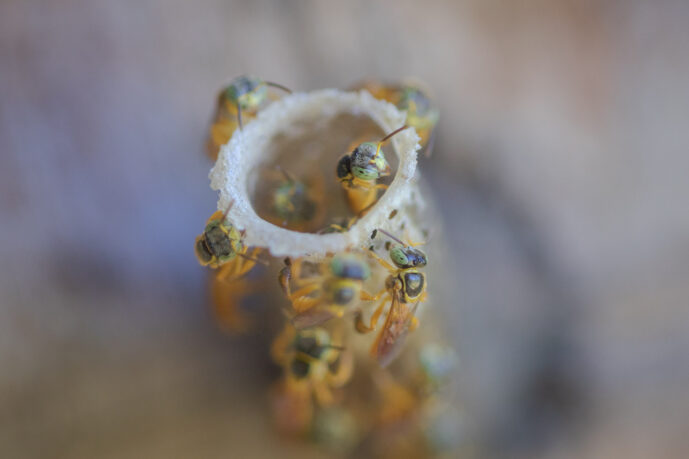
- Key Feature: Slender golden-yellow body and a long, characteristic wax entrance tube to the nest
- Primary Diet: Nectar and Pollen (Palynivore/Nectarivore)
- Range: Central and South America (Southern Mexico to Northern Argentina)
- Habitat: Tropical and Subtropical Forests, Urban Gardens, and Secondary Forests
- Social Structure: Eusocial (Highly Social colonies with a single queen)
- Nesting/Breeding: Cavities such as tree hollows, wall crevices, or abandoned nests
- Conservation Status: Not Evaluated (NE)
- Population Trend: Stable
The Narrow Stingless Bee (*Tetragonisca angustula*), affectionately known as the Jataí bee, is a small but remarkably resilient pollinator native to the Neotropics, ranging from Mexico to Argentina. Measuring only about 4 to 5 millimeters in length, this bee is easily identified by its slender, golden-amber abdomen, contrasting dark thorax, and long, delicate legs. While it lacks a functional stinger, it is far from defenseless; the colony employs "soldier" bees to guard their distinctive, tube-shaped wax entrance and will aggressively bite or entangle intruders in sticky resin if provoked. Highly adaptable and prized for its clear, citrusy medicinal honey, the Jataí is a master architect that builds intricate brood combs, making it one of the most beloved and ecologically vital stingless bee species in both rural forests and urban gardens.
Faits amusants
These bees are famous for their elaborate wax entrance tubes, which they seal every night with a perforated lace-like curtain to deter predators. Unlike most species, they deploy a specialized "hovering guard" force that stays suspended in mid-air to monitor the colony’s perimeter. When threatened, these tiny defenders engage in a "suicide bite" by clamping onto the antennae or wings of intruders and refusing to let go, effectively grounding the enemy at the cost of their own lives. They are also remarkable housekeepers that use a mix of wax and resin to mummify any large pests that breach the hive, permanently entombing them to prevent decay from contaminating the nest.
Habitats et répartition
This species is widely distributed across the Neotropical region, ranging from southern Mexico through Central America and extending deep into South America, including Brazil, Paraguay, and northern Argentina. It is one of the most common and widespread stingless bees in these regions due to its remarkable adaptability to various climates and altitudes.
It thrives in a diverse array of environments, from dense primary rainforests and semi-arid savannas to heavily urbanized areas. These bees are opportunistic cavity nesters, frequently establishing colonies in hollow tree trunks, abandoned animal burrows, or rock crevices. In cities, they are well-known for nesting within man-made structures such as wall cavities, electrical boxes, and drainage pipes, making them highly resilient to human-altered landscapes.
Comportements & Reproduction
These bees exhibit a highly organized eusocial structure within perennial colonies, led by a single physogastric queen and supported by thousands of female workers. They are characterized by their docile temperament and unique nest architecture, which includes a distinctive wax entrance tube guarded by specialized soldier bees. Within the hive, workers manage the colony through an age-based division of labor, constructing horizontal brood combs and storing honey and pollen in specialized oval wax pots. Communication and defense are central to their behavior, with soldiers constantly monitoring the nest perimeter to intercept potential intruders.
Reproduction involves a gradual swarming process where a new colony is established in a nearby cavity while remaining connected to the mother nest for resource transfer until it becomes self-sufficient. Mating occurs during a single nuptial flight, where a virgin queen typically mates with only one drone from a large male aggregation that forms near the nest site. A unique reproductive strategy of this species is mass provisioning; workers fill brood cells with all the necessary larval food before the queen lays an egg, after which the cell is immediately sealed. This ensures the larvae develop independently without further contact from the adult bees until they emerge as adults.
Alimentation
The Narrow Stingless Bee, commonly known as the Jataí, maintains a generalist diet primarily consisting of nectar and pollen gathered from a vast range of botanical families. These bees are highly adaptable foragers, often visiting both native forest trees and common urban garden flowers to secure the carbohydrates and proteins necessary for the colony's survival. An intriguing aspect of their dietary behavior is their consumption of extrafloral nectar and their occasional collection of honeydew—a sugary substance excreted by aphids and other hemipterans—which serves as a vital alternative energy source. Once back at the nest, the bees store their floral resources in distinctive egg-shaped cerumen pots, where the pollen undergoes a specialized fermentation process that increases its protein bioavailability for developing larvae. Furthermore, they are known to be opportunistic, sometimes gathering juices from overripe fruits, demonstrating a versatile foraging strategy that allows them to thrive in diverse ecosystems.
Couleurs
*Tetragonisca angustula* exhibits a slender, elongated body characterized by a vibrant golden-yellow to amber abdomen, sometimes accented with subtle dark bands. Its thorax is typically a contrasting dark brown or black, while the head features prominent yellow markings near the face and antennae. The legs are generally amber-colored and the wings are transparent, creating a bright, distinctive appearance that lacks specialized camouflage.