Orange-winged Amazon Parrot
Amazona amazonica
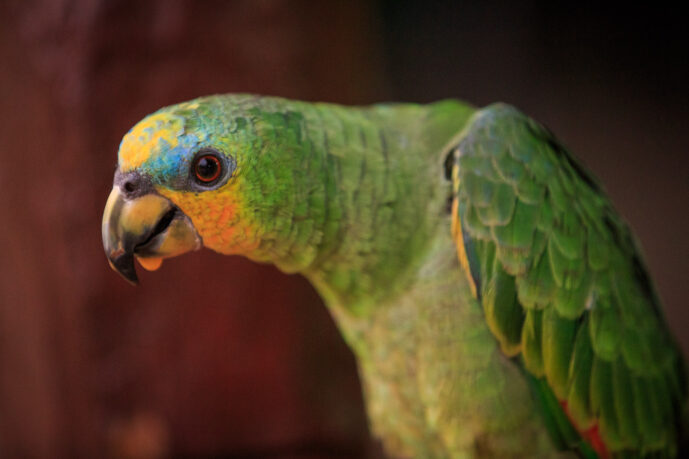
Quick Facts
- Scientific Name: Amazona amazonica
- Spanish Name: Loro guaro
- Family: Psittacidae
- Known Nicknames: Orange-winged Amazon, Orange-winged Parrot, Loro Guaro
- Average Length: 31–33 cm / 12–13 in
- Average Weight: 340–470 g / 12–16.6 oz
- Wingspan: 60–70 cm / 24–28 in
- Key Feature: Orange speculum feathers on the wings and blue-and-yellow facial markings
- Primary Diet: Herbivore (Primarily Frugivore and Granivore)
- Range: Tropical South America, including Colombia, Venezuela, the Guianas, Trinidad and Tobago, Peru, Bolivia, and Brazil
- Habitat: Lowland tropical forests, mangroves, swampy woodlands, and savannas
- Social Structure: Highly Social; travels in pairs or large communal flocks
- Nesting/Breeding: Tree hollows and cavities
- Statut de conservation : Préoccupation mineure (LC)
- Population Trend: Decreasing
The Orange-winged Amazon Parrot (*Amazona amazonica*) is a vibrant, medium-sized bird native to the lush tropical regions of South America, easily recognized by its predominantly lime-green plumage. What truly sets this species apart are the vivid splashes of yellow and turquoise-blue across its crown and cheeks, paired with its namesake feature: brilliant orange feathers hidden within the speculum of its wings, which create a striking flash of color during flight. Beyond their colorful appearance, these parrots are celebrated for their highly social and boisterous nature, often traveling in large, noisy flocks and possessing a remarkable ability to mimic human speech and environmental sounds. While frequently confused with the Blue-fronted Amazon, the Orange-winged variant is distinguished by its unique orange wing patches and a playful, inquisitive personality that makes it a standout member of the *Amazona* genus.
Faits amusants
These social birds are famous for their "hand-like" dexterity, using zygodactyl feet to hold and manipulate food with surgical precision. While their namesake orange wing patches are often hidden while perched, they flash brilliantly during flight as a visual signal to the flock. Unique among many parrots, they are known to engage in geophagy, intentionally consuming clay from riverbanks to neutralize toxins found in the wild seeds and fruits they eat. Additionally, they are incredibly vocal "socialites," often gathering in massive communal roosts of several thousand individuals to exchange information about foraging locations through a complex series of high-pitched shrieks and whistles.
Habitats et répartition
The geographical range of this species extends across much of tropical South America, including Colombia, Venezuela, the Guianas, and Trinidad and Tobago, stretching south through the Amazon basin into eastern Peru, northern Bolivia, and central Brazil. It is predominantly found in lowland regions, maintaining a widespread presence throughout these diverse continental territories. In terms of habitat, it favors humid lowland forests, mangroves, and swampy woodlands, often staying in close proximity to water. However, it is a versatile bird that also occupies semi-open country, savannas with scattered trees, and even agricultural plantations or suburban areas. It generally avoids mountainous terrain, preferring elevations below 800 meters.
Comportements & Reproduction
These highly gregarious birds typically congregate in large, noisy flocks that can number in the hundreds or even thousands at communal roosting sites. Despite these massive gatherings, the fundamental social unit is the monogamous pair, with mates remaining close to one another even while flying within the larger group. They reinforce their social bonds through mutual preening and ritualized displays, which are vital for maintaining stability and hierarchy. During the day, they are active foragers, using a variety of loud shrieks and whistles to communicate with flock members while searching for seasonal fruits and seeds. Breeding typically coincides with the dry season, during which monogamous pairs seek out hollows in tall trees or dead palms to serve as nests. Courtship involves the male regurgitating food for the female, a behavior that strengthens their long-term bond before she lays a clutch of two to four eggs. While the female handles the majority of the incubation, the male remains nearby to provide her with constant nourishment. A notable reproductive strategy is their high degree of site fidelity, as pairs often return to the same nesting locations year after year, fiercely defending the immediate cavity from potential competitors.
Alimentation
The Orange-winged Amazon Parrot is primarily a granivore and frugivore, subsisting on a diverse menu of seeds, nuts, berries, and fruits found within the forest canopy. In their native habitats across South America, they show a particular fondness for palm fruits, such as those from the moriche palm, and will also consume blossoms and leaf buds for additional nutrients. An interesting aspect of their feeding behavior is their adaptability; they are known to visit agricultural plantations to forage on cultivated crops like cocoa, mangoes, and citrus fruits, which sometimes leads to them being viewed as pests by local farmers. Furthermore, like many parrots, they exhibit high dexterity by using their zygodactyl feet to grasp and manipulate food items while using their powerful, hooked beaks to crack open tough shells or extract seeds. Their foraging habits play a crucial role in their ecosystem as they act as significant seed dispersers, helping to maintain the biodiversity of the tropical rainforests they inhabit.
Couleurs
The Orange-winged Amazon features primarily green plumage that serves as effective forest canopy camouflage, accented by a yellow forehead and crown with violet-blue patches around the eyes. Its namesake characteristic is the vibrant orange speculum on the wing feathers, visible mainly in flight, complemented by orange-red bases on the outer tail feathers.