Pied Water Tyrant
Fluvicola pica
Quick Facts
- Scientific Name: Fluvicola pica
- Spanish Name: Viudita pía
- Family: Tyrannidae
- Known Nicknames: Black-and-white Water Tyrant, Pied Water-tyrant
- Average Length: 12.5–14 cm / 4.9–5.5 in
- Average Weight: 11–14 g / 0.39–0.49 oz
- Wingspan: 18–22 cm / 7.1–8.7 in
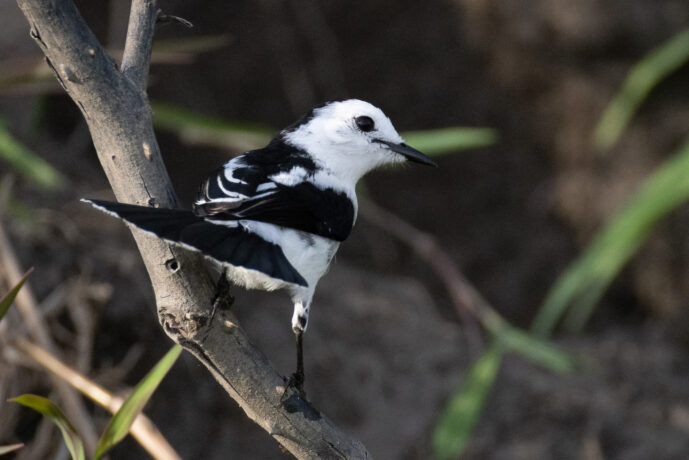
- Key Feature: Contrasting black and white plumage with a white crown, face, and underparts against black wings and tail
- Primary Diet: Insectivore
- Range: Panama and Trinidad south to northern Brazil, Colombia, and Venezuela
- Habitat: Freshwater marshes, lake edges, swamps, and flooded grasslands
- Social Structure: Solitary or in pairs
- Nesting/Breeding: Oval ball-shaped nest with a side entrance, usually built on a branch overhanging water
- Statut de conservation : Préoccupation mineure (LC)
- Population Trend: Stable
The Pied Water Tyrant (*Fluvicola pica*) is a striking small flycatcher that brings a touch of monochrome elegance to the freshwater marshes and mangrove edges of South America and the Caribbean. Immediately recognizable by its crisp, high-contrast plumage, this bird features a snowy white body offset by jet-black wings, a black tail, and a distinctive dark stripe running from the nape through the eye. A true specialist of the water’s edge, it is frequently seen perched on low reeds or floating vegetation, where it performs a signature rhythmic tail-pumping motion while scanning for prey. This agile hunter utilizes a "hover-gleaning" technique to snatch insects directly from the air or the water's surface with remarkable precision. Beyond its bold appearance, the Pied Water Tyrant is a clever architect, constructing intricate, oval-shaped nests of grass and feathers that often dangle over the water to protect its offspring from terrestrial predators.
Faits amusants
This energetic flycatcher is famous for its rhythmic "tail-pumping" habit, constantly wagging its tail up and down while scouting for prey from low perches. To protect its offspring from climbing predators like snakes, it constructs a bulky, oval-shaped nest that dangles precariously from branches directly overhanging the water. Despite being a member of the tyrant flycatcher family, it has uniquely adapted to a semi-aquatic lifestyle, often using floating lily pads as hunting platforms to snatch insects off the water's surface. Its bold personality and striking tuxedo-like plumage make it stand out, as it frequently ignores human presence while performing impressive mid-air somersaults to catch flying insects.
Habitats et répartition
This species is primarily distributed across northern South America and southern Central America. Its range encompasses Panama, Colombia, Venezuela, Trinidad and Tobago, and the Guianas, extending southward into the Amazon basin of northern Brazil. It is largely a sedentary resident throughout these regions, maintaining a consistent presence where suitable water sources are available. Its preferred habitats are strictly tied to aquatic environments, including freshwater marshes, swamps, and the vegetated banks of slow-moving rivers and ponds. It is commonly found in open or semi-open areas like flooded pastures, mangroves, and irrigation canals. The bird specifically seeks out low-lying vegetation, reeds, or shrubs near the water's surface, avoiding deep forest interiors in favor of exposed, sunlit wetlands.
Comportements & Reproduction
These birds are typically observed alone or in pairs, maintaining a monogamous bond throughout the breeding season. They are highly territorial and active hunters, frequently seen darting from low perches over water to capture insects. Their social structure is centered on the breeding pair, which works together to defend their foraging territory and nesting site from intruders. For reproduction, the pair constructs a distinctive, globular nest with a side entrance, often suspended from a branch overhanging water to deter terrestrial predators. This structure is woven from grasses and plant fibers and lined with soft feathers. The female typically lays two to three creamy-white eggs with reddish-brown spots, and both parents share the responsibilities of incubating the eggs and feeding the chicks, ensuring a cooperative approach to raising their brood.
Alimentation
The Pied Water Tyrant is a dedicated insectivore that primarily feeds on a variety of small invertebrates, including flies, beetles, dragonflies, and spiders. It typically hunts from low-lying perches such as reeds, mangroves, or floating vegetation, where it employs a strategy known as sallying to snatch prey from the air or directly off the water's surface. An intriguing aspect of its dietary habits is its opportunistic nature; it is often observed following larger animals or even humans through marshy areas to capture insects that are flushed out by their movement. Additionally, this bird is known to hover briefly over the water to pick up aquatic larvae, demonstrating a high level of agility and precision tailored to its specialized wetland environment.
Couleurs
The Pied Water Tyrant displays a stark bicolor pattern, featuring a primarily white body, head, and underparts contrasted against jet-black wings and a black tail. A prominent black patch covers the nape and upper back, while its dark bill and eyes stand out against its snowy plumage, providing high-contrast visibility in open wetland environments rather than traditional camouflage.