Red-crested Cardinal
Paroaria coronata
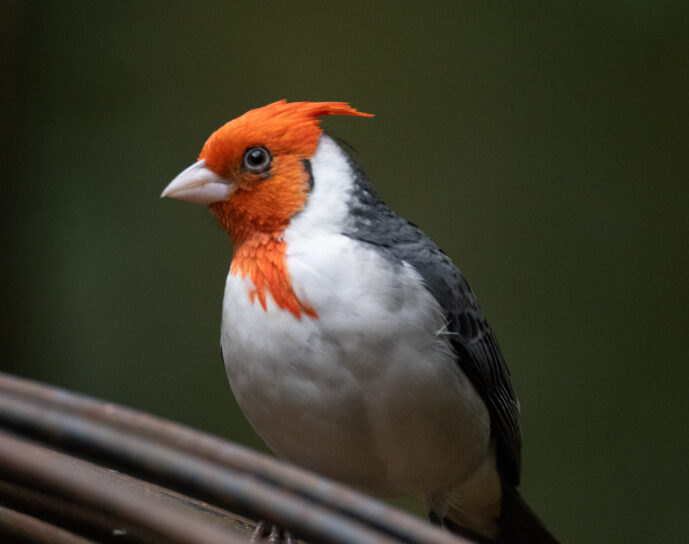
Quick Facts
- Scientific Name: Paroaria coronata
- Spanish Name: Cardenal copete rojo
- Family: Thraupidae
- Known Nicknames: Brazilian Cardinal, Crested Cardinal
- Average Length: 18–20 cm / 7–8 in
- Average Weight: 30–35 g / 1.0–1.2 oz
- Wingspan: 25–28 cm / 10–11 in
- Key Feature: Prominent scarlet-red crest and bib with a white belly and grey back
- Primary Diet: Omnivore (Seeds, insects, and fruits)
- Range: South America (Northern Argentina, Bolivia, Southern Brazil, Paraguay, Uruguay); Introduced to Hawaii
- Habitat: Subtropical or tropical moist shrubland, degraded former forest, and urban parks
- Social Structure: Pairs or small family groups
- Nesting/Breeding: Open cup-shaped nest in trees or shrubs
- Statut de conservation : Préoccupation mineure (LC)
- Population Trend: Stable
The Red-crested Cardinal (*Paroaria coronata*) is a visually stunning songbird easily identified by its vibrant crimson head, throat, and prominent pointed crest, which contrasts sharply against its snowy white underparts and slate-grey wings. Although its name and striking appearance suggest a close relation to North American cardinals, this species is actually a member of the tanager family and is native to central South America, though it has famously thrived in Hawaii since its introduction. These charismatic birds are known for their bold personalities and melodic, whistling songs, often seen foraging on the ground for seeds and insects. A unique feature of the Red-crested Cardinal is its expressive crest, which it can raise or lower to signal its mood, adding a touch of dramatic flair to its already sophisticated and elegant silhouette.
Faits amusants
Despite its name, this bird is actually a member of the tanager family rather than a true cardinal. It uses its iconic crimson crest as a sophisticated communication tool, raising or lowering the feathers to signal aggression or social intent to rivals. In regions where they have been introduced, such as Hawaii, these birds have developed a quirky reputation as bold scavengers, often nicknamed "coffee shop birds" for their habit of landing on outdoor tables to steal crumbs. Furthermore, they are highly territorial and possess a remarkably diverse vocal range, with individual birds often developing their own unique "dialects" of melodic whistles to mark their personal space.
Habitats et répartition
This species is native to central South America, where its range extends across northern Argentina, Bolivia, southern Brazil, Paraguay, and Uruguay. Beyond its indigenous territories, it has been successfully introduced to several other regions, most notably the Hawaiian Islands, where it is now a common sight across all the main islands. Smaller introduced populations also persist in Puerto Rico and various urban areas within the mainland United States. In its natural and introduced ranges, it prefers semi-open subtropical or tropical environments, particularly shrublands, light woodlands, and areas near water sources like rivers and marshes. Highly adaptable to human-altered landscapes, it is frequently found in urban parks, residential gardens, and agricultural edges. It generally avoids dense, unbroken forests, instead favoring edge habitats where low-lying vegetation and thickets provide ample cover and foraging opportunities.
Comportements & Reproduction
These birds are highly social and typically forage in pairs or small family groups, though they become aggressively territorial during the breeding season. Monogamous pairs engage in elaborate courtship displays where the male hops and fans his tail to strengthen the bond. Outside of the breeding period, they may gather in larger communal groups to feed on the ground, but they remain vigilant, often using a distinct call to signal potential threats to their companions. Nesting occurs in dense foliage, where both partners work together to construct a cup-shaped structure from twigs, rootlets, and grasses. The female typically lays a clutch of two to four eggs, which she incubates while the male provides protection and occasionally food. A key reproductive strategy is the intensive biparental care; both parents are deeply involved in feeding and defending the chicks after they hatch. This shared responsibility continues even after the young fledge, ensuring the offspring gain the necessary skills to survive in diverse habitats.
Alimentation
The Red-crested Cardinal is primarily an omnivorous bird with a diet heavily focused on seeds, small fruits, and berries found within its subtropical and tropical habitats. While granivorous by nature, often foraging on the ground for fallen seeds and grains, it also incorporates various insects and small invertebrates into its meals, particularly during the breeding season to provide essential protein for its developing chicks. An interesting aspect of its dietary behavior is its opportunistic tendency to frequent human-modified environments, such as gardens and parks, where it readily consumes birdseed from feeders and even small food scraps. Furthermore, because it consumes a wide variety of whole berries, this species plays a vital role in its ecosystem as a seed disperser, helping to propagate native vegetation across its range.
Couleurs
The Red-crested Cardinal features a vibrant scarlet-red head, crest, and throat that contrast sharply against its snowy white underparts and prominent white collar. Its back, wings, and tail are a uniform slate gray, while the bill is typically a pale horn color. While the bold red head serves as a social signal, the neutral gray and white body provides effective countershading and camouflage within the dappled light of its woodland and shrubland habitats.