Red-crowned Woodpecker
Melanerpes rubricapillus
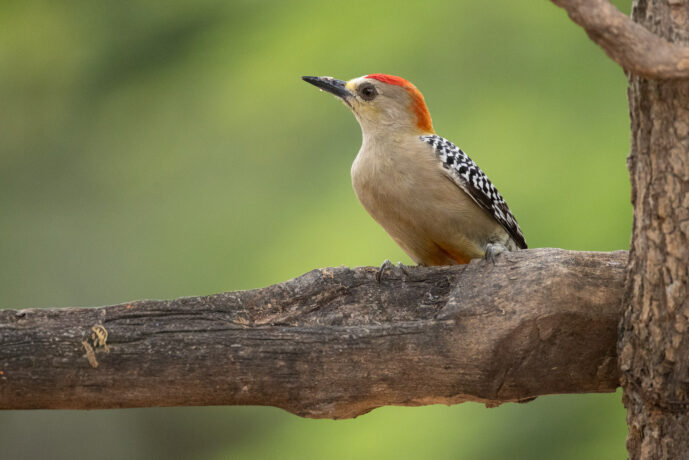
Quick Facts
- Scientific Name: Melanerpes rubricapillus
- Spanish Name: Carpintero habado
- Family: Picidae
- Known Nicknames: Red-crowned Woodpecker, Carpintero Habado
- Average Length: 16–18.5 cm / 6.3–7.3 in
- Average Weight: 40–63 g / 1.4–2.2 oz
- Wingspan: 30–35 cm / 12–14 in
- Key Feature: Red crown and nape in males, zebra-barred black and white upperparts, and a small red patch on the lower belly
- Primary Diet: Omnivore (Insects, fruit, and nectar)
- Range: Southwest Costa Rica to Colombia, Venezuela, Tobago, and the Guianas
- Habitat: Open woodland, scrub, mangroves, and urban gardens
- Social Structure: Solitary or in pairs
- Nesting/Breeding: Excavated cavities in dead trees, palms, or fence posts
- Statut de conservation : Préoccupation mineure (LC)
- Population Trend: Increasing
The Red-crowned Woodpecker (*Melanerpes rubricapillus*) is a spirited and adaptable bird native to the open woodlands and gardens of Central and South America. Easily identified by its striking zebra-like black and white barred back, this medium-sized woodpecker features a pale, buffy-gray breast and a subtle golden-yellow patch on its lower belly. Its most defining characteristic is its namesake crimson crown; while males sport a vibrant red cap extending from the forehead to the nape, females possess red only on the back of the head, leaving the forehead a pale gray. Beyond its rhythmic drumming on dead wood to excavate nesting cavities, this species is notably versatile in its diet, frequently venturing into backyard feeders to supplement its insect-heavy meals with fruit and nectar, making it a charmingly bold presence in its tropical habitat.
Faits amusants
These resourceful birds possess a surprising sweet tooth, frequently visiting hummingbird feeders to lap up nectar with their long, specialized tongues. Beyond their typical diet of insects, they act as miniature gardeners by caching seeds and fruit in tree bark crevices to save for later consumption. They are also known for their bold urban adaptations, often choosing to drum on resonant metal pipes or rooftops rather than wood to maximize the volume of their territorial signals. In a charming display of social coordination, mated pairs frequently engage in synchronized vocal duets to defend their nesting sites from intruders.
Habitats et répartition
This species is distributed across Central and South America, ranging from southwestern Costa Rica and Panama into northern Colombia, Venezuela, and the Guianas. It also occupies several Caribbean islands, including Trinidad, Tobago, and the Netherlands Antilles. Its range is primarily restricted to lowlands and coastal areas, though it can be found in foothills up to approximately 1,600 meters.
It favors open or semi-open landscapes over dense, continuous rainforests. Typical habitats include dry forests, scrubby woodlands, mangroves, and gallery forests. This adaptable bird is also common in human-modified environments such as agricultural fields, coffee plantations, suburban gardens, and urban parks, provided there are enough trees for nesting and foraging.
Comportements & Reproduction
These birds are primarily territorial and are most often observed in monogamous pairs or small family groups. They communicate through persistent drumming and sharp vocalizations to defend their nesting sites and foraging grounds in open woodlands or suburban areas. During the breeding season, both sexes collaborate to excavate a new nesting cavity, typically situated in a dead tree trunk, palm, or utility pole. This shared labor reinforces the pair bond and ensures a secure environment for their offspring.
The female typically lays two to four eggs, which are incubated by both parents; notably, the male usually takes the night shift while the female incubates during the day. Once the chicks hatch, both adults share the responsibility of foraging and feeding them a varied diet of insects and fruit. This biparental care continues until the young fledge, a strategy that enhances survival rates in their diverse tropical and subtropical habitats.
Alimentation
The Red-crowned Woodpecker maintains an omnivorous diet that primarily consists of a diverse range of insects, including ants, termites, and beetle larvae, which it extracts from tree bark through probing and gleaning. Beyond its insectivorous habits, this bird is notably fond of various fruits and berries, such as figs and cactus fruit, often playing a crucial role in seed dispersal within its tropical habitat. Interestingly, it frequently supplements its meals with floral nectar and has been observed visiting hummingbird feeders for sugar water, showcasing a versatile feeding strategy. In addition to these sources, it occasionally preys upon small lizards or the eggs of other birds, demonstrating an opportunistic approach to nutrition that shifts based on seasonal availability.
Couleurs
The Red-crowned Woodpecker features a distinctive black-and-white "zebra" barred pattern on its back and wings, providing disruptive camouflage against tree bark. Males possess a vibrant red crown and nape, while females display red only on the nape, leaving the crown pale. Their underparts are a neutral buff-gray, often marked by a subtle reddish or golden patch on the lower belly.