Russet-throated Puffbird
Hypnelus ruficollis
Quick Facts
- Scientific Name: Hypnelus ruficollis
- Spanish Name: Buco rufu-collarejo
- Family: Bucconidae
- Known Nicknames: Bobo de collar, Juan bobo
- Average Length: 20–22 cm / 8–8.5 in
- Average Weight: 45–55 g / 1.6–1.9 oz
- Wingspan: N/A
- Key Feature: Large head with a heavy, hooked black bill and a distinctive russet or cinnamon-colored throat and upper breast
- Primary Diet: Insectivore (primarily insects and occasionally small vertebrates like lizards)
- Range: Northern South America, specifically northeastern Colombia and northern Venezuela
- Habitat: Arid to semi-arid scrublands, deciduous forests, and mangrove edges
- Social Structure: Solitary or in pairs; known for sitting motionless for long periods on low branches
- Nesting/Breeding: Burrows excavated in earth banks or occasionally in arboreal termite mounds
- Statut de conservation : Préoccupation mineure (LC)
- Population Trend: Stable
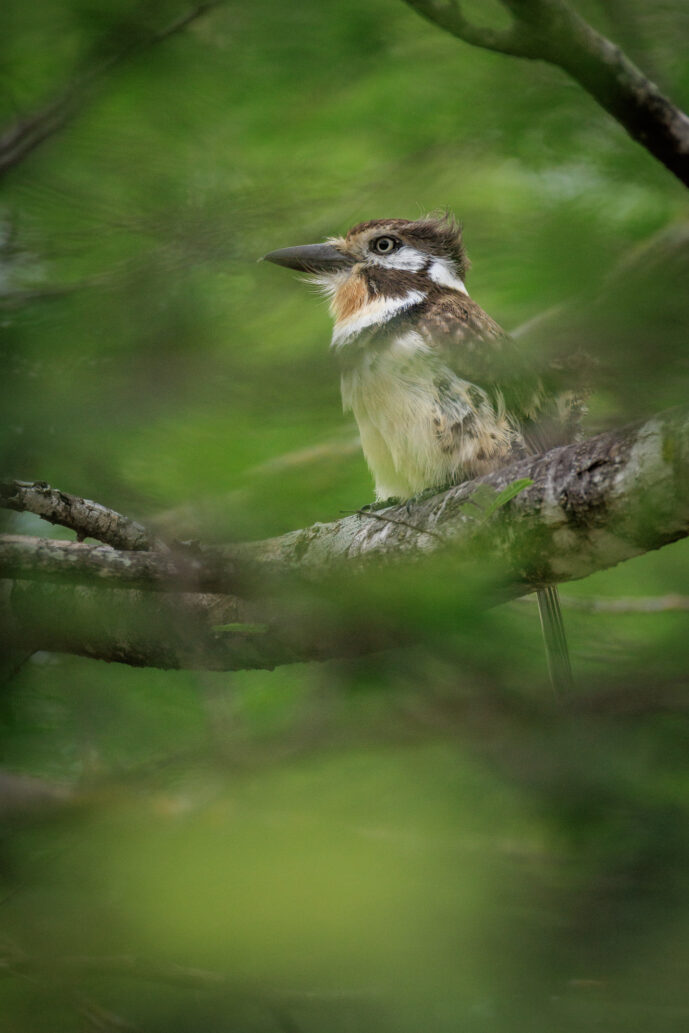
The Russet-throated Puffbird (*Hypnelus ruficollis*) is a captivating, stout-bodied avian native to the arid scrublands and open woodlands of northern South America. Characterized by its disproportionately large head and a heavy, hooked black bill, this species is most easily identified by the rich, cinnamon-colored patch adorning its throat, which contrasts sharply with its white underparts and distinctive dark breast bands. True to its name, it often appears "puffy" due to its dense plumage and its habit of sitting motionlessly for long periods on exposed branches, waiting with stoic patience to ambush insects or small lizards. This "sit-and-wait" predator possesses large, dark eyes for keen hunting and prominent bristles around its beak, adding to its rugged charm. Perhaps most remarkably, these birds often excavate their nests within active arboreal termite mounds, showcasing a unique and hardy adaptation to their environment.
Faits amusants
Known for their remarkably lethargic "sit-and-wait" hunting style, these birds often remain motionless for so long they appear statue-like, earning them a reputation for being quite lazy. They possess a quirky nesting habit of excavating tunnels directly into active arboreal termite mounds, utilizing the insects' own fortress for protection against predators. When resting or threatened, they can dramatically fluff out their loose plumage until they resemble a stout, feathery ball, a signature trait that gives the puffbird family its name. Furthermore, their heavy bills feature a specialized bifid or two-pronged tip, providing a lethal grip for snatching up the large insects and small lizards that make up their diet.
Habitats et répartition
This species is native to northern South America, where its range is concentrated along the Caribbean coastal lowlands of northern Colombia and northern Venezuela. It is also widely distributed throughout the Magdalena Valley and the Maracaibo Basin, occupying much of the arid and semi-arid regions within these two countries. Its preferred habitats include dry deciduous forests, arid scrublands, and thorny thickets. It is also well-adapted to modified landscapes, such as cattle pastures with isolated trees, gardens, and forest edges, as well as coastal mangroves. These birds are typically found in lowland areas, rarely venturing above elevations of 1,200 meters.
Comportements & Reproduction
These birds are primarily solitary or found in monogamous pairs, characterized by a "sit-and-wait" hunting strategy where they remain motionless on open perches for long intervals. This sedentary behavior makes them notably approachable, as they rely on stillness to observe prey. Socially, they are relatively quiet and territorial, with pairs working closely together during the breeding season to maintain their nesting site and coordinate activity. Reproduction involves a specialized nesting strategy where pairs excavate tunnels into arboreal or terrestrial termite mounds, or occasionally into earthen banks. Both sexes contribute to the labor of digging the nest and subsequent parental duties, such as incubating the eggs and feeding the hatchlings. A typical clutch includes two to three eggs, which benefit from the structural integrity and thermal regulation provided by the termite mound, ensuring a secure environment for the young until they fledge.
Alimentation
The Russet-throated Puffbird is a generalist predator that primarily consumes a wide variety of large insects, including beetles, grasshoppers, and dragonflies, but it also opportunistically hunts small vertebrates like lizards, frogs, and small snakes. Utilizing a sit-and-wait hunting strategy, this bird remains motionless on a perch for extended periods before making a sudden, swift sally to snatch prey from the ground or foliage. An interesting aspect of its feeding behavior is its tendency to vigorously beat larger prey against a branch to stun it or break its bones before consumption, a technique that allows it to handle relatively large meals for its size. Furthermore, these puffbirds are known to occasionally follow army ant swarms to intercept insects that are flushed out by the advancing ants, demonstrating a clever and opportunistic approach to foraging within their tropical habitats.
Couleurs
The Russet-throated Puffbird features mottled brown upperparts speckled with white for camouflage, contrasted by a distinctive reddish-brown throat patch. Its underparts are buff-white, marked by one or two prominent dark breast bands. A heavy black bill, pale forehead, and dark eye mask define its large head, while the overall neutral, streaked plumage allows it to blend seamlessly into dry woodland environments.