Santa Marta Mountain Tanager
Anisognathus melanogenys
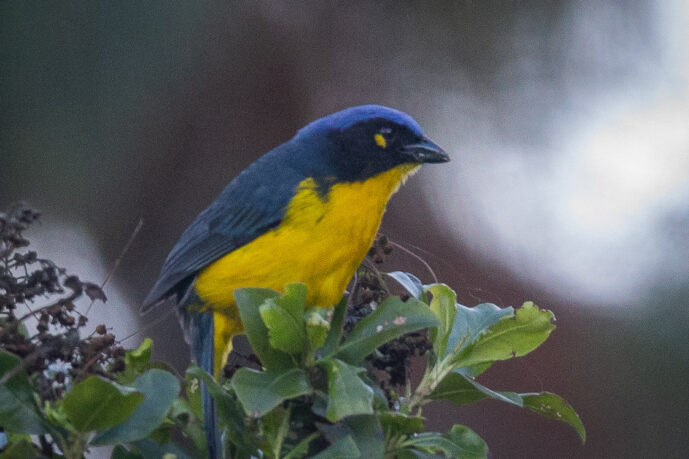
Quick Facts
- Scientific Name: Anisognathus melanogenys
- Spanish Name: Tangara de Santa Marta
- Family: Thraupidae
- Known Nicknames: Black-cheeked Mountain-Tanager, Santa Marta Mountain-Tanager
- Average Length: 18.5–19 cm / 7.3–7.5 in
- Average Weight: 38–45 g / 1.3–1.6 oz
- Wingspan: N/A
- Key Feature: Bright blue crown and nape contrasting with a prominent black mask and golden-yellow underparts
- Primary Diet: Primarily Frugivore (fruits and berries), occasionally Insectivore
- Range: Endemic to the Sierra Nevada de Santa Marta in Northern Colombia
- Habitat: Humid montane forest, forest edges, and high-altitude elfin forest
- Social Structure: Pairs or small family groups; frequently associates with mixed-species foraging flocks
- Nesting/Breeding: Cup-shaped nests built in dense foliage or shrubs
- Statut de conservation : Préoccupation mineure (LC)
- Population Trend: Stable
The Santa Marta Mountain Tanager (*Anisognathus melanogenys*) is a striking songbird found exclusively in the mist-shrouded highlands of the Sierra Nevada de Santa Marta in Colombia. This endemic beauty is easily recognized by its vibrant plumage, featuring brilliant golden-yellow underparts that contrast sharply against its slate-blue back and wings. Its most defining characteristic is its bold black facial mask, punctuated by a distinctive small yellow spot just behind each eye, which gives the bird an alert and expressive appearance. Often seen foraging in small, active groups through the canopy of humid montane forests, this tanager is a remarkable example of localized evolution, thriving in a narrow ecological niche where it plays a vital role as a high-altitude seed disperser.
Faits amusants
The Santa Marta Mountain Tanager is a high-altitude specialist that thrives in misty elfin forests, often acting as a charismatic "nuclear species" that leads large, mixed-species foraging parties through the canopy. To survive near-freezing mountain nights, these birds possess an exceptionally dense layer of insulating feathers and exhibit acrobatic feeding habits, such as hanging completely upside down to reach ripe berries. Their bold black facial mask and brilliant blue crown aren't just for show; these striking markings serve as vital visual beacons, helping the flock maintain social cohesion and stay together while navigating through the thick, disorienting cloud forest fog.
Habitats et répartition
This species is strictly endemic to the Sierra Nevada de Santa Marta, an isolated mountain range in northern Colombia. Its geographical distribution is highly restricted, confined entirely to this specific massif, where it is found across both the northern and southern slopes. It primarily inhabits humid montane forests, high-altitude elfin forests, and dense forest edges, typically at elevations between 1,600 and 3,200 meters. Within these environments, it is most frequently encountered in the canopy and sub-canopy layers, often moving through moss-laden trees and shrubby clearings adjacent to primary forest.
Comportements & Reproduction
This species is highly social, typically found in pairs or small family groups of three to six individuals. They are active foragers that frequently join mixed-species flocks, moving through the canopy and sub-canopy of humid montane forests to feed on berries and small insects. Their behavior is characterized by agile movements and constant vocal communication, which helps maintain group cohesion as they navigate the dense, moss-draped vegetation of their restricted range. Reproduction generally takes place from February to May, during which time monogamous pairs establish and defend breeding territories. They construct well-concealed, cup-shaped nests made of moss and rootlets, often positioned within thick foliage or epiphytes to protect against the elements and predators. Although specific details regarding their courtship rituals are sparse, both adults are believed to contribute to the care and feeding of the fledglings, reflecting a cooperative effort common among high-altitude tanagers.
Alimentation
The Santa Marta Mountain Tanager sustains itself on a primarily frugivorous diet, focusing heavily on a diverse array of small fruits and berries native to the high-altitude forests of the Sierra Nevada de Santa Marta. To complement its fruit intake, this species also functions as an opportunistic insectivore, gleaning small invertebrates and insects from the undersides of leaves or mossy branches. An interesting facet of its dietary habits is its social foraging strategy; it frequently participates in mixed-species flocks, moving through the canopy and sub-canopy to exploit patchily distributed food resources. By consuming a variety of melastome fruits and other highland berries, the bird plays a vital ecological role as a seed disperser, ensuring the regeneration of its restricted montane habitat while adapting its feeding patterns to the seasonal fruiting cycles of the Andean flora.
Couleurs
The Santa Marta Mountain Tanager features vibrant yellow underparts contrasted against deep blue-gray upperparts and a dark crown. Its most distinctive markings include a bold black facial mask and a small, prominent white or yellowish spot located immediately behind the eye. This high-contrast plumage provides visibility among dark montane foliage while maintaining a shadowed profile from above.