Satin Bowerbird
Ptilonorhynchus violaceus
Quick Facts
- Scientific Name: Ptilonorhynchus violaceus
- Spanish Name: Tilonorrinco satinado
- Family: Ptilonorhynchidae
- Known Nicknames: Satin Bird
- Average Length: 27–33 cm / 10.6–13 in
- Average Weight: 170–290 g / 6–10.2 oz
- Wingspan: 45–50 cm / 17.7–19.7 in
- Key Feature: Iridescent blue-black plumage and striking violet-blue eyes in adult males
- Primary Diet: Primarily Frugivore (Fruits, insects, and leaves)
- Range: Eastern and South-eastern Australia (Queensland to Victoria)
- Habitat: Rainforests, wet sclerophyll forests, and woodland edges
- Social Structure: Polygynous; males are solitary at bowers while females and immatures form small flocks
- Nesting/Breeding: Shallow cup nest of twigs and leaves located in trees or shrubs
- Statut de conservation : Préoccupation mineure (LC)
- Population Trend: Stable
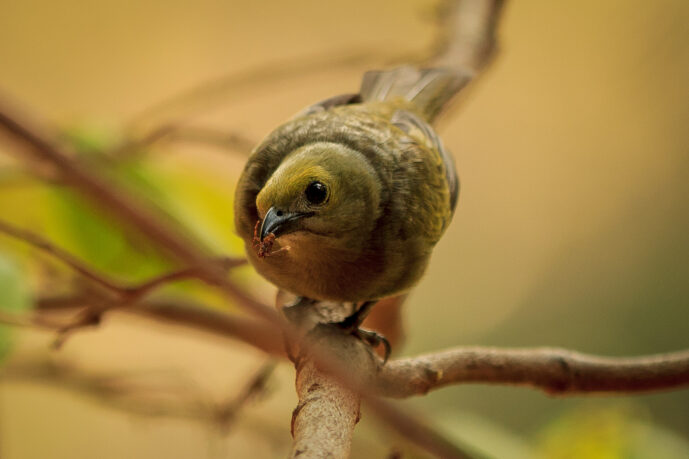
The Satin Bowerbird (*Ptilonorhynchus violaceus*) is a medium-sized bird native to the rainforests and woodlands of eastern Australia, celebrated for its extraordinary intelligence and artistic courtship rituals. While females and juveniles sport a camouflaging olive-green plumage with scalloped underparts, adult males are striking for their lustrous, iridescent blue-black feathers that shimmer like satin, paired with piercing violet-blue eyes. This species is most famous for the male’s architectural prowess; he constructs an intricate "bower"—a U-shaped avenue of upright sticks—solely to attract a mate. Most remarkably, the male acts as a fastidious curator, decorating his display ground with a curated collection of vibrant blue objects, ranging from natural parrot feathers and berries to discarded plastic bottle caps and straws. This unique obsession with the color blue, combined with their ability to mimic complex environmental sounds and perform elaborate dances, marks the Satin Bowerbird as one of nature’s most sophisticated and captivating performers.
Faits amusants
The Satin Bowerbird is nature’s most obsessive interior decorator, specifically fixated on the color blue; males will scavenge everything from rare flowers and parrot feathers to discarded plastic bottle caps and straws to adorn their elaborate stick avenues. Beyond simple collecting, they practice "bower painting" by mixing saliva with chewed berries or charcoal to create a pigment, which they apply to the walls using a wad of bark as a primitive paintbrush. These birds are also notorious saboteurs, frequently stealing ornaments from rivals or physically trashing neighboring bowers to eliminate the competition. Remarkably, as males reach maturity, their eyes transform into a vivid, glowing violet that perfectly complements the iridescent ink-blue sheen of their plumage.
Habitats et répartition
This species is endemic to eastern and southeastern Australia, with a geographical range extending from the coastal regions of northern Queensland down through New South Wales to southern Victoria. It occupies two distinct populations: one situated in the wet tropical regions of the north and a much larger, continuous population throughout the temperate and subtropical zones of the south. Its primary habitats include rainforests, wet sclerophyll forests, and woodland margins. While these birds rely on dense forest cover for nesting and protection, they are frequently found in more open areas such as orchards, parks, and suburban gardens adjacent to forested environments. These locations provide a necessary combination of fruit-bearing plants for foraging and sheltered, relatively clear ground suitable for the construction of display bowers.
Comportements & Reproduction
These birds are renowned for their complex courtship displays, where males construct specialized "avenue" bowers made of sticks. To attract mates, they meticulously decorate these structures and the surrounding platform with various blue objects, such as berries, feathers, and discarded plastic. During the breeding season, males engage in elaborate performances involving rhythmic movements, wing spreading, and sophisticated vocal mimicry to impress visiting females. This polygynous mating system ensures that dominant males with the most aesthetically pleasing bowers secure the majority of matings, while rivals often attempt to sabotage or steal decorations from neighboring sites. Socially, these birds are generally solitary during the breeding period but may form mixed-age foraging flocks during the winter months. Once a female selects a mate based on his display and bower quality, she assumes all responsibility for nesting and chick-rearing. She builds a separate, cup-shaped nest in a tree, well away from the male's display area to avoid predation. The male provides no parental care, instead focusing his energy entirely on maintaining his bower and attracting further mates throughout the season.
Alimentation
The Satin Bowerbird is primarily a frugivore, with a diet heavily centered on a wide variety of native and introduced fruits, including those from the blueberry ash, lilly pilly, and various figs. Beyond fruit, these birds are opportunistic omnivores that consume flowers, nectar, and young green leaves, while also hunting for invertebrates such as beetles, cicadas, and spiders to provide essential protein, particularly when feeding their young. An interesting facet of their dietary habits is their significant role in forest regeneration through seed dispersal, as they often consume whole fruits and deposit seeds far from the parent tree. Additionally, during the winter months, they exhibit a shift in social behavior by forming large, mobile foraging flocks that may venture into suburban gardens and orchards, demonstrating a remarkable adaptability to different food sources outside their typical rainforest and sclerophyll forest habitats.
Couleurs
Adult male Satin Bowerbirds possess a uniform, glossy blue-black plumage that exhibits an iridescent violet sheen in direct light, complemented by striking violet-blue eyes. In contrast, females and immature males display cryptic olive-green or brownish upperparts and pale, scalloped underparts, providing effective camouflage within forest canopies.