Silkworm Moth
Bombyx mori
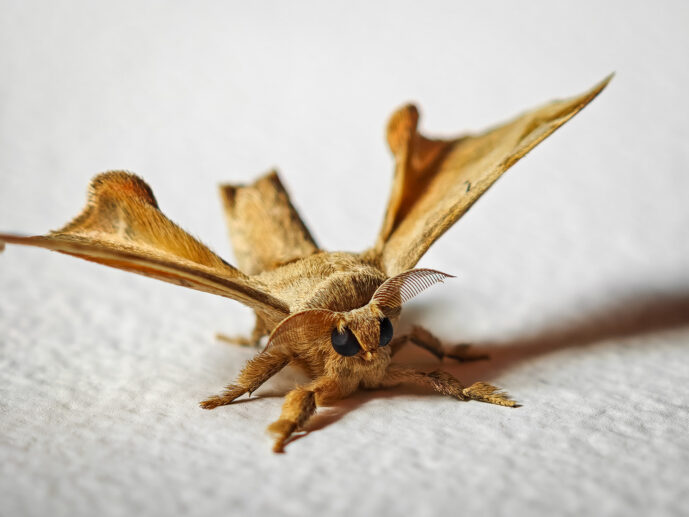
Quick Facts
- Scientific Name: Bombyx mori
- Spanish Name: Gusano de seda
- Family: Bombycidae
- Known Nicknames: Mulberry silkworm, Domestic silkmoth
- Average Length: 2.5–3 cm / 1.0–1.2 in
- Average Weight: 0.3–0.5 g / 0.01–0.018 oz
- Wingspan: 3–5 cm / 1.2–2.0 in
- Key Feature: Creamy white color, thick hairy body, and prominent bipectinate (feathery) antennae
- Primary Diet: Adults do not feed; Larvae are Monophagous (Mulberry leaves)
- Range: Global (Domesticated); originally native to Northern China
- Habitat: Captivity (Sericulture facilities); no wild populations exist
- Social Structure: Non-social; domesticated
- Nesting/Breeding: Mulberry leaves or controlled breeding trays
- Conservation Status: Not Evaluated (Domesticated)
- Population Trend: Stable (Human-dependent)
The Silkworm Moth (*Bombyx mori*) is a remarkable insect renowned for its pivotal role in the textile industry as the primary producer of natural silk. This domesticated species possesses a distinctive, stout body covered in soft, creamy-white scales and features elegant, feathery antennae that serve as highly sensitive sensory organs. One of its most extraordinary characteristics is its complete dependence on human care; due to millennia of selective breeding, adult moths have lost the ability to fly and even lack functional mouthparts, living only long enough to mate and lay eggs. The true marvel of this species lies in its larval stage, where a single silkworm can spin a continuous strand of liquid silk up to 900 meters long to form its protective cocoon, a natural feat that remains the foundation of global sericulture.
Faits amusants
Entirely dependent on humans for survival, these moths have been so heavily domesticated that they no longer exist in the wild and have lost the ability to fly. Adult silkworm moths lack functional mouthparts and never eat, spending their brief lives solely focused on reproduction. A single cocoon is produced from a continuous strand of silk that can stretch up to 900 meters long, nearly ten times the length of a football field. To find mates without flying, males utilize specialized, comb-like antennae so sensitive they can detect a single pheromone molecule from a female miles away.
Habitats et répartition
This species is entirely domesticated and no longer exists in the wild. Its habitat is restricted to human-controlled environments, specifically sericulture facilities where it is raised for silk production. Within these settings, its survival depends on a steady supply of fresh leaves from the white mulberry tree, which serves as its sole food source. Geographically, its distribution is widespread but artificial, spanning regions where silk farming is economically significant. While its ancestral roots are in Northern China, it is now cultivated across many parts of the world, including India, Uzbekistan, Brazil, and Vietnam. Because it has lost the ability to fly or survive independently, its range is defined entirely by the locations of commercial breeding operations.
Comportements & Reproduction
As flightless and non-feeding adults, these moths focus exclusively on reproduction during their brief lifespan of only a few days. They lack a formal social structure, operating independently to locate mates through specialized chemical signaling. The female releases a potent pheromone called bombykol, which the male detects from a distance using highly sensitive, feathery antennae. Upon locating a female, the male performs a characteristic fluttering dance before mating. This process is urgent, as the adults possess vestigial mouthparts and cannot consume food, surviving solely on energy reserves stored from their larval stage. Following successful mating, the female lays between 300 and 500 eggs before her life cycle concludes. A key reproductive strategy is the eggs' ability to enter diapause, a state of suspended development that allows them to survive through winter and hatch only when environmental conditions are favorable and food sources are abundant. Having been domesticated for millennia, these moths have lost their natural survival instincts; they are entirely dependent on human intervention to facilitate mating and protect their eggs, as they can no longer fly to escape predators or seek out mates in the wild.
Alimentation
The diet of the silkworm moth is highly specialized and changes dramatically throughout its life cycle, as the adult moths possess vestigial mouthparts and do not consume any food at all during their brief existence. In contrast, the larval stage, commonly known as the silkworm, is a voracious feeder that subsists almost exclusively on the leaves of the white mulberry tree (Morus alba). These caterpillars are monophagous, meaning they are biologically programmed to prefer this specific plant, though they can occasionally be reared on artificial diets or other mulberry species in laboratory settings. An extraordinary fact about their consumption is that a silkworm will increase its body weight by approximately 10,000 times from the moment it hatches until it begins spinning its cocoon, eating continuously day and night to fuel this rapid growth. This intense feeding process is essential because the larvae must store all the energy and nutrients required for their metamorphosis and for the adult moth’s short life, which is dedicated solely to reproduction.
Couleurs
The silkworm moth is primarily creamy white or pale buff, characterized by a stout, densely hairy body and wings marked with faint, brownish-grey transverse veins. Due to millennia of domestication, it lacks functional camouflage or vibrant patterns, exhibiting a muted, monochromatic appearance suited to its flightless and sedentary existence.