Snail Kite
Rostrhamus sociabilis
Quick Facts
- Scientific Name: Rostrhamus sociabilis
- Spanish Name: Gavilán caracolero
- Family: Accipitridae
- Known Nicknames: Everglade Snail Kite, Caracolero
- Average Length: 36–48 cm / 14–19 in
- Average Weight: 300–570 g / 11–20 oz
- Wingspan: 99–120 cm / 39–47 in
- Key Feature: Slender, deeply hooked upper mandible specialized for extracting snails
- Primary Diet: Molluscivore (specializing in Apple Snails)
- Range: Florida (USA), Caribbean, Central America, and South America to Argentina
- Habitat: Freshwater marshes, wetlands, and lake margins with emergent vegetation
- Social Structure: Gregarious; often colonial breeders and communal roosters
- Nesting/Breeding: Stick nests in low trees, shrubs, or tall marsh vegetation over water
- Statut de conservation : Préoccupation mineure (LC)
- Population Trend: Decreasing
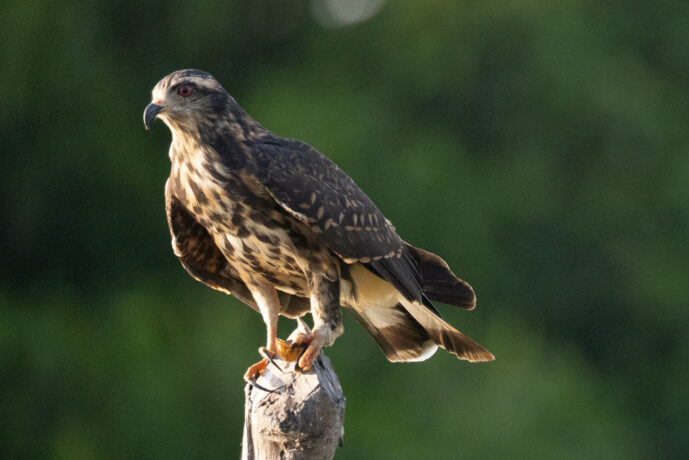
The Snail Kite (*Rostrhamus sociabilis*) is a medium-sized raptor of the Americas, distinguished by its remarkable evolutionary specialization: a deeply curved, slender bill designed almost exclusively for extracting meat from apple snails with surgical precision. While adult males sport a sophisticated slaty-gray plumage accented by bright red eyes and orange facial skin, females and juveniles are more cryptically colored with streaked brown feathers and prominent white eyebrows. Unlike many solitary birds of prey, the Snail Kite is notably gregarious, as its scientific name suggests, often nesting in loose colonies and foraging in groups over freshwater marshes. This specialized predator serves as a vital indicator species for wetland health, as its survival is inextricably linked to the precise water levels and vegetation required by its primary aquatic prey.
Faits amusants
The Snail Kite is a highly specialized predator that feeds almost exclusively on apple snails, using its remarkably thin, deeply hooked beak as a surgical tool to extract the meat without damaging the shell. In a fascinating display of rapid evolution, Florida populations have recently grown larger beaks to adapt to the arrival of massive, invasive snail species. Unlike most solitary raptors, this bird is notably social, often nesting in communal colonies and foraging in groups. When it catches a meal, it retreats to a preferred "butcher branch" to dine, leaving behind telltale mounds of perfectly intact, empty shells that reveal its favorite hunting spots.
Habitats et répartition
This raptor is strictly tied to freshwater wetlands, including marshes, shallow lakes, and flooded savannas. It requires open water with emergent vegetation, such as sawgrass or cattails, which supports its primary prey, the apple snail. Because of its specialized diet, it is highly sensitive to changes in water levels and hydrology that affect snail populations or the visibility of prey. Its geographical range extends across the tropical and subtropical Americas. In the United States, it is found locally in central and southern Florida. Beyond this, it inhabits the Caribbean islands, including Cuba, and ranges from eastern Mexico through Central America into South America, reaching as far south as northern Argentina and Uruguay.
Comportements & Reproduction
These birds are notably social, often roosting and nesting in loose colonies where they exhibit minimal territoriality outside the immediate nest site. Mating begins with intricate courtship rituals, including high-altitude aerial displays and nuptial feeding, where the male presents captured snails to the female. While they form monogamous pairs for the duration of a nesting attempt, their reproductive cycles are highly flexible and driven by the availability of water and their specialized prey. A distinctive reproductive strategy is their practice of sequential polygamy through mate desertion. When environmental conditions are optimal and food is abundant, one parent—frequently the female—may abandon the nest once the chicks are approximately three to five weeks old. This leaves the remaining partner to finish rearing the young while the departing parent seeks a new mate to begin a subsequent brood. This behavior maximizes reproductive success within a single season, provided the wetland habitat remains stable.
Alimentation
The Snail Kite is a highly specialized raptor whose diet consists almost exclusively of large freshwater apple snails from the genus Pomacea. To facilitate this niche feeding habit, the bird possesses a uniquely slender, deeply hooked beak designed to reach into the spiral of a snail's shell and sever the attachment muscle, allowing it to extract the meat without breaking the casing. These birds typically hunt by flying low over wetlands, using their talons to pluck snails from aquatic vegetation before carrying them to a preferred perch. An fascinating aspect of their biology is their rapid evolutionary adaptability; in regions like Florida, Snail Kites have developed significantly larger beaks in just a few generations to better handle the arrival of much larger, invasive island apple snails. While they are extreme specialists, they have been known to occasionally supplement their diet with crayfish, small turtles, or crabs during severe droughts when their primary prey becomes scarce.
Couleurs
Adult males are primarily slaty-gray with a prominent white patch at the base of the tail, while females and juveniles exhibit dark brown, heavily streaked plumage that provides camouflage in marshy environments. Both sexes feature striking red eyes, orange-red facial skin and legs, and a specialized, deeply hooked black bill adapted for extracting snails.