Squirrel Monkey
Saimiri
Quick Facts
- Scientific Name: Saimiri
- Spanish Name: Mono ardilla
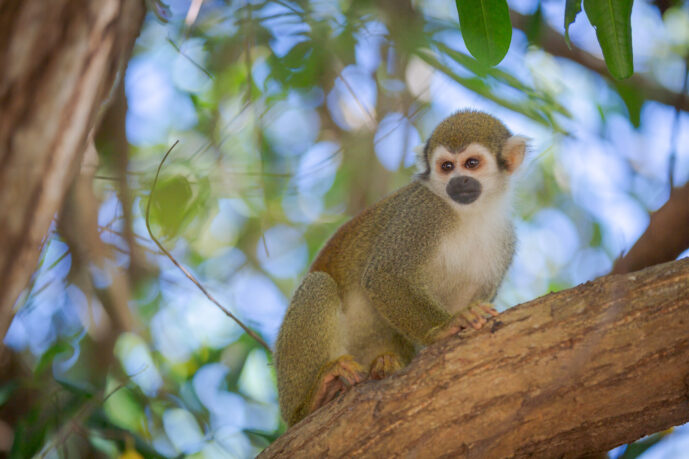
The Squirrel Monkey, belonging to the genus *Saimiri*, is a small and remarkably agile primate native to the tropical forests of Central and South America. These monkeys are easily identified by their short, dense fur—typically a mix of olive, grey, and golden-yellow—and their striking facial "mask," characterized by white fur around the eyes and a dark, black muzzle. One of their most extraordinary biological features is their brain-to-body mass ratio, which is the highest of all primates, reflecting their high intelligence and complex social behaviors. While they possess exceptionally long tails, these are non-prehensile and serve primarily as balancing poles as the monkeys leap through the canopy in large, vocal troops. Fascinatingly, they also engage in "urine washing" to scent-mark their territory and improve their grip, making them one of the most unique and energetic residents of the rainforest.
Faits amusants
Squirrel monkeys possess the highest brain-to-body mass ratio of all primates, making them remarkably intelligent for their size. To improve their grip and mark territory, these monkeys engage in a behavior called "urine washing," where they deliberately soak their hands and feet in their own urine. Unlike many other New World monkeys, their long tails are not prehensile and serve only as balancing poles while they navigate the canopy. Additionally, during the breeding season, males undergo a dramatic physical transformation by storing water in their upper bodies, appearing significantly "fattened" to establish dominance and attract mates.
Habitats et répartition
These primates are primarily distributed across the tropical regions of Central and South America, spanning from Costa Rica and Panama through the Amazon Basin to Bolivia and Paraguay. They are most prevalent in the lowland rainforests of Brazil, Peru, and Colombia, where their specific geographical ranges are frequently delineated by major river systems.
Within these territories, they occupy diverse environments such as primary and secondary tropical rainforests, gallery forests, and mangrove swamps. While they show a strong preference for the middle canopy to avoid predators and access food, they are highly adaptable and frequently inhabit seasonally flooded forests, marshes, and edge habitats near water sources.
Comportements & Reproduction
These primates live in large, complex social groups ranging from 20 to 100 individuals, characterized by a multi-male, multi-female structure where females typically form the stable core. During the breeding season, males undergo a unique physiological change known as "fattening," where they gain significant weight and water retention in their upper bodies to signal strength and attract mates. This sexual dimorphism is crucial, as females often prefer the largest, most "fattened" males for breeding, which helps establish a temporary dominance hierarchy among the males.
Reproduction is strictly seasonal and synchronized within the troop to ensure infant survival during periods of high food availability. After a gestation period of approximately five months, a single infant is born. A notable reproductive strategy is allomothering, where other females in the group assist in carrying and protecting the newborn. This communal care allows the mother to forage more effectively while ensuring the infant’s safety, though males rarely participate in direct parental care, focusing instead on group defense.
Alimentation
The Squirrel Monkey maintains an omnivorous diet primarily characterized as frugivorous-insectivorous, consisting largely of seasonal fruits and various insects. These primates spend a significant portion of their day—up to 80% of their active hours—foraging through the canopy for high-protein snacks such as grasshoppers, beetles, and spiders, and they are even known to hunt small vertebrates like lizards, bats, and birds. An interesting aspect of their feeding strategy is their adaptability; when fruit becomes scarce during certain seasons, they shift their focus almost entirely to animal prey to sustain their high metabolism. They are particularly adept at capturing camouflaged insects and often follow other animals, such as birds or larger monkeys, to snatch up prey that has been flushed out of hiding. Additionally, while they consume nectar and seeds, squirrel monkeys rarely share food with one another, and they typically obtain necessary hydration from their diet or from water collected in tree holes and plant leaves.
Couleurs
Squirrel monkeys possess short, dense fur that is primarily olive, grey, or yellowish-orange on their backs and limbs, fading to a pale cream or white underside. Their most striking feature is a "mask-like" face characterized by white fur around the eyes and ears contrasted against a dark black or brown muzzle. This olive-toned coloration provides effective camouflage within the dappled sunlight of the forest canopy, while their long tails often culminate in a distinct black tip.