Streak-headed Woodcreeper
Lepidocolaptes souleyetii
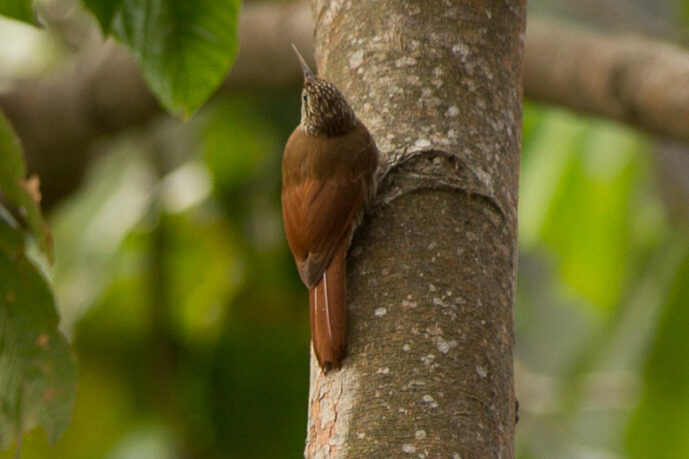
Quick Facts
- Scientific Name: Lepidocolaptes souleyetii
- Spanish Name: Trepatroncos cabecirrayado
- Family: Furnariidae
- Known Nicknames: Souleyet's Woodcreeper
- Average Length: 17–22 cm / 6.7–8.7 in
- Average Weight: 22–35 g / 0.78–1.23 oz
- Wingspan: 30–35 cm / 11.8–13.8 in
- Key Feature: Slender, slightly decurved bill and fine buffy-white streaking on head, neck, and underparts
- Primary Diet: Insectivore
- Range: Southern Mexico through Central America to northwestern Peru, central Guyana, and northern Brazil
- Habitat: Open woodland, forest edges, mangroves, and plantations
- Social Structure: Solitary or in pairs; occasionally joins mixed-species flocks
- Nesting/Breeding: Tree cavities or old woodpecker holes
- Statut de conservation : Préoccupation mineure (LC)
- Population Trend: Decreasing
A master of vertical navigation, the Streak-headed Woodcreeper (*Lepidocolaptes souleyetii*) is a slender, cinnamon-hued songbird common to the tropical forests and open woodlands of Central and South America. It is most easily identified by the elegant, buffy-white longitudinal streaks that decorate its dark crown, neck, and breast, a feature that distinguishes it from its spot-crowned relatives. This woodcreeper possesses a remarkably long, thin, and gracefully down-curved bill, perfectly evolved for probing deep into bark crevices for hidden insects. As it hitches its way up tree trunks in a characteristic spiral, it utilizes its stiff, spine-tipped tail feathers as a sturdy tripod for stability, showcasing a specialized anatomy that makes it one of the most agile and distinctive foragers of the forest canopy.
Faits amusants
The Streak-headed Woodcreeper is a master of the "hitch-and-glide" technique, spiraling up tree trunks like a mechanical toy before diving to the base of a neighboring tree to repeat the process. Unlike woodpeckers, they don't drum on wood but use their slender, decurved bills like surgical tweezers to extract insects from deep bark crevices. To stay upright while climbing, they possess exceptionally stiff, spine-tipped tail feathers that act as a sturdy tripod against the bark. Perhaps most charming is their song—a rapid, descending trill that sounds remarkably like a tiny, high-pitched whinny or a bubbling laugh echoing through the canopy.
Habitats et répartition
This species occupies a broad geographical range extending from southern Mexico through Central America and into northern South America, reaching as far as northwestern Peru, northern Brazil, and Guyana. It is primarily a lowland and foothill resident, typically found from sea level up to mid-elevations of approximately 1,500 meters. Its preferred habitats consist of semi-open environments rather than dense, interior rainforest. It is frequently encountered in deciduous woodlands, forest edges, gallery forests, and clearings with scattered trees. The species is notably adaptable to human-modified landscapes, often inhabiting mangroves, coffee and cacao plantations, and mature suburban gardens.
Comportements & Reproduction
This species is primarily solitary or found in pairs, frequently joining mixed-species foraging flocks as it hitches up tree trunks to probe bark for invertebrates. It maintains a territorial social structure, using a distinctive trilling song to define and defend its range. During the breeding season, it forms monogamous pairs and seeks out nesting sites in natural tree cavities, abandoned woodpecker holes, or even hollow fence posts. Reproduction involves the female laying two white eggs on a lining of bark chips or dry leaves within the chosen cavity. Both parents participate in incubating the eggs and provisioning the nestlings, a cooperative effort that enhances offspring survival. While it does not excavate its own holes, its adaptability in selecting varied nesting sites and its consistent foraging territory are key to its reproductive success across diverse habitats.
Alimentation
The Streak-headed Woodcreeper is primarily insectivorous, focusing its diet on a wide variety of small invertebrates such as beetles, ants, spiders, and cockroaches. It utilizes its long, slender, and slightly decurved bill to probe deep into the crevices of bark and moss as it hitches its way up tree trunks in a characteristic spiral pattern. While it mainly targets insects, it is known to occasionally supplement its diet with small vertebrates like tiny lizards. An interesting aspect of its foraging behavior is its participation in mixed-species flocks, where it benefits from the insects flushed out by other birds, and although it is less dependent on them than some relatives, it will sometimes follow army ant swarms to capture fleeing prey. Its stiffened tail feathers serve as a crucial structural support, acting like a tripod against the tree trunk to stabilize the bird as it focuses on extracting hidden larvae and adults from the wood.
Couleurs
The Streak-headed Woodcreeper features warm cinnamon-brown upperparts and rufous wings and tail, heavily accented by fine, buffy-white longitudinal streaks across its dark brown crown, nape, and breast. Its long, pale, decurved bill complements a plumage designed for camouflage, perfectly mimicking the textured patterns and shadows of tree bark to remain inconspicuous while foraging.