Streaked Saltator
Saltator striatipectus
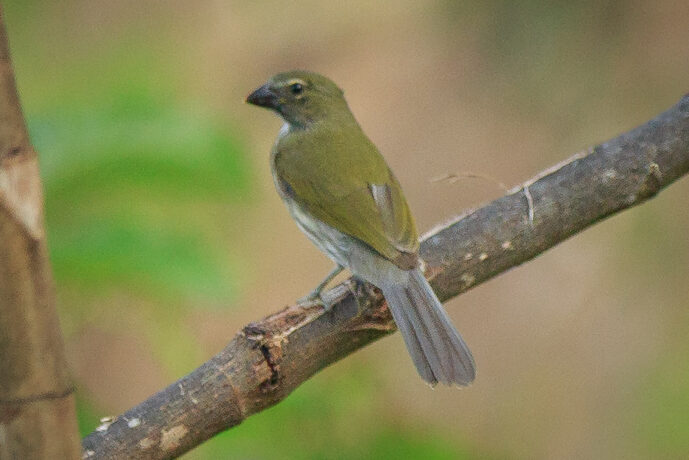
Quick Facts
- Scientific Name: Saltator striatipectus
- Spanish Name: Pepitero listado
- Family: Thraupidae
- Known Nicknames: Streaked-bellied Saltator
- Average Length: 18–20 cm / 7–8 in
- Average Weight: 33–42 g / 1.1–1.5 oz
- Wingspan: 25–30 cm / 10–12 in
- Key Feature: Heavily streaked breast and belly with a thick, pale-based bill
- Primary Diet: Omnivore (fruits, seeds, and insects)
- Range: Panama, Colombia, Ecuador, and Peru
- Habitat: Dry forest, humid forest edges, scrub, and gardens
- Social Structure: Solitary or in pairs
- Nesting/Breeding: Shallow cup nest in shrubs or low trees
- Statut de conservation : Préoccupation mineure (LC)
- Population Trend: Stable
The Streaked Saltator (*Saltator striatipectus*) is a charismatic songbird native to the open woodlands and scrubby landscapes of Central and South America, easily distinguished from its relatives by its namesake plumage. Characterized by heavy, dark longitudinal streaks across a pale breast and belly, this bird features olive-gray upperparts, a prominent white eyebrow, and a robust, conical bill perfectly adapted for a diet of seeds and fruit. While it belongs to the tanager family, it lacks the brilliant colors of its cousins, instead favoring a sophisticated, camouflaged aesthetic that blends seamlessly into tropical gardens. Beyond its appearance, the Streaked Saltator is most celebrated for its melodious, whistling song, which serves as a bold vocal signature across its Neotropical habitat.
Faits amusants
The Streaked Saltator possesses a deceptively thick, parrot-like bill used to crush tough seeds and fibrous fruits, a specialized adaptation that often leads casual observers to misidentify it. Although its genus name *Saltator* is Latin for "leaper" or "dancer," the bird is actually quite methodical and lacks any unique jumping behaviors compared to its peers. Interestingly, while long classified as a cardinal, modern genetic testing recently re-categorized it as a member of the tanager family. These birds are also remarkably bold, frequently abandoning the cover of dense scrub to sing their flute-like melodies from exposed garden perches, showing a lack of shyness rarely seen in other tropical songbirds.
Habitats et répartition
It inhabits a broad range of semi-open environments, including scrublands, forest edges, clearings, and cultivated areas like gardens and plantations. It thrives in secondary growth and is less common in the dense interior of primary forests. Typically found in tropical and subtropical zones, it occupies both dry and humid landscapes, generally ranging from sea level up to mid-elevation foothills. Its geographical distribution spans from Costa Rica and Panama in Central America through northern and western South America, covering parts of Colombia, Venezuela, Ecuador, and Peru. Within this range, it is frequently sighted in inter-Andean valleys and along coastal regions, adapting well to human-altered landscapes and disturbed habitats.
Comportements & Reproduction
Typically found alone or in monogamous pairs, these birds exhibit a relatively solitary social structure, foraging quietly within dense thickets and scrubby woodlands. During the breeding season, they become highly territorial, with males utilizing melodic, whistling songs to define and defend their nesting boundaries. While not highly gregarious, they may occasionally join mixed-species foraging flocks outside of the reproductive period, though they generally prefer to remain within their established home ranges. Reproduction involves the construction of a bulky, cup-shaped nest composed of twigs, rootlets, and grass, usually hidden low in shrubs or small trees. The female typically lays a clutch of two pale blue or greenish eggs, which are distinctively marked with dark, hair-like streaks at the larger end. Both parents share the responsibilities of defending the nest and provisioning the hatchlings with a diet of fruit and insects, demonstrating a cooperative approach to parental care that lasts until the young fledge.
Alimentation
The Streaked Saltator maintains a diverse and primarily herbivorous diet, focusing heavily on a wide array of fruits, seeds, and flower buds found within its tropical and subtropical habitats. Its stout, powerful bill is specifically adapted for crushing hard seeds and efficiently handling various berries, making it a highly effective generalist feeder. While plant matter constitutes the bulk of its nutritional intake, this species also opportunistically consumes insects and other small invertebrates, a behavior that becomes particularly prominent during the breeding season to provide essential protein for growing chicks. Interestingly, the Streaked Saltator is known for its versatile foraging habits, often seen searching for food at multiple levels of the forest from the low understory to the high canopy, frequently participating in mixed-species flocks to maximize its foraging efficiency.
Couleurs
The Streaked Saltator features olive-gray upperparts and pale underparts defined by dense, dark vertical streaking. It displays a faint whitish eyebrow and a thick, dark bill frequently tipped with orange. This streaked plumage acts as camouflage, allowing the bird to blend into the shadows and dappled light of its dense scrubland habitat.