Swallow Tanager
Tersina viridis
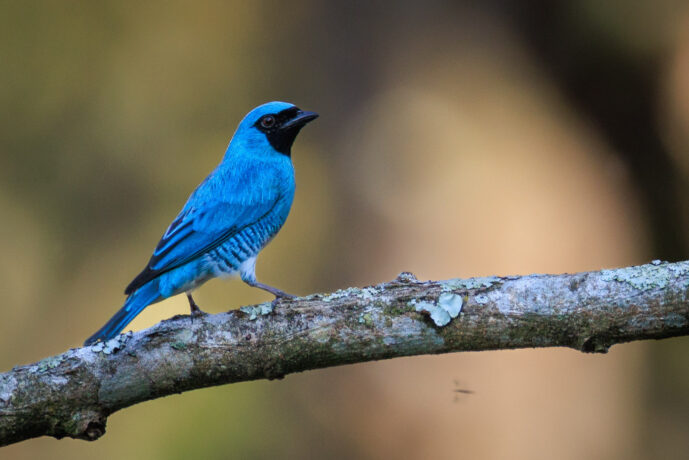
Quick Facts
- Scientific Name: Tersina viridis
- Spanish Name: Tersina
- Family: Thraupidae
- Known Nicknames: Swallow-tanager, Tersina
- Average Length: 14–15 cm / 5.5–6 in
- Average Weight: 27–31 g / 0.95–1.1 oz
- Wingspan: 25–28 cm / 10–11 in
- Key Feature: Broad, flat swallow-like bill and vibrant turquoise plumage with a black face mask in males
- Primary Diet: Frugivore and Insectivore
- Range: Panama and most of South America to Northern Argentina and Southern Brazil
- Habitat: Tropical and subtropical moist lowland forests, woodland edges, and clearings
- Social Structure: Highly social, often found in small flocks or pairs
- Nesting/Breeding: Burrows in earth banks, rock crevices, or tree cavities
- Statut de conservation : Préoccupation mineure (LC)
- Population Trend: Stable
The Swallow Tanager (*Tersina viridis*) is a visually stunning Neotropical bird celebrated for its extreme sexual dimorphism and specialized anatomy. Males are draped in a brilliant, shimmering turquoise-blue plumage contrasted by a dramatic black face mask and throat, while females display a vibrant leaf-green coat with yellow-streaked underparts. True to its name, this species possesses an unusually wide, flattened bill and a capacious gape similar to a swallow's, allowing it to expertly snatch insects mid-air or swallow large fruits whole. Beyond its striking appearance, the Swallow Tanager is unique among its relatives for its nesting behavior; rather than building traditional nests in branches, it is a dedicated cavity nester that often excavates burrows in earthen banks or utilizes holes in trees and buildings, making it one of the most ecologically distinct members of the tanager family.
Faits amusants
The Swallow Tanager is a master of aerial acrobatics, using an unusually wide, flat bill to snatch insects mid-flight just like the swallows it is named after. Unlike most tanagers that nest in trees, this species is a subterranean specialist, excavating deep burrows into earthen banks or stone walls to raise its young. While females blend into the foliage with lime-green feathers, males sport a brilliant, iridescent turquoise plumage accented by a stark black "bandit mask" across their eyes. These birds also act as vital forest gardeners by swallowing large fruits whole and later regurgitating the seeds far from the parent tree.
Habitats et répartition
This species is widely distributed across South America, ranging from eastern Panama and Trinidad south to northern Argentina and southern Brazil. It inhabits a variety of open and semi-open environments, including forest edges, clearings, gallery forests, and woodland borders. It is particularly drawn to areas near rivers or streams and is frequently found in hilly or mountainous terrain where vertical surfaces like earth banks or cliffs are available for nesting. Habitat preferences often shift seasonally, as populations may move between lowland tropical forests and higher elevations. It generally avoids the interior of dense, primary rainforests, favoring instead disturbed areas or landscapes where fruiting trees are abundant. The presence of suitable cavities in banks or even man-made structures is a critical requirement for its specialized nesting behavior.
Comportements & Reproduction
Swallow Tanagers are highly social birds, often gathering in small groups or larger flocks outside the breeding season. They exhibit a unique foraging style, combining fruit consumption with agile, swallow-like aerial maneuvers to catch insects mid-air. During the breeding period, pairs become more territorial, though they may still forage in loose associations. This social structure shifts seasonally from gregarious flocking to focused, pair-based interactions centered around nesting sites. Reproduction involves a distinctive nesting strategy where the female typically excavates a burrow in an earthen bank or utilizes existing cavities in trees and cliffs. While the female takes sole responsibility for constructing the cup-shaped nest and incubating the eggs, the male remains nearby to defend the territory and provide her with food. Generally monogamous, both parents collaborate to feed the nestlings, often regurgitating a mixture of fruit and insects to sustain their young until they fledge.
Alimentation
The Swallow Tanager (Tersina viridis) sustains itself on a mixed diet of fruits and insects, demonstrating a specialized feeding strategy that bridges two distinct nutritional sources. While it consumes a wide variety of berries and small fruits from trees like melastomes and figs, it is particularly famous for its "hawking" behavior, where it launches from high perches to snatch flying insects—such as termites, ants, and beetles—out of the air with the agility of a swallow. An interesting anatomical adaptation is its exceptionally broad gape, which allows it to swallow relatively large fruits whole rather than pecking at them. Furthermore, this species plays a vital role in its ecosystem as a seed disperser; after digesting the fleshy pulp of a fruit, it often regurgitates the larger seeds or passes them through its system, facilitating the growth of new trees across its tropical habitat. During the nesting period, the bird shifts its focus more heavily toward protein-rich insects to ensure the rapid growth of its fledglings.
Couleurs
Male Swallow Tanagers display brilliant turquoise-blue or emerald iridescent plumage with a contrasting black facial mask and black-barred white flanks. Females are predominantly bright green with yellowish-white bellies and green flank barring, providing effective camouflage within forest canopies. This structural coloration shifts hue based on light angles, while the female’s green tones offer protection through foliage mimicry.