Wattled Jacana
Jacana jacana
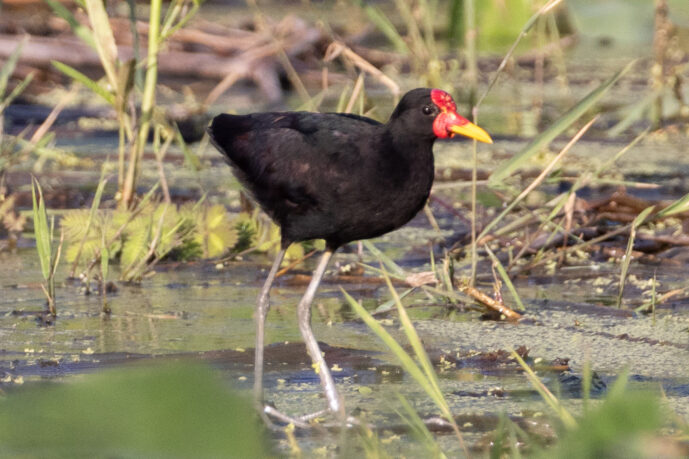
Quick Facts
- Scientific Name: Jacana jacana
- Spanish Name: Jacana común
- Family: Jacanidae
- Known Nicknames: Lily trotter, Jesus bird
- Average Length: 17–25 cm / 6.7–9.8 in
- Average Weight: 90–150 g / 3.2–5.3 oz
- Wingspan: 37–40 cm / 14.6–15.7 in
- Key Feature: Fleshy red facial wattles and extremely elongated toes and claws
- Primary Diet: Omnivore (Insects, small invertebrates, and seeds)
- Range: South America (east of the Andes) to Panama and Trinidad
- Habitat: Freshwater wetlands and marshes with floating vegetation
- Social Structure: Polyandrous (territorial females with multiple male mates)
- Nesting/Breeding: Floating nests on aquatic vegetation
- Statut de conservation : Préoccupation mineure (LC)
- Population Trend: Stable
The Wattled Jacana (*Jacana jacana*) is a striking tropical wader famous for its remarkably long toes and claws, which distribute its weight so effectively that it can walk across floating lily pads, earning it the nickname "Jesus bird." Primarily found in the wetlands of South America, this medium-sized bird features a vibrant chestnut-brown back and wings contrasted against a sleek black body, accented by a brilliant red fleshy frontal shield and wattles at the base of its bill. A surprising flash of greenish-yellow flight feathers is revealed when it takes to the air, often displaying the sharp, defensive spurs located on its wing joints. Beyond its appearance, the Wattled Jacana is noted for its rare polyandrous mating system, where larger, territorial females mate with multiple males who are then left with the sole responsibility of incubating the eggs and raising the chicks.
Faits amusants
The Wattled Jacana is famously nicknamed the "Jesus bird" because its incredibly long toes distribute its weight so effectively that it can walk across floating lily pads as if moving on water. In a striking reversal of typical avian roles, this species practices polyandry; larger, aggressive females defend territories while multiple smaller males perform all the incubation and chick-rearing. These devoted fathers have a unique "luggage" maneuver where they tuck their chicks under their wings and carry them to safety when predators approach. Additionally, both sexes are armed with sharp, yellow spurs on the bends of their wings, which they use as weapons during intense territorial disputes.
Habitats et répartition
This species is widely distributed across South America east of the Andes, ranging from Colombia and Venezuela southward to northern Argentina and Uruguay. It is also found in Panama and on Caribbean islands such as Trinidad. While primarily a sedentary resident throughout its range, it may perform seasonal movements in response to changing water levels or local droughts. It thrives in freshwater environments characterized by shallow water and dense floating vegetation, such as water lilies and lotus. Typical habitats include marshes, swamps, the edges of ponds and lakes, and slow-flowing rivers. Its specialized long toes enable it to walk easily across floating aquatic plants, which serve as its primary platform for both foraging and nesting.
Comportements & Reproduction
Exhibiting a rare polyandrous social structure, females are significantly larger than males and aggressively defend territories that encompass the smaller ranges of multiple mates. While males are responsible for the majority of parental duties, females focus on territory defense and competing with rivals. In some instances, a dominant female may even commit infanticide by killing the offspring of a competitor to secure the resident male for herself, forcing him to replace the lost clutch with her own eggs. These wetland inhabitants utilize exceptionally long toes to walk across floating vegetation, where males construct flimsy nests. Once the eggs are laid, the male takes over the entire process of incubation and chick-rearing. He demonstrates a unique brooding behavior, tucking the chicks under his wings to carry them across the lily pads to safety if a predator approaches. This reversal of traditional avian roles is a defining characteristic of their reproductive strategy, allowing the female to maximize egg production while the male ensures the survival of the brood.
Alimentation
The Wattled Jacana is primarily an omnivore with a diet heavily focused on insects and small aquatic invertebrates. It spends much of its time foraging atop floating vegetation, such as lily pads, where it hunts for beetles, grasshoppers, dragonflies, and small mollusks. Interestingly, these birds often utilize their specialized long toes to flip over lily pads and other aquatic plants to uncover hidden prey like snails or insect larvae. In addition to animal matter, they occasionally consume the seeds and roots of aquatic plants, making them opportunistic feeders that adapt to the resources available within their tropical wetland habitats.
Couleurs
The Wattled Jacana features a black head, neck, and breast contrasted against a rich chestnut-brown mantle and wings. It is characterized by a prominent red facial wattle, a yellow-tipped bill, and long, dull-grey legs. While its dark plumage provides effective camouflage among the shadows of floating aquatic plants, the bird reveals striking neon-yellow flight feathers when it takes to the air.