Whitened Crescent Butterfly
Anthanassa drusilla
Quick Facts
- Scientific Name: Anthanassa drusilla
- Spanish Name: Creciente Blanca
- Family: Nymphalidae
- Known Nicknames: Drusilla Crescent, Whitened Crescent
- Average Length: 1.5–2.0 cm / 0.6–0.8 in
- Average Weight: Negligible (< 0.5 g / 0.018 oz)
- Wingspan: 3.2–4.5 cm / 1.25–1.75 in
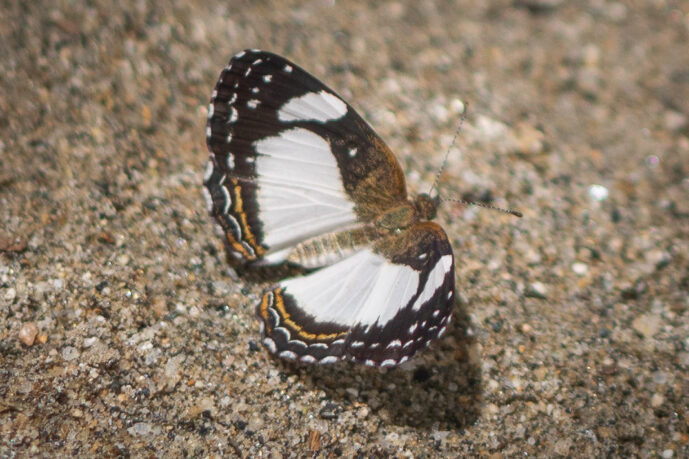
- Key Feature: Orange and dark brown dorsal pattern with a distinct pale, whitened crescent-shaped mark on the hindwing margin
- Primary Diet: Nectarivore (Adults); Herbivore (Larvae)
- Range: Southern Texas through Mexico and Central America to Argentina
- Habitat: Tropical and subtropical forest edges, secondary growth, and disturbed fields
- Social Structure: Solitary
- Nesting/Breeding: Underside of host plant leaves (Acanthaceae family, such as Justicia)
- Conservation Status: Not Evaluated (NE)
- Population Trend: Stable
The Whitened Crescent Butterfly (*Anthanassa drusilla*) is a captivating nymphalid found fluttering across the forest edges and tropical landscapes of Central and South America. Characterized by its intricate wing patterns, this species typically displays a rich dark brown or black dorsal surface adorned with vibrant orange and tawny bands that create a striking mosaic. However, its most defining feature—and the source of its name—is found on the ventral side of the hindwing: a prominent, pearly-white crescent-shaped spot that stands out against a complex, marbled brown background. This delicate mark serves as a key identifier, while the mottled underside provides excellent camouflage against leaf litter when the butterfly is at rest. Known for their agile flight and tendency to congregate near moist soil to "puddle" for essential minerals, these butterflies are a testament to the subtle beauty and specialized adaptations found within diverse tropical ecosystems.
Faits amusants
The Whitened Crescent is a social sipper, frequently engaging in "mud-puddling" where groups of males congregate on damp ground to suck up essential sodium and minerals. These butterflies possess a unique defense mechanism in their erratic, low-to-the-ground flight style, which makes them difficult for predators to track through dense undergrowth. Their most distinctive feature is the namesake pearly-white crescent mark on the underside of the hindwing, which serves as a confusing focal point for hungry birds, often tricking them into striking the non-vital wing edges rather than the body. Additionally, while they are primarily tropical residents, they are known for their occasional adventurous "wandering" behavior, appearing in regions far north of their typical breeding range during warm seasons.
Habitats et répartition
This species is widely distributed across the Neotropical realm, spanning from Mexico and Central America through much of South America, including the Amazon basin, and reaching as far south as northern Argentina. It is commonly found in a variety of lowland and mid-elevation environments, ranging from sea level up to approximately 1,500 meters in the Andean foothills. Its preferred habitats include tropical rainforests, subtropical deciduous forests, and cloud forest margins. It is particularly adaptable to disturbed areas, frequently appearing in secondary growth forests, agricultural clearings, and along riverbanks where its larval host plants, such as those in the Acanthaceae family, are prevalent.
Comportements & Reproduction
These butterflies exhibit a low, fluttering flight pattern and are frequently observed visiting various wildflowers for nectar or congregating on damp soil to engage in puddling, a behavior used to extract essential minerals. While primarily solitary as adults, they are highly active during the day, especially in sunny, open areas such as forest edges and meadows. They do not maintain a complex social hierarchy, though multiple individuals may gather at rich nutrient sources without significant territorial aggression. Reproduction involves a patrolling strategy where males actively search for receptive females within their habitat. Once mating is successful, females deposit their eggs in clusters on the underside of host plant leaves, typically within the Acanthaceae family. This clustered egg-laying strategy results in gregarious behavior among young larvae, which feed together for protection and shared resources during their early developmental stages before becoming more solitary as they mature.
Alimentation
The Whitened Crescent butterfly (Anthanassa drusilla) maintains a specialized diet that shifts significantly throughout its metamorphosis, beginning with the larvae feeding almost exclusively on host plants within the Acanthaceae family, particularly those in the genera Dicliptera and Justicia. A fascinating characteristic of these caterpillars is their gregarious feeding behavior during early developmental stages, where they cluster together to consume foliage more efficiently. Once they reach adulthood, the butterflies primarily seek out nectar from various small flowering plants to acquire energy, though they also engage in the intriguing behavior known as puddling. During this process, they congregate on damp patches of earth or mud to imbibe water rich in dissolved minerals and salts, which are vital for metabolic functions and are often transferred from males to females during mating to improve the overall success of their reproductive efforts.
Couleurs
The Whitened Crescent butterfly features dark brown to black uppersides marked with vibrant orange-tawny bands and a signature pale cream or white crescent on the hindwing margin. Its underside is cryptically patterned with mottled shades of tan, gray, and brown to mimic dead leaves, providing essential camouflage when at rest. This ventral side also displays a distinct silvery-white crescent, a key identifying trait set against its complex, leaf-like markings.