Blue-and-yellow Macaw
Ara ararauna
Quick Facts
- Scientific Name: Ara ararauna
- Family: Psittacidae
- Known Nicknames: Blue-and-gold Macaw
- Average Length: 76–91 cm / 30–36 in
- Average Weight: 900–1,300 g / 2.0–2.9 lb
- Wingspan: 102–114 cm / 40–45 in
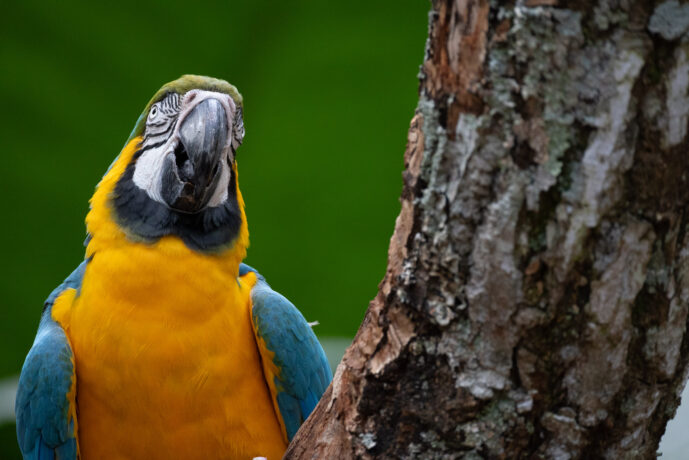
- Key Feature: Vibrant blue upperparts and golden-yellow underparts with a green forehead and black throat patch
- Primary Diet: Herbivore (Frugivore and Granivore)
- Range: South America, from Panama to Brazil, Bolivia, and Paraguay
- Habitat: Humid lowland forests, woodlands, and swampy savannas
- Social Structure: Highly Social (Monogamous pairs within small to large flocks)
- Nesting/Breeding: Tree hollows, specifically dead palm trees
- Conservation Status: Least Concern (LC)
- Population Trend: Decreasing
The Blue-and-yellow Macaw (*Ara ararauna*) is a breathtakingly vibrant parrot native to the lush rainforests and woodlands of South America, instantly recognizable by its brilliant azure-blue upperparts and contrasting golden-yellow underbelly. This large, charismatic bird features a signature white facial patch etched with fine black feather lines, a splash of lime green on its forehead, and a massive, hooked black beak powerful enough to crack the toughest tropical nuts. Renowned for its high intelligence and social complexity, the macaw is a masterful communicator capable of mimicking human speech and forming deep, lifelong monogamous bonds with its mate. Whether skillfully navigating the canopy with its specialized zygodactyl feet—two toes facing forward and two backward—or soaring through the skies with a nearly four-foot wingspan, this magnificent avian stands as a true icon of tropical biodiversity.
Habitats & Distribution
This species is widely distributed across South America, spanning a range that includes eastern Panama, Colombia, Venezuela, the Guianas, Brazil, Ecuador, Peru, Bolivia, and Paraguay. It thrives primarily in humid lowland forests, particularly those situated near riverbanks, lakes, and other freshwater sources. The environments it inhabits are diverse, ranging from dense tropical rainforests and swampy palm groves to gallery forests and wooded savannas. It shows a strong preference for areas with large, mature trees for nesting and is frequently associated with flooded forests, where it can easily access its preferred food sources and water.
Behaviours & Reproduction
Highly social and intelligent, these birds form lifelong monogamous pairs that remain inseparable even within large communal flocks. They maintain their strong pair bonds through mutual preening and synchronized flight, where partners often fly close enough for their wings to nearly touch. This social structure provides collective security against predators and facilitates the sharing of information regarding food sources across the canopy. During the breeding season, pairs seek out nesting sites in the hollow cavities of tall, dead palm trees. The female typically lays two to three eggs and handles the majority of the incubation, while the male takes on the responsibility of foraging and feeding his mate. A distinctive reproductive strategy involves a lengthy period of parental investment; the altricial chicks remain in the nest for about three months and continue to receive guidance from their parents long after fledging to ensure they master complex foraging and survival skills.
Diet
The Blue-and-yellow Macaw maintains a diverse diet primarily composed of seeds, nuts, fruits, berries, and occasionally flowers or leaf buds. Equipped with exceptionally powerful beaks, these birds can easily crack open the toughest shells, including those of large palm nuts and Brazil nuts that are inaccessible to most other species. A fascinating behavioral adaptation is their regular visits to riverbank clay licks, where they consume mineral-rich soil; this practice is thought to neutralize toxins and tannins found in the unripe fruits and seeds they ingest, while also providing essential dietary minerals like sodium. Furthermore, as they forage across vast areas of the rainforest, they act as vital seed dispersers, inadvertently planting future generations of trees by dropping seeds far from the parent plant.
Colors
The Blue-and-yellow Macaw displays striking ultramarine blue upperparts and vibrant golden-yellow underparts, separated by a distinct black throat patch. Its face features a bare white patch etched with fine black feather lines, topped by a bright green forehead. While seemingly conspicuous, this intense countershading serves as disruptive camouflage, allowing the bird to blend into the high-contrast sunlight and shadows of the rainforest canopy.
Fun Facts
These vibrant parrots possess a "blushing" ability where the white skin on their faces turns pink when they are excited or stressed. Each bird also has a unique pattern of black feathers on its face, functioning much like a human fingerprint for individual identification. They are famous for geophagy—gathering at riverbanks to consume mineral-rich clay that helps neutralize toxins found in the unripe seeds and fruits they eat. Additionally, their powerful beaks are strong enough to crack open hard macadamia nuts and can exert enough pressure to easily snap a wooden broomstick.