Blue-grey Tanager
Thraupis episcopus
Quick Facts
- Scientific Name: Thraupis episcopus
- Family: Thraupidae
- Known Nicknames: Blue Tanager, Blue-gray Tanager, Azulejo de jardín
- Average Length: 16–18 cm / 6.3–7.1 in
- Average Weight: 30–40 g / 1.1–1.4 oz
- Wingspan: 25–30 cm / 10–12 in
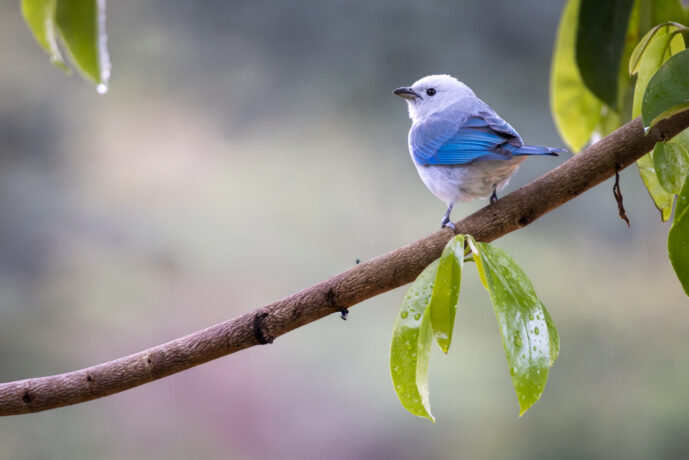
- Key Feature: Pale bluish-grey body plumage with distinctively brighter cerulean blue wing and tail edges
- Primary Diet: Omnivore (Primarily Frugivorous and Insectivorous)
- Range: Southern Mexico to Northeast Bolivia and Northern Brazil
- Habitat: Open woodlands, gardens, parks, and light secondary forest
- Social Structure: Social; typically found in pairs, small groups, or mixed-species flocks
- Nesting/Breeding: Cup nest built in the fork of a tree or dense shrubbery
- Conservation Status: Least Concern (LC)
- Population Trend: Increasing
The Blue-grey Tanager (*Thraupis episcopus*) is a vibrant and social songbird native to the tropical landscapes of Central and South America, easily recognized by its striking monochromatic palette. This elegant bird features a soft, pale bluish-grey body that contrasts beautifully with the deeper, cerulean tones of its wings and tail, which often display a subtle iridescent shimmer in the sunlight. Its scientific name, *episcopus*, refers to its "episcopal" plumage, which early naturalists thought resembled the traditional blue robes of a bishop. Highly adaptable and energetic, this tanager is a common sight in gardens and forest edges, where it flits restlessly in search of fruit and nectar, often traveling in pairs or small, lively groups. Its combination of bold coloration and confident, friendly demeanor makes it one of the most iconic and beloved avian residents of the Neotropics.
Habitats & Distribution
This species maintains an extensive geographical range stretching from central Mexico south through Central America and across much of northern South America, reaching as far as Peru, Bolivia, and the Amazon Basin in Brazil. It is also common on the islands of Trinidad and Tobago. Throughout this territory, it primarily occupies lowland areas, though it is occasionally found at elevations up to approximately 2,300 meters. It thrives in open and semi-open environments, generally avoiding the interior of dense, primary rainforests. Common habitats include forest edges, secondary-growth woodlands, and agricultural clearings. Highly adaptable to human-altered landscapes, it is frequently observed in suburban gardens, urban parks, and orchards, where it benefits from the availability of cultivated fruit and ornamental trees.
Behaviours & Reproduction
These highly social and restless birds are typically seen in pairs or small groups of up to ten individuals. They are active and noisy, frequently moving through the canopy or garden shrubbery in search of food. While they are not strictly territorial in a broad sense, they will defend the immediate area around their nest from intruders. They are socially monogamous, maintaining strong pair bonds that often last through multiple breeding seasons. Breeding occurs throughout the year, peaking with the arrival of the rainy season. The female primarily constructs the small, sturdy cup nest out of moss, rootlets, and fibers, usually concealing it well within dense foliage. A standard clutch consists of two whitish or pale-grey eggs speckled with brown. While the female handles the 14-day incubation period, both parents are dedicated to feeding the chicks a mixture of fruit and insects. Their ability to nest in human-altered landscapes, such as urban parks and plantations, is a key reproductive strategy that has contributed to their widespread success.
Diet
The Blue-grey Tanager is primarily a frugivorous bird, though it maintains an omnivorous diet by consuming a wide variety of wild and cultivated fruits alongside insects and nectar. It is frequently seen foraging in the mid-to-upper canopy for berries, figs, and papayas, and it plays a vital ecological role as a seed disperser within its tropical habitat. Interestingly, this species is highly opportunistic and well-adapted to human environments, often visiting garden feeders for bananas or oranges and even engaging in "hawking" to catch slow-flying insects in mid-air. To supplement its nutritional needs, it also gleans larvae and spiders from foliage, demonstrating a flexible foraging strategy that allows it to thrive in both dense forests and urban parks.
Colors
The Blue-grey Tanager is characterized by a uniform pale bluish-grey body, accented by vibrant cerulean or turquoise-blue edging on its wings and tail feathers. Many subspecies feature a distinct, brighter blue shoulder patch on the lesser wing coverts, while the underparts are typically a lighter, washed-out grey. This soft, monochromatic coloration serves as effective camouflage, allowing the bird to blend into the bright, sun-dappled sky and tropical canopy foliage.
Fun Facts
The Blue-grey Tanager is nicknamed the "Blue Jean" in some regions due to its denim-like hues, but its scientific name *episcopus* actually references the blue robes of a bishop. These birds are notoriously restless, rarely staying still for more than a few seconds as they constantly flick their tails and hop between branches. They are also known to engage in "anting," a behavior where they rub live ants onto their feathers to utilize formic acid as a natural pesticide and fungicide. Remarkably bold, they have successfully adapted to urban life, often becoming garden regulars that will fearlessly snatch fruit right off a patio table or join mixed-species flocks to lead the way to new food sources.