Brumback’s night monkeys (Douroucouli)
Aotus brumbacki
Quick Facts
- Scientific Name: Aotus brumbacki
- Family: Aotidae
- Known Nicknames: Brumback's Night Monkey, Douroucouli, Owl Monkey
- Average Length: 24–37 cm (9.4–14.6 in) head-body; 31–40 cm (12.2–15.7 in) tail
- Average Weight: 0.45–0.92 kg / 1.0–2.0 lb
- Wingspan: N/A
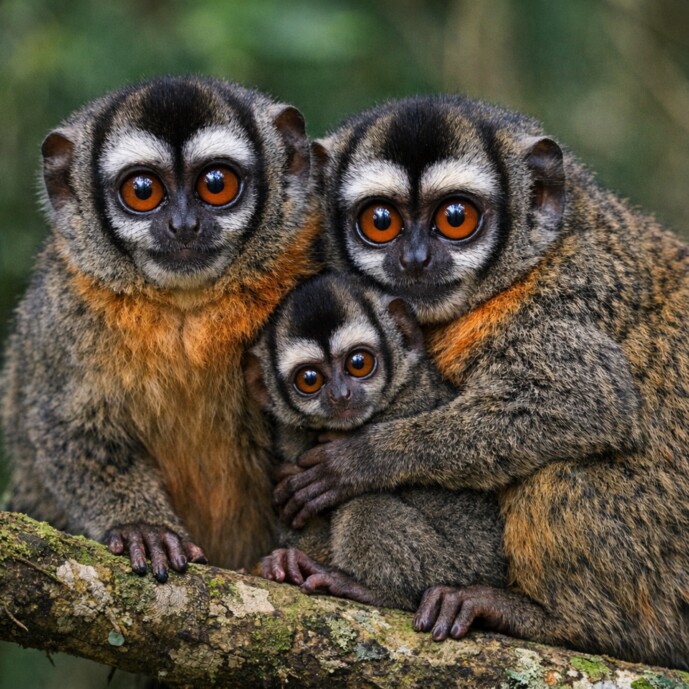
- Key Feature: Large nocturnal eyes and three distinct dark parallel stripes on the forehead
- Primary Diet: Primarily Frugivore (supplemented by leaves, nectar, and insects)
- Range: Eastern Colombia (Llanos region between the Arauca and Guaviare rivers)
- Habitat: Lowland tropical rainforest, gallery forests, and primary woodland
- Social Structure: Monogamous family groups (pair-bonded adults and their offspring)
- Nesting/Breeding: Tree hollows or dense vegetation in the upper canopy
- Conservation Status: Vulnerable (VU)
- Population Trend: Decreasing
Brumback's night monkey (*Aotus brumbacki*), also known as the Douroucouli, is a captivating nocturnal primate endemic to the tropical forests and Llanos region of Colombia. Distinguished by its remarkably large, amber-colored eyes designed for exceptional low-light navigation, this small monkey possesses a thick, woolly coat of greyish-brown fur with a pale underbelly and a characteristic dark, bushy tail. As one of the few truly nocturnal monkeys, it spends its nights foraging for fruits and insects while communicating through a series of complex vocalizations. Socially, these primates are renowned for their devoted monogamous pairings and extraordinary paternal care, with fathers taking the primary responsibility for carrying and protecting their offspring. Despite their elusive nature and unique adaptations, Brumback's night monkeys face significant threats from habitat fragmentation, making them a vulnerable yet vital component of South American biodiversity.
Habitats & Distribution
Found exclusively in Colombia, this primate inhabits the eastern slopes of the Andes and the adjacent lowland plains known as the Llanos. Its geographical range is concentrated within the departments of Meta, Arauca, Casanare, and Cundinamarca, typically occurring at elevations between 450 and 1,500 meters above sea level.
The species is primarily arboreal, occupying a variety of forested environments such as primary tropical lowland forests, secondary growth areas, and gallery forests along riverbanks. These habitats provide the dense canopy cover necessary for its nocturnal lifestyle, though it is increasingly forced to adapt to fragmented forest patches due to agricultural expansion and habitat loss within its limited range.
Behaviours & Reproduction
These nocturnal primates live in small, stable family groups centered around a monogamous breeding pair and their immature offspring. They are highly social and maintain strong pair bonds, frequently engaging in grooming and huddling together during their daytime rest periods. Territoriality is a key behavioral trait, as pairs actively defend their home range through loud vocalizations and scent marking to deter neighboring groups or solitary individuals.
Reproduction is characterized by a single birth per year following a gestation period of approximately 133 days. A unique and critical reproductive strategy is the extensive paternal care; the male carries the infant for the vast majority of the time, transferring it to the mother only for nursing. This heavy investment by the father allows the mother to recover more quickly from the energetic demands of lactation, ensuring the survival of the offspring within their specialized arboreal niche.
Diet
Brumback's night monkeys are primarily frugivorous, with their diet revolving around a wide variety of small, ripe fruits that provide the essential sugars and energy needed for their active nocturnal life. To balance their nutritional intake, they supplement these fruits with young leaves, flowers, and nectar, while also acting as opportunistic insectivores by hunting for moths, beetles, and other small invertebrates during the night. An intriguing aspect of their feeding behavior is their significant role in forest regeneration; as they travel through the canopy, they serve as vital seed dispersers for many tropical plant species. Interestingly, because they are active when most other primates are asleep, they occupy a unique ecological niche that minimizes direct competition for food, although they must still compete with other nocturnal foragers like bats and kinkajous. Their foraging strategy is highly efficient, relying on a keen sense of smell and large, light-sensitive eyes to identify the most nutrient-dense food sources in the darkness of the Colombian forests.
Colors
Brumback's night monkeys possess a dense, grayish-brown dorsal coat that transitions to pale orange or yellowish-tan underparts. Their most distinctive feature is a facial mask consisting of large white patches surrounding the eyes, separated by three dark vertical stripes on the forehead. This cryptic coloration, combined with their brownish-orange eyes, provides essential camouflage against the dappled light and shadows of the tropical forest canopy.
Fun Facts
Brumback's night monkeys are the only truly nocturnal monkeys, possessing massive, soulful eyes that lack the reflective layer found in most night-dwellers, forcing them to rely purely on oversized pupils to gather light. These primates are famously monogamous, but the real surprise is their "super-dad" dynamic; fathers perform nearly all the heavy lifting, carrying infants on their backs at all times except during nursing. To navigate their dark canopy homes, they practice "urine washing," where they soak their hands and feet in their own scent to leave a chemical trail for family members. They also communicate through deep, resonant hoots that sound remarkably like owls, and they possess a rare natural resistance to certain strains of malaria, a unique biological trait that distinguishes them from many other New World primates.