Cotton-top tamarin
Saguinus oedipus
Quick Facts
- Scientific Name: Saguinus oedipus
- Family: Callitrichidae
- Known Nicknames: Pinché tamarin, Liszt monkey
- Average Length: 21–26 cm / 8–10 in (Head-body); 33–41 cm / 13–16 in (Tail)
- Average Weight: 300–500 g / 11–18 oz
- Wingspan: N/A
- Key Feature: Long, flowing white sagittal crest of hair extending from the forehead to the nape
- Primary Diet: Omnivore (Primarily Frugivore and Insectivore)
- Range: Northwestern Colombia (between the Atrato and Magdalena Rivers)
- Habitat: Tropical Dry Forests and Lowland Wet Forests
- Social Structure: Highly Social (Cooperative breeding groups of 2–15 individuals)
- Nesting/Breeding: Arboreal (Young are carried on the backs of group members in the canopy)
- Conservation Status: Critically Endangered (CR)
- Population Trend: Decreasing
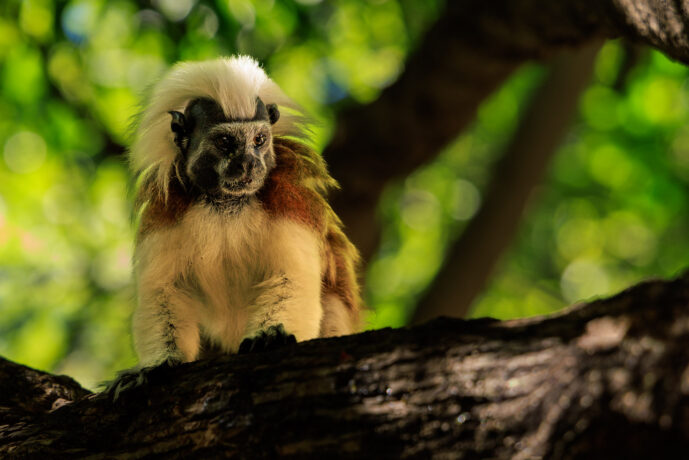
The Cotton-top tamarin (*Saguinus oedipus*) is a small, critically endangered New World monkey native to the tropical forests of northwestern Colombia, instantly recognizable by its spectacular fan of long, white hair that flows from its forehead to its shoulders like a miniature, wild mane. Weighing no more than a pound, this charismatic primate features a dark brown back, white underparts, and a long tail with a vibrant reddish-orange base. Beyond its striking "punk rock" appearance, the cotton-top is renowned for its sophisticated communication system, which includes over 38 distinct bird-like whistles and chirps used to coordinate group movements and signal alarms. These agile arboreal acrobats are also unique cooperative breeders, where entire family groups assist in carrying and caring for the young, making them one of the most socially intricate and visually captivating species in the primate world.
Habitats & Distribution
This species is endemic to a small region of northwestern Colombia, specifically bounded by the Atrato and Magdalena Rivers and extending north toward the Caribbean coast. Its extremely limited geographical range is confined to these lowland areas, making it one of the most geographically restricted primates in the world. It thrives in a variety of forest environments, ranging from humid tropical rainforests to seasonal dry deciduous forests. The species prefers secondary growth forests and areas with dense vine tangles, which provide both safety from predators and a rich supply of fruits and insects. As an arboreal animal, it spends the majority of its time in the middle and upper layers of the forest canopy.
Behaviours & Reproduction
These primates live in highly cohesive social groups governed by a cooperative breeding system where typically only a single dominant pair reproduces. To maintain this hierarchy, the dominant female suppresses the reproductive capabilities of subordinate females through a combination of behavioral dominance and pheromonal signals. This ensures that the group's collective energy is focused on the survival of the dominant pair's offspring, which almost always consist of non-identical twins. This reproductive strategy is highly intensive, requiring significant investment from all group members to ensure the infants reach maturity. Mating habits are primarily monogamous or polyandrous, with the father playing an exceptionally active role in child-rearing. Immediately following birth, the male takes over the primary responsibility of carrying the infants, a task shared by other subordinate "helpers" in the group. This alloparental care allows the mother to conserve energy for lactation, as the weight of the twins can represent a significant portion of her body mass. This collaborative effort not only increases infant survival rates but also provides younger members with the necessary experience to successfully raise their own young in the future.
Diet
The cotton-top tamarin is an omnivorous primate whose diet primarily consists of high-energy fruits and protein-rich insects. These small monkeys spend a significant portion of their day foraging in the forest canopy for ripe seasonal fruits, which provide the necessary sugars to sustain their high metabolic rates. In addition to fruit, they actively hunt for various invertebrates such as crickets, spiders, and snails, and occasionally consume small vertebrates like lizards or frogs. An interesting aspect of their dietary behavior is their role as vital seed dispersers; they swallow large seeds whole, which then pass through their digestive systems and are deposited throughout the forest, facilitating plant growth. Furthermore, during periods when fruit is scarce, cotton-top tamarins supplement their intake with plant exudates like gum and sap, as well as nectar from flowers, showcasing their adaptability to fluctuating environmental resources.
Colors
The cotton-top tamarin is defined by its signature long, white sagittal crest that flows from the forehead to the nape, contrasting with a dark, greyish face. Its back is covered in mottled brown fur that provides camouflage within the forest canopy, while the chest, belly, and limbs are a stark white or cream color. The tail features a distinct reddish-orange base that transitions into a dark brown or black tip.
Fun Facts
Cotton-top tamarins are famous for their wild, "punk-rock" white crests, which they puff up to appear larger and more intimidating when threatened. These tiny primates possess a remarkably complex communication system, using over 38 distinct bird-like whistles and chirps to convey specific messages about food or predators. They practice a unique social structure called cooperative breeding, where the entire group—not just the parents—carries and cares for the offspring, which are almost always born as twins. Additionally, they are highly territorial and use specialized scent glands on their chests to mark their jungle boundaries with a pungent, musk-like perfume.