Crimson-back Tanager
Ramphocelus dimidiatus
Quick Facts
- Scientific Name: Ramphocelus dimidiatus
- Family: Thraupidae
- Known Nicknames: Sangre de Toro, Crimson-backed Tanager
- Average Length: 16–18 cm / 6.3–7.1 in
- Average Weight: 23–31 g / 0.8–1.1 oz
- Wingspan: 23–26 cm / 9–10 in
- Key Feature: Vivid crimson-red plumage on the back and rump with a thick, silvery-white lower mandible
- Primary Diet: Omnivore (Primarily Frugivore and Insectivore)
- Range: Panama, Colombia, and Venezuela
- Habitat: Humid lowland forest edges, clearings, secondary growth, and gardens
- Social Structure: Social (Pairs or small family groups)
- Nesting/Breeding: Cup-shaped nest in dense shrubs or low trees
- Conservation Status: Least Concern (LC)
- Population Trend: Stable
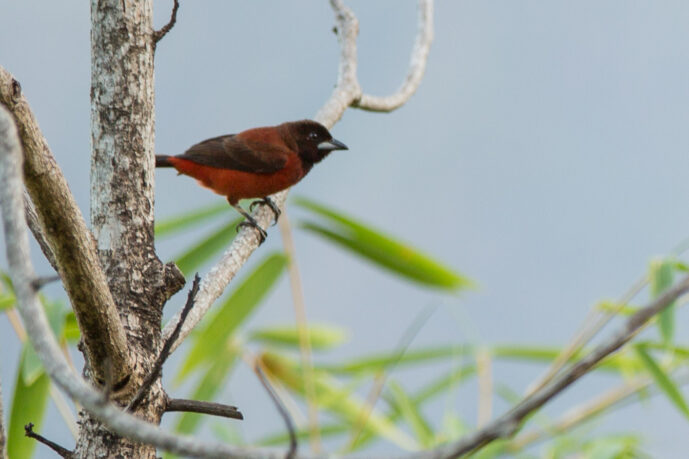
The Crimson-back Tanager (*Ramphocelus dimidiatus*) is a striking songbird native to the humid lowlands of Central and South America, renowned for its bold and velvety coloration. The male is a visual masterpiece, featuring deep, saturated crimson plumage on its back and underparts that contrasts sharply against its jet-black wings and tail. Its most distinctive characteristic, however, is its "silver" beak; the lower mandible possesses a brilliant, chalky-white sheen that appears to glow against its dark face, a feature much less pronounced in the more subtly brownish-red females. Highly social and energetic, these tanagers are often seen flitting through forest edges and gardens in small, lively groups, where their radiant feathers and luminous beaks make them a favorite sight for birdwatchers and a vital, vibrant presence in their tropical ecosystems.
Habitats & Distribution
This species is native to Central and South America, with a geographical range extending from Panama through northern and central Colombia into western Venezuela. It has also been successfully introduced to French Polynesia, particularly on the island of Tahiti. Within these regions, it is commonly found in tropical and subtropical lowland areas, maintaining a presence across both mainland and some coastal territories.
It primarily inhabits semi-open environments such as forest edges, second-growth forests, and shrubby clearings. Highly adaptable to human-altered landscapes, it is frequently observed in plantations, gardens, and urban parks. It tends to favor disturbed habitats and thickets over the dense, undisturbed interior of primary rainforests, often staying near water sources or moist lowland terrain.
Behaviours & Reproduction
These birds typically live in small, active groups of three to six individuals, often consisting of a breeding pair and their offspring from previous seasons. They are highly social and maintain a vocal presence while foraging through low-growth vegetation and forest edges. During the breeding season, males become markedly more territorial, using their vibrant plumage and persistent songs to defend nesting sites and attract mates, though they remain cooperative within their immediate family units.
Mating generally follows a monogamous pattern, where the female takes primary responsibility for constructing a compact, cup-shaped nest hidden in dense foliage. She typically lays a clutch of two pale blue eggs speckled with dark markings. While the female handles the incubation, both parents—and occasionally non-breeding members of the social group—participate in feeding and protecting the fledglings. This communal approach to chick-rearing is a key strategy that increases the survival rate of the young in competitive tropical environments.
Diet
The Crimson-backed Tanager is primarily a frugivore, consuming a diverse array of small fruits and berries from tropical plants such as those in the Melastomataceae family. While fruit makes up the bulk of its sustenance, this tanager is also an opportunistic insectivore, actively hunting for spiders, beetles, and ants among the foliage to meet its protein requirements. An interesting feature of its dietary habits is its high level of sociality during foraging; these birds often join mixed-species flocks to locate food more effectively and increase their safety from predators. Additionally, they have adapted well to human-altered landscapes and are known to be frequent visitors at garden bird feeders, where they show a particular fondness for bananas and papayas. By consuming whole fruits and dispersing the seeds throughout their territory, they serve as essential ecological contributors to forest regeneration.
Colors
The male Crimson-back Tanager features deep maroon plumage on its head and back, contrasting with a brilliant scarlet rump and belly, jet-black wings and tail, and a signature silvery-white lower mandible. In contrast, females exhibit duller, brownish-red tones that provide effective camouflage within dense tropical foliage. This sharp sexual dimorphism allows males to attract mates with vivid coloration while ensuring females remain concealed during nesting.
Fun Facts
The male’s lower beak features a striking, reflective silvery-white mandible that looks almost metallic against its velvety red plumage. These highly social birds often travel in boisterous family groups, where they engage in a "follow-the-leader" flight pattern through the undergrowth. During courtship, males perform a rhythmic bowing display specifically designed to flash their brilliant crimson rumps at potential mates. Additionally, they are clever opportunists that frequently follow army ant swarms to feast on the insects and small invertebrates displaced by the marching colony.