Crimson-crested Woodpecker
Campephilus melanoleucos
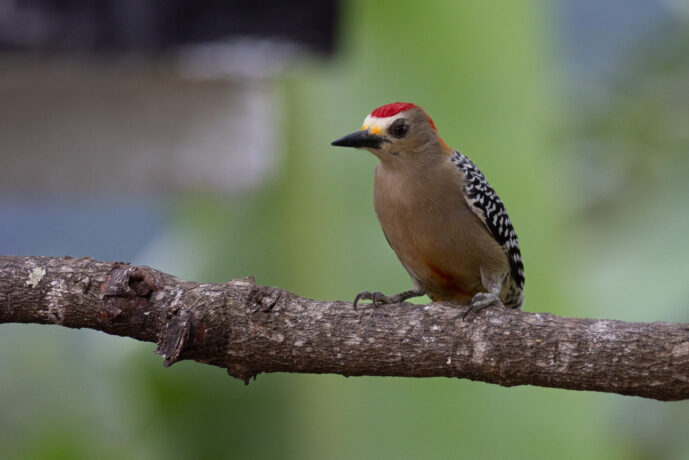
Quick Facts
- Scientific Name: Campephilus melanoleucos
- Family: Picidae
- Known Nicknames: Lineated Woodpecker (often confused with), Carpintero real
- Average Length: 33–38 cm / 13–15 in
- Average Weight: 180–285 g / 6.3–10.1 oz
- Wingspan: 45–60 cm / 18–24 in
- Key Feature: Prominent scarlet-red crest and a white 'V' pattern on the black back
- Primary Diet: Insectivore (primarily wood-boring larvae and ants)
- Range: Panama and South America east of the Andes to northern Argentina and Trinidad
- Habitat: Humid lowland forests, deciduous forests, and forest edges
- Social Structure: Solitary or in pairs
- Nesting/Breeding: Self-excavated tree cavities in dead wood
- Conservation Status: Least Concern (LC)
- Population Trend: Stable
The Crimson-crested Woodpecker (*Campephilus melanoleucos*) is a striking, large-bodied bird that serves as a vibrant icon of the tropical forests of South America and Panama. Immediately recognizable by its magnificent, pointed scarlet crest, the species displays subtle sexual dimorphism: while the male boasts an entirely red head, the female is distinguished by a bold black-and-white stripe extending across her cheek. Their plumage is predominantly charcoal-black, dramatically offset by a clean white "V" shape on the back and elegant white stripes tracing down the neck. As a member of the same genus as the legendary Ivory-billed Woodpecker, it is famous for its powerful "double-tap" drumming—a resonant, percussive signature that echoes through the canopy. Equipped with a sturdy, chisel-like bill and a specialized long tongue, this formidable avian architect expertly excavates decaying wood to hunt for larvae, playing a vital role in its ecosystem by creating nesting cavities for various other forest dwellers.
Habitats & Distribution
This species thrives primarily in humid lowland forests, terra firme, and gallery forests, though it is also frequently found in tall secondary growth and along forest edges. It shows a strong preference for environments with an abundance of large, decaying trees, which are essential for its nesting and foraging activities. Additionally, it can inhabit mangroves and occasionally ventures into more open woodland or shaded plantations. Geographically, its range extends across much of South America, primarily east of the Andes, and reaches northward into Panama. It is widely distributed throughout the Amazon Basin and the Guianas, spanning countries such as Colombia, Venezuela, Brazil, Ecuador, Peru, Bolivia, and Paraguay, with its southernmost reaches extending into northern Argentina.
Behaviours & Reproduction
These woodpeckers are typically observed in pairs or small family units, maintaining a monogamous social structure. They are highly territorial, utilizing a signature "double-tap" drumming pattern—a trait characteristic of their genus—to communicate and defend their range. This auditory signaling is often accompanied by vocalizations and rhythmic head-swaying displays during social encounters or territorial disputes. Reproduction involves the cooperative excavation of a nesting cavity, usually carved into a tall, dead tree trunk by both the male and female. The female typically lays two to three eggs, which both parents take turns incubating during the day, though the male often remains in the nest throughout the night. Once hatched, the altricial chicks are cared for by both adults, who provide a diet rich in wood-boring larvae until the young are ready to fledge and eventually forage independently.
Diet
The Crimson-crested Woodpecker is primarily an insectivore, specializing in a diet composed largely of wood-boring beetle larvae, ants, and termites found deep within the trunks of decaying trees. Using its exceptionally strong, chisel-like beak, it performs powerful excavations into hard wood to reach prey that other birds cannot access, often stripping away large sections of bark in the process. An interesting aspect of its feeding strategy is the use of its long, barbed tongue, which is coated in sticky saliva to extract insects from narrow crevices and tunnels. While its primary focus remains on invertebrates, this species is known to supplement its protein-heavy diet with occasional berries and small fruits, demonstrating a degree of dietary flexibility depending on seasonal availability. Its foraging behavior plays a crucial role in its ecosystem by controlling wood-boring pest populations and creating cavities that serve as habitats for various other forest-dwelling species.
Colors
The Crimson-crested Woodpecker is defined by its vibrant red crest and black upperparts marked with a prominent white "V" on the back. Its underparts are buff with dense black horizontal barring that provides camouflage against tree bark, while a bold white stripe accents the face. Males are distinguished by a small red patch at the base of the bill, completing a high-contrast plumage that disrupts the bird's silhouette within the forest canopy.
Fun Facts
Known for its signature "double-knock" display, this woodpecker delivers two rapid-fire strikes that echo through the forest to signal its territory. To survive such high-impact hammering, it possesses a specialized hyoid bone that wraps entirely around its skull, acting as a biological shock absorber. Beyond its drumming, this species uses a long, barbed tongue coated in sticky saliva to "fish" for beetle larvae deep inside tree trunks. Its large, rectangular nesting cavities are so well-constructed that they frequently become high-demand real estate for other forest dwellers, such as owls and parrots, once the woodpecker moves on.