Damon Variegatus
Damon variegatus
Quick Facts
- Scientific Name: Damon variegatus
- Family: Phrynichidae
- Known Nicknames: Tanzanian Giant Tailless Whip Scorpion, Tailless Whip Scorpion, Whip Spider
- Average Length: Body: 2.8–4.5 cm (1.1–1.8 in); Leg span: up to 20 cm (8 in)
- Average Weight: 2–8 g (0.07–0.28 oz)
- Wingspan: N/A
- Key Feature: Extremely long, whip-like antenniform legs and spiny raptorial pedipalps
- Primary Diet: Insectivore (Primarily nocturnal insects and small arthropods)
- Range: East Africa, including Tanzania, Kenya, and Uganda
- Habitat: Humid tropical forests, caves, rock crevices, and under tree bark
- Social Structure: Solitary
- Nesting/Breeding: Females carry egg sacs on the underside of their abdomen
- Conservation Status: Not Evaluated (NE)
- Population Trend: Data Deficient
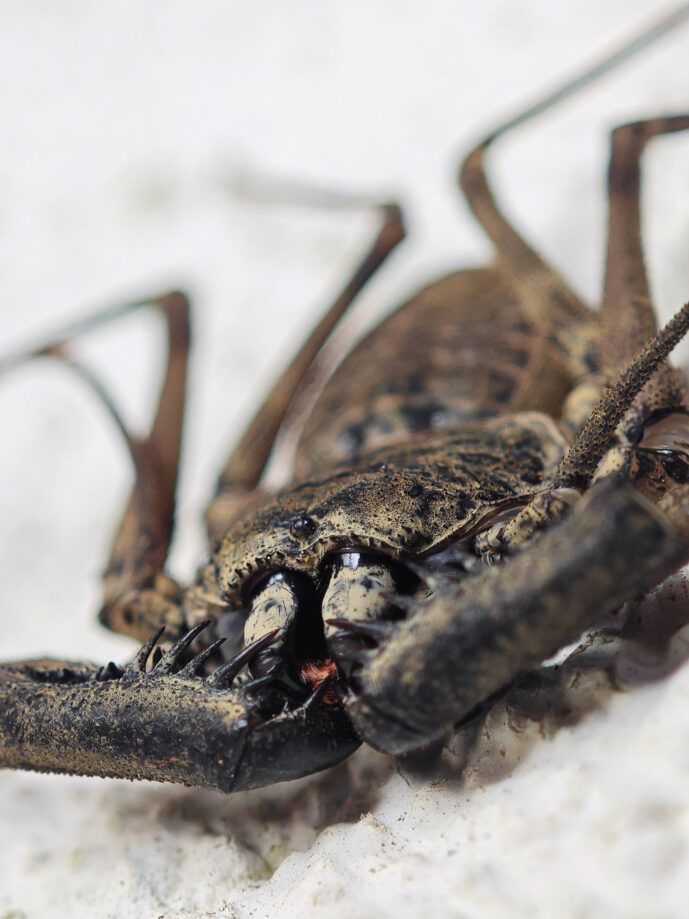
*Damon variegatus*, commonly known as the Tanzanian Giant Tailless Whip Scorpion, is a prehistoric-looking arachnid that belongs to the unique order Amblypygi. Despite its fearsome appearance, characterized by a heavily flattened, disc-like body and formidable spiny pedipalps used for grasping prey, this creature is entirely non-venomous and harmless to humans. Its most extraordinary feature is its first pair of legs, which have evolved into incredibly long, whip-like sensory organs that can stretch several times its body length, allowing it to "feel" and navigate dark crevices in its native African habitats. Dressed in mottled shades of grey and brown for perfect camouflage, *Damon variegatus* is a master of the night, combining a delicate touch with a specialized anatomy that has remained largely unchanged for millions of years.
Habitats & Distribution
This species is primarily distributed across East Africa, with its range centered in Tanzania and Kenya, extending into parts of Ethiopia and Somalia. It thrives in diverse tropical and subtropical landscapes, ranging from coastal lowlands to higher altitude forests, provided the environment maintains sufficient humidity and adequate cover. Within these regions, it inhabits dark, secluded micro-habitats such as deep rock crevices, caves, and the undersides of fallen logs or loose tree bark. Its flattened body is an evolutionary adaptation that allows it to navigate narrow fissures where it remains protected from predators and desiccation during the day, emerging only at night to hunt within its humid, shaded environment.
Behaviours & Reproduction
These arachnids are primarily nocturnal and exhibit a surprisingly non-aggressive social structure, often tolerating the presence of conspecifics in communal hiding spots. Their mating ritual is a sophisticated process involving an elaborate courtship dance where the male uses his elongated antenniform legs to gently stroke and guide the female. This interaction culminates in the male depositing a spermatophore on the substrate, which the female then picks up to fertilize her eggs internally. Reproduction is characterized by significant maternal investment, as the female carries her eggs in a protective ventral sac beneath her abdomen. Once the young hatch, they immediately migrate to the mother's back, clinging to her for several weeks until their first molt. This specialized parental care provides the vulnerable offspring with protection from predators and environmental stressors during their most fragile life stage, a strategy that distinguishes them from many other solitary arachnids.
Diet
Damon variegatus, commonly known as the Tanzanian giant tailless whip scorpion, is a nocturnal generalist predator that primarily feeds on a variety of small invertebrates, including crickets, cockroaches, moths, and spiders. Instead of using venom, these arachnids rely on their specialized, elongated antenniform legs to sense the vibrations and chemical signatures of prey, allowing them to hunt effectively in complete darkness. Once a target is detected, they use their powerful, spined raptorial pedipalps to snatch and securely hold the victim while their chelicerae macerate the food. An intriguing aspect of their dietary behavior is the use of extra-oral digestion, where they secrete enzymes to liquefy the internal tissues of their prey before sucking up the nutrient-rich fluid. Additionally, their remarkably low metabolic rate enables them to survive for extended periods without food, although they are known to occasionally exhibit cannibalistic tendencies, particularly toward smaller individuals when resources are scarce.
Colors
*Damon variegatus* features a flattened body with a mottled, variegated pattern of earthy browns, grays, and charcoal blacks that mimic lichen or bark. Its long, spindly legs are marked with distinct alternating light and dark bands, providing effective disruptive coloration. This somber, blotchy palette serves as essential camouflage, allowing the arachnid to blend seamlessly into the shadows of rocky crevices and tree trunks.
Fun Facts
These arachnids are masters of tactile navigation, using a specialized pair of ultra-long, whip-like legs that can rotate 360 degrees to "see" their surroundings through touch in total darkness. Despite their fearsome appearance, they are entirely non-venomous and exhibit surprisingly social behaviors, such as mothers using their long whips to tenderly caress and communicate with their young. When they need to move quickly, they display a quirky, crab-like sideways gait and can snatch prey with lightning-fast, spiny pedipalps that snap shut in milliseconds.