Dobsonfly
Corydalus cornutus
Quick Facts
- Scientific Name: Corydalus cornutus
- Family: Corydalidae
- Known Nicknames: Hellgrammite (larval stage), Kingbug, Go-devil
- Average Length: Up to 12.5 cm / 5 in
- Average Weight: Approx. 1–2 g / 0.035–0.07 oz
- Wingspan: 12.5–18 cm / 5–7 in
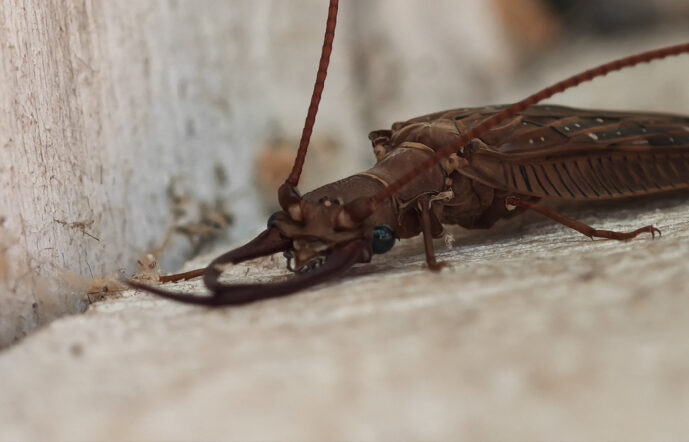
- Key Feature: Elongated, sickle-shaped mandibles in males; large, veined wings
- Primary Diet: Adults: Non-feeding or nectar; Larvae: Generalist carnivore (aquatic insects)
- Range: Eastern and Central North America
- Habitat: Clean, fast-flowing freshwater streams and rivers with rocky substrates
- Social Structure: Solitary
- Nesting/Breeding: Rocks, logs, or overhanging vegetation near water
- Conservation Status: Not Evaluated (NE)
- Population Trend: Stable
The Eastern Dobsonfly (*Corydalus cornutus*) is a striking, prehistoric-looking insect famous for its impressive size and dramatic sexual dimorphism. Reaching up to five inches in length, these nocturnal giants possess two pairs of intricately veined, smoky-translucent wings and long, segmented antennae. The most startling feature belongs to the males, who sport massive, sickle-shaped mandibles that resemble tusks; while these look menacing, they are primarily used for ritualized wrestling and grasping females during mating rather than biting. In contrast, females possess shorter, more powerful mandibles capable of delivering a painful pinch if handled. Before emerging as adults for a brief summer flight, they spend years as "hellgrammites," formidable aquatic larvae that act as top predators in freshwater streams and are highly prized by anglers as elite fishing bait.
Habitats & Distribution
These insects are widely distributed across eastern North America, spanning from southern Canada and the Atlantic coast westward to the Great Plains and south to the Gulf of Mexico. Their presence is heavily dependent on the availability of clean, permanent freshwater sources. The larvae, known as hellgrammites, are found exclusively in aquatic environments, specifically favoring the well-oxygenated, fast-moving waters of rocky streams and rivers where they can hide beneath stones in riffle areas. The terrestrial adults typically inhabit the dense vegetation and riparian zones immediately surrounding these same waterways. While they are capable of flight, they rarely venture far from the aquatic habitats necessary for their reproduction. They are primarily nocturnal and are often encountered on foliage or near artificial lights in wooded areas adjacent to healthy river systems.
Behaviours & Reproduction
Primarily nocturnal and solitary, these insects spend their brief adult lives near oxygen-rich waterways. The most striking behavioral feature is the male's elongated, sickle-shaped mandibles, which are used as specialized tools for ritualized combat and mating rather than feeding. During courtship, a male utilizes these tusks to spar with competitors or to gently grasp a female’s wings, positioning her for copulation. While the males appear more intimidating, it is the females who possess shorter, more powerful mandibles capable of delivering a painful defensive bite. Reproduction is a rapid process, as adults typically survive for only about a week. Following a successful mating encounter, the female seeks out rocks or vegetation overhanging a stream to deposit her eggs in large, chalky white clusters. This placement is a vital reproductive strategy; upon hatching, the larvae—known as hellgrammites—drop directly into the water. They then spend several years as formidable aquatic predators before emerging to undergo their final transformation into winged adults.
Diet
The dobsonfly exhibits a dramatic shift in nutritional habits throughout its life cycle, characterized by a voracious larval stage and a largely non-feeding adult stage. As larvae, known as hellgrammites, they are formidable sit-and-wait predators in freshwater ecosystems, using their powerful, sharp mandibles to consume a variety of aquatic organisms including mayflies, caddisflies, stoneflies, and even small fish or crustaceans. An interesting aspect of their biology is that while the larvae are top-tier invertebrate hunters for several years, the adult dobsonflies typically do not eat at all during their brief existence, which lasts only a few days to a week. Although adult males possess massive, sickle-shaped mandibles that appear intimidating, these are used exclusively for male-to-male combat and mating rituals rather than feeding, as the adults lack the functional musculature to bite or process solid food effectively.
Colors
The Eastern Dobsonfly exhibits a dull, grayish-brown or tan body with large, translucent wings marked by a complex network of dark veins and small, scattered white spots. This mottled, neutral coloration serves as effective camouflage, allowing the insect to blend seamlessly into tree bark and rocky riverbanks. Its somber, smoky-gray appearance is consistent across its head and prominent mandibles, ensuring it remains inconspicuous within its shaded riparian environment.
Fun Facts
Despite their terrifying appearance, the massive, sickle-shaped mandibles of the male dobsonfly are purely for show and lack the leverage to deliver a painful bite; instead, they are used like grappling hooks to spar with rivals and secure mates. In contrast, the much smaller mandibles of the female are deceptively powerful and can easily draw blood if handled. These insects spend up to three years as predatory aquatic larvae known as "hellgrammites"—formidable hunters that are highly prized by anglers as bait—only to emerge as winged adults that live for just a few days, often without eating at all. Furthermore, their presence in a stream is a badge of honor for the local ecosystem, as they are sensitive bioindicators that thrive only in high-quality, well-oxygenated water.