American Flamingo
Phoenicopterus ruber
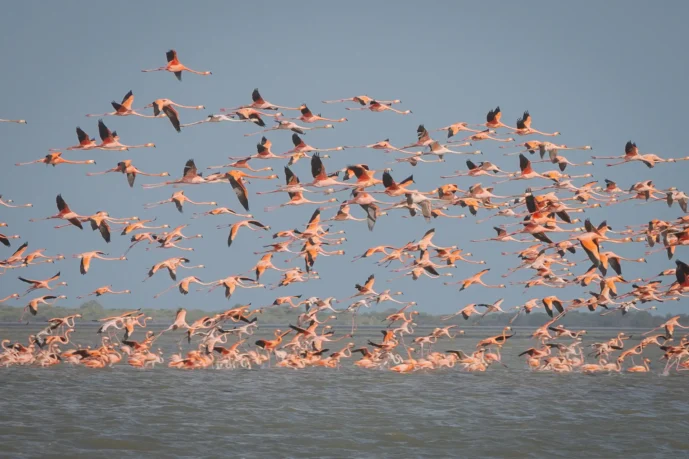
Quick Facts
- Scientific Name: Phoenicopterus ruber
- Family: Phoenicopteridae
- Known Nicknames: Caribbean Flamingo, Rosy Flamingo
- Average Length: 120–145 cm / 47–57 in
- Average Weight: 2.2–2.8 kg / 4.8–6.2 lb
- Wingspan: 140–165 cm / 55–65 in
- Key Feature: Vibrant pink-to-red plumage and long, slender neck and legs
- Primary Diet: Omnivore (Filter feeder: algae, small crustaceans, and mollusks)
- Range: Caribbean, Galapagos Islands, northern South America, and southern Florida
- Habitat: Saline lagoons, mudflats, and shallow brackish coastal waters
- Social Structure: Highly Social (Large Colonies)
- Nesting/Breeding: Mound-shaped mud nests in shallow water
- Conservation Status: Least Concern (LC)
- Population Trend: Increasing
The American Flamingo (*Phoenicopterus ruber*) is a stunning wading bird renowned for its vibrant reddish-pink plumage, which is the most intense of any flamingo species. This brilliant coloration is not innate but is acquired from carotenoid pigments found in its specialized diet of brine shrimp and algae. Standing up to five feet tall on spindly, stilt-like legs, this bird features a remarkably long, flexible neck and a unique, downward-curving beak equipped with hair-like filters to strain food from salty or alkaline lagoons. Beyond their striking appearance, American Flamingos are famous for their ability to balance effortlessly on a single leg—a behavior thought to conserve body heat—and for their highly social nature, often congregating in massive, synchronized colonies that create a spectacular display of tropical elegance.
Habitats & Distribution
This species is primarily distributed throughout the Caribbean, including the Bahamas, Cuba, and Hispaniola, as well as along the northern coast of South America in countries like Venezuela and Colombia. It also maintains a significant population on the Galápagos Islands and the Yucatán Peninsula of Mexico. While they were historically more common in southern Florida, current sightings in the United States are often considered occasional visitors or wanderers from Caribbean colonies. Their preferred habitats consist of shallow, saline, or alkaline environments such as coastal lagoons, mudflats, and inland salt pans. These birds favor hypersaline waters where few other species can survive, as these conditions support the growth of their primary food sources like brine shrimp and blue-green algae. They require expansive, open areas for nesting, typically constructing mud mounds in these remote wetlands to protect their eggs from rising water levels.
Behaviours & Reproduction
Highly gregarious, these birds thrive in large, dense colonies that can number in the thousands, providing protection and facilitating synchronized breeding. Mating begins with elaborate, communal displays where groups perform ritualized movements such as "head-flagging," "wing-saluting," and synchronized marching to stimulate hormones and establish pair bonds. Although they are primarily monogamous during a single breeding season, these pairs are reinforced through these coordinated group performances, ensuring that the majority of the colony is ready to nest simultaneously. Once paired, both individuals participate in constructing a pillar-like mound of mud, topped with a small depression to protect their single egg from flooding and intense ground heat. Both parents share incubation duties and later cooperate in feeding the chick a specialized, nutrient-rich "crop milk" secreted from their upper digestive tracts. This unique reproductive strategy allows the young to grow rapidly until they are old enough to join "crèches," large nurseries where hundreds of chicks are communalized and guarded by a few adults while the parents forage.
Diet
The American Flamingo is primarily an omnivorous filter feeder that consumes a variety of microscopic organisms, including blue-green algae, diatoms, small seeds, mollusks, crustaceans, and insect larvae. To feed, these birds submerge their heads upside down and use their specialized, hook-shaped beaks to pump water through comb-like structures called lamellae, which trap nutrients while expelling excess water and silt. One of the most fascinating aspects of their diet is the presence of carotenoid pigments found in their preferred food sources, such as brine shrimp and certain algae. These organic chemicals are processed by the flamingo's liver and deposited into their feathers, skin, and fat, creating the iconic vibrant pink and orange plumage for which the species is famous; without a diet rich in these pigments, their feathers would eventually fade to a dull white or grey.
Colors
The American Flamingo displays vibrant reddish-pink or salmon plumage, a hue derived from carotenoid pigments in its diet of algae and crustaceans. While its body is largely uniform in color, it features distinct black primary and secondary flight feathers visible during flight, as well as a pale bill with a prominent black tip. This bold coloration lacks traditional camouflage, functioning instead as a social signal of health and maturity for mating purposes.
Fun Facts
These vibrant birds owe their iconic pink color to carotenoid pigments found in their diet of brine shrimp and blue-green algae; without these, their feathers would eventually turn white. To feed, they submerge their heads and use specialized lamellae in their bills to filter-feed upside down, a rare technique among birds. They are famous for standing on one leg to conserve body heat, and the prominent joint in the middle of their long legs is actually an ankle, while their true knee is hidden close to the body. Both males and females produce a nutrient-rich "crop milk" to feed their chicks, a unique physiological adaptation that allows them to raise young in harsh, salty environments where other food sources are scarce.