Giant Hooded Katydid
Siliquofera grandis
Quick Facts
- Scientific Name: Siliquofera grandis
- Family: Tettigoniidae
- Known Nicknames: New Guinea Giant Katydid, Giant Katydid
- Average Length: 10–13 cm / 4–5 in
- Average Weight: 20–30 g / 0.7–1.1 oz
- Wingspan: 20–25 cm / 8–10 in
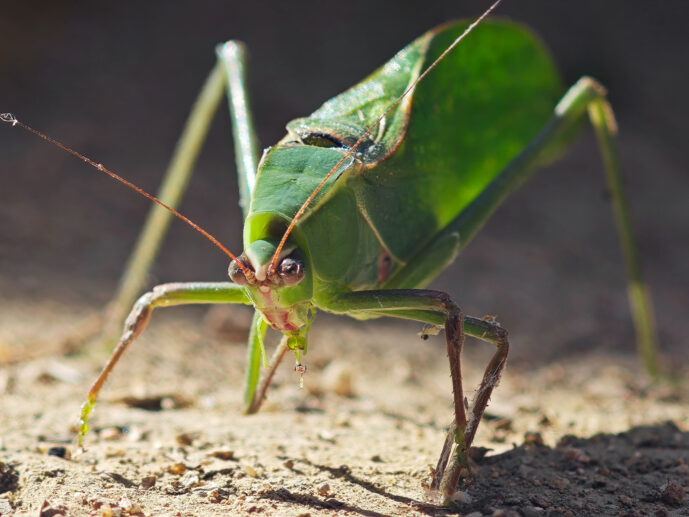
- Key Feature: Large leaf-like pronotum forming a 'hood' over the head and thorax
- Primary Diet: Herbivore (Primarily Folivore)
- Range: New Guinea, Aru Islands, and Cape York Peninsula (Australia)
- Habitat: Tropical Rainforest Canopy
- Social Structure: Solitary
- Nesting/Breeding: Soil or soft plant tissue
- Conservation Status: Not Evaluated (NE)
- Population Trend: Stable
The Giant Hooded Katydid (*Siliquofera grandis*) is a true titan of the insect world, renowned as one of the largest and most visually striking members of the Tettigoniidae family. Native to the tropical rainforests of New Guinea and its surrounding islands, this magnificent orthopteran is instantly recognizable by its massive, leaf-like pronotal shield that arches over its body like a protective green hood, providing near-perfect camouflage against the lush canopy. Reaching impressive lengths with a wingspan that can exceed twenty-five centimeters, it features broad, intricately veined wings that mimic the texture and color of foliage to evade predators. Beyond its sheer size and masterclass in mimicry, the Giant Hooded Katydid is famous for its thunderous stridulation; by rubbing its wings together, it produces a startlingly loud, rhythmic sound used to communicate across the dense jungle, making it as acoustically formidable as it is visually impressive.
Habitats & Distribution
This species is native to the tropical regions of the Indo-Australian Archipelago, with its primary range spanning the island of New Guinea and the neighboring Aru Islands. It is also found in the northernmost parts of Australia, specifically within the dense, humid environments of the Cape York Peninsula in Queensland. It exclusively inhabits tropical rainforests and lowland jungles characterized by high humidity and lush vegetation. As a strictly arboreal insect, it spends the majority of its life high within the forest canopy, where its specialized morphology allows it to blend seamlessly among the broad leaves of the treetops.
Behaviours & Reproduction
These insects are primarily nocturnal and solitary, relying on their massive, leaf-like pronotums for camouflage within the rainforest canopy. To communicate over long distances, males engage in stridulation, rubbing their wings together to produce exceptionally loud, high-frequency calls that attract potential mates. When threatened, they may employ deimatic displays, fluttering their wings or emitting sharp clicking sounds to startle and deter predators. Reproduction involves the male transferring a nutrient-rich spermatophore to the female, which serves as both a sperm packet and a vital food gift. Following fertilization, the female uses her elongated, sword-like ovipositor to deposit eggs into the soil or soft plant tissue. The young emerge as nymphs and undergo incomplete metamorphosis, gradually developing their distinctive hooded appearance and large body size through a series of molts.
Diet
The Giant Hooded Katydid is primarily a herbivore that subsists on a diverse range of tropical vegetation found within the rainforests of New Guinea and surrounding islands. Its diet consists mostly of leaves, flowers, and various types of foliage, which it processes using exceptionally large and powerful mandibles capable of slicing through tough, fibrous plant matter. Interestingly, while they are predominantly phytophagous, these insects are known to be opportunistic feeders and may occasionally supplement their diet with small insects or other protein sources to meet their nutritional needs. Because of their massive size—often exceeding 13 centimeters in length—they must consume significant quantities of plant material, and their feeding is sometimes audible as a distinct crunching sound. Their specialized mouthparts are so strong that they can easily chew through dense vegetation that other smaller insects might find impenetrable, making them efficient consumers within the forest canopy.
Colors
The Giant Hooded Katydid is predominantly a vibrant, leaf-like green, featuring intricate wing venation that mimics the vascular patterns of tropical foliage. Its most distinctive feature is an oversized, flattened pronotum that forms a broad "hood" over the head, often detailed with subtle dark speckles or yellowish margins to enhance its camouflage. This specialized coloration and structural mimicry allow the insect to blend seamlessly into the canopy, appearing nearly identical to a living leaf to evade predators.
Fun Facts
These massive insects are master mimics, using an oversized, leaf-like pronotal shield to blend seamlessly into the rainforest canopy. When threatened, they engage in a startling defense behavior called a deimatic display, where they suddenly flare their wings to reveal hidden patterns or raise their spiny front legs to appear more formidable. Remarkably, their "hood" acts like a protective suit of armor, and despite their heavy build, they are capable of producing an incredibly piercing, metallic song by rubbing their wings together, a sound that can dominate the nocturnal soundscape of their native New Guinea.