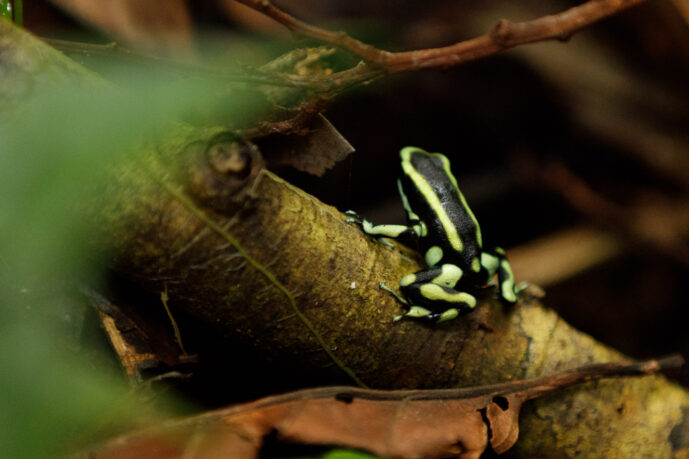
Green-and-black poison dart frog
Dendrobates auratus
Quick Facts
- Scientific Name: Dendrobates auratus
- Family: Dendrobatidae
- Known Nicknames: Green-and-black poison frog, Mint poison frog
- Average Length: 2.5–4.2 cm / 1.0–1.65 in
- Average Weight: 2–4 g / 0.07–0.14 oz
- Wingspan: N/A
- Key Feature: Vivid mint-green to bright-green patterns on a dark black or brown background
- Primary Diet: Insectivore (primarily ants, termites, and tiny beetles)
- Range: Central America (Southeastern Nicaragua to Northwestern Colombia), introduced to Hawaii (Oahu)
- Habitat: Humid lowland tropical rainforest floor and leaf litter
- Social Structure: Solitary; males are highly territorial during breeding
- Nesting/Breeding: Eggs laid in leaf litter; tadpoles transported to water-filled bromeliads or tree cavities
- Conservation Status: Least Concern (LC)
- Population Trend: Stable
The Green-and-black poison dart frog (*Dendrobates auratus*) is a small but visually stunning amphibian native to the humid rainforests of Central and South America. Renowned for its bold aposematic coloration, this frog typically displays a vibrant mosaic of mint-green or neon-lime patches set against a deep black background, a striking pattern that serves as a high-contrast warning to potential predators. Its most remarkable feature is its potent toxicity; in the wild, these frogs sequester lethal alkaloids from a specialized diet of ants and mites, making their skin dangerous to touch or ingest. Beyond their chemical defenses, they are known for their complex social behaviors and dedicated parental care, with males often carrying newly hatched tadpoles on their backs to water-filled bromeliads. Despite their diminutive size, these diurnal creatures are highly active and charismatic, standing out as one of nature’s most beautiful yet formidable examples of survival through specialized adaptation.
Habitats & Distribution
This species is native to the humid tropical forests of Central America, with a geographical range extending from southeastern Nicaragua through Costa Rica and Panama into northwestern Colombia. It has also been successfully introduced to the island of Oahu in Hawaii. Within these territories, it is primarily found in lowland rainforests and premontane forests, where it thrives in the moist environments provided by the forest floor's leaf litter. Its preferred habitats are characterized by high humidity, stable temperatures, and proximity to small streams or stagnant water sources. Although largely terrestrial, it displays semi-arboreal behavior, frequently climbing trees to reach water-filled bromeliads and other epiphytes used for larval development. It is most common in undisturbed primary forests but can also be found in secondary growth areas and plantations that provide sufficient shade and moisture.
Behaviours & Reproduction
Primarily diurnal and territorial, these frogs exhibit a social structure where males use buzzing vocalizations to defend their space and attract mates. Courtship is an active process often initiated by the female, who may follow or stroke a chosen male to signal her readiness. After a pair bonds, the female lays her eggs in moist leaf litter on the forest floor. The male then assumes a dedicated parental role, guarding the clutch and periodically shedding water over the eggs to keep them hydrated until they hatch. Once the tadpoles emerge, the male carries them individually on his back, navigating the terrain to deposit them into small pools of water found in tree holes or the leaf axils of bromeliads. This unique strategy of transporting offspring to elevated, isolated nurseries protects the larvae from the predators found in larger bodies of water. While generally solitary, their social interactions are defined by these complex mating rituals and the intense competition between females for the most attentive male caregivers.
Diet
The green-and-black poison dart frog is primarily an insectivore that consumes a specialized diet consisting of small invertebrates such as ants, mites, beetles, and termites. Utilizing their keen eyesight to track movement, these frogs capture prey with their long, sticky tongues. A fascinating aspect of their nutrition is the direct link between their diet and their chemical defenses; the potent alkaloids that make the frog toxic are sequestered from the specific types of ants and mites they ingest in the wild. Consequently, individuals raised in captivity or fed a diet lacking these specific insects, such as flightless fruit flies and pinhead crickets, eventually lose their toxicity, demonstrating that their lethal nature is an acquired trait rather than an innate biological function.
Colors
The green-and-black poison dart frog displays a striking contrast of vibrant mint, lime, or turquoise markings against a jet-black or dark brown background. These patterns manifest as irregular swirls, blotches, or bands, serving as aposematic coloration to warn predators of its potent toxicity. Unlike many amphibians, its bold aesthetic functions as a high-visibility deterrent rather than camouflage.
Fun Facts
These vibrant amphibians are famous for their "toxic diet," as they sequester potent alkaloids from the ants and mites they consume to become poisonous to predators. Unlike many of their nocturnal relatives, they are strictly diurnal and possess exceptional color vision, which they use to navigate complex social interactions. Their most remarkable behavior is their dedicated parental care; after eggs hatch on the forest floor, the father allows the tadpoles to wiggle onto his back, painstakingly carrying them high into the rainforest canopy to deposit them into individual water-filled bromeliads. While their name suggests a specific color scheme, their appearance is actually highly variable across different regions, with some populations sporting brilliant shades of neon blue, yellow, or even forest white instead of green.