Imperious Sawyer Beetle
Monochamus imperialis
Quick Facts
- Scientific Name: Monochamus imperialis
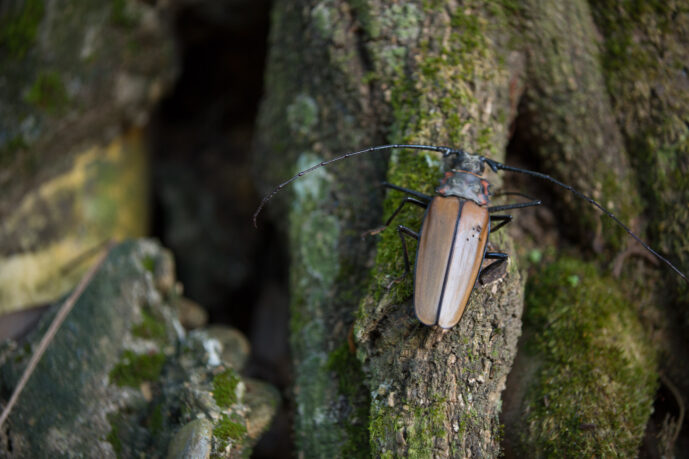
The Imperious Sawyer Beetle (*Monochamus imperialis*) is a majestic member of the longhorn beetle family, distinguished by its imposing stature and remarkably elongated antennae that can reach several times the length of its body. Adorned in a sophisticated coat of velvety black punctuated by striking creamy-yellow or golden markings, this beetle is a visual marvel found primarily in the high-altitude forests of the Himalayas and Southeast Asia. As a "sawyer," it possesses powerful mandibles designed for navigating woody terrain, while its exceptionally sensitive antennae serve as high-tech sensory arrays for detecting pheromones and suitable host trees. Beyond its regal appearance, the Imperious Sawyer plays a vital ecological role in nutrient cycling, as its larvae act as natural decomposers by boring into fallen timber, making it both a formidable presence and an essential architect of its woodland habitat.
Habitats & Distribution
This species is primarily distributed across Southeast Asia, with a geographical range that encompasses countries such as Myanmar, Thailand, Laos, and Vietnam, as well as southern regions of China. It is most frequently encountered in high-altitude environments, particularly within the mountainous or hilly forests that characterize these regions. Its habitat typically consists of dense coniferous and mixed-broadleaf forests where suitable host trees are available. The beetle is closely associated with dead, dying, or recently felled timber, as its larvae develop by boring into the wood. Adults are commonly found on the bark of these trees or within the surrounding canopy during their active periods.
Behaviours & Reproduction
These beetles are primarily solitary and exhibit a diurnal or crepuscular lifestyle, often congregating on stressed or freshly fallen timber. Males utilize their exceptionally long antennae to detect female pheromones and may engage in competitive guarding behaviors to secure mating rights. This social structure is characterized by brief, individualistic interactions centered solely on reproduction rather than communal living or cooperation. The female employs a specific reproductive strategy by chewing small oviposition pits into the bark of host trees to deposit her eggs. This ensures the emerging larvae have immediate access to the nutrient-rich sub-cortical tissues. The larvae then bore deep into the wood, creating extensive galleries where they develop over several years, a process that protects them from predators and environmental fluctuations until they are ready to pupate and emerge as adults.
Diet
The Imperious Sawyer Beetle follows a specialized xylophagous diet that shifts markedly between its life stages. During its larval phase, the insect functions as a primary wood-borer, targeting the inner bark and cambium of stressed or recently dead coniferous trees, where it carves deep galleries to consume nutrient-rich plant tissues. A fascinating aspect of this diet is the larvae's reliance on specialized enzymes and symbiotic microorganisms to digest complex cellulose, a process that plays a vital role in decomposing timber and recycling nutrients within forest ecosystems. Once the beetle reaches adulthood, it engages in maturation feeding, switching its focus to the tender bark of young twigs and the needles of host trees to gain the energy required for reproduction. Interestingly, while the adults consume relatively small amounts of plant material compared to the larvae, their feeding behavior is ecologically significant as it often serves as the primary mechanism for the transmission of parasitic nematodes, which utilize the beetle's dietary habits to move from one host tree to another.
Colors
The Imperious Sawyer Beetle features a dark brown or blackish body covered in irregular, vibrant patches of yellow or cream-colored pubescence. This mottled patterning serves as disruptive camouflage, mimicking lichen and bark to blend into forest environments. Its characteristic long antennae are often marked with alternating dark and light bands, further obscuring its silhouette against tree trunks.
Fun Facts
The Imperious Sawyer Beetle possesses antennae that can grow several times longer than its own body, acting as highly sensitive trackers for finding mates and suitable wood. Its larvae are legendary for their "sawing" capabilities, creating a rhythmic rasping noise so loud it can be heard by anyone standing near their host logs. To gain a competitive edge, these beetles often carry hitchhiking phoretic mites that prey on the eggs of rival flies, effectively protecting the beetle's offspring. Additionally, their striking mottled patterns provide excellent camouflage against lichen-covered bark, making them nearly invisible to predators despite their impressive size.