Masked Tityra
Tityra semifasciata
Quick Facts
- Scientific Name: Tityra semifasciata
- Family: Tityridae
- Known Nicknames: Tityra enmascarada, Masked tityra
- Average Length: 20–25 cm / 8–10 in
- Average Weight: 70–90 g / 2.5–3.2 oz
- Wingspan: 38–42 cm / 15–16.5 in
- Key Feature: Prominent patch of bare red skin around the eyes and at the base of the bill
- Primary Diet: Omnivorous (primarily Frugivore and Insectivore)
- Range: Southern Mexico through Central America to Northern South America, including the Amazon Basin
- Habitat: Humid forest edges, clearings with scattered trees, and secondary growth woodland
- Social Structure: Usually found in pairs or small family groups
- Nesting/Breeding: Tree cavities, frequently utilizing abandoned woodpecker holes
- Conservation Status: Least Concern (LC)
- Population Trend: Stable
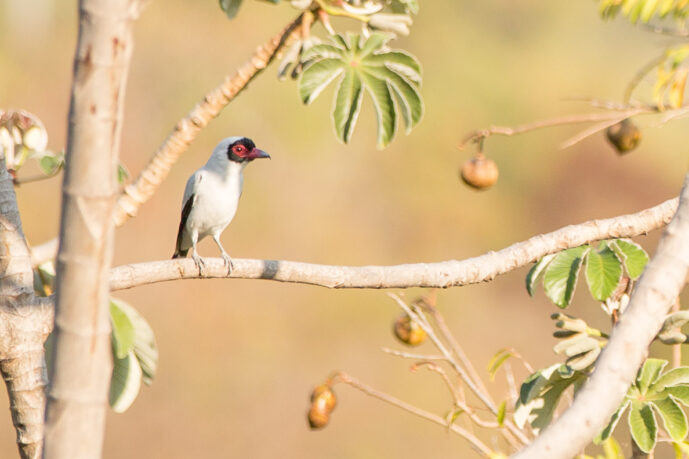
The Masked Tityra (*Tityra semifasciata*) is a striking, medium-sized bird of the Neotropics, instantly recognizable by its ghostly, pearly-white plumage and contrasting black crown, wings, and tail. Its most captivating feature is the vivid, rose-red patch of bare skin surrounding its dark eyes and the base of its powerful, hooked bill, creating a dramatic "mask" that stands out against its frosty feathers. While males sport a clean, high-contrast look, females are distinguished by more subtle brownish-gray washes on their heads and backs. Often seen perched prominently in the forest canopy or darting through the air to snatch fruit and insects, these social birds are also known for their resourceful nesting habits, frequently colonizing old woodpecker holes. With its unique blend of ethereal coloration and brilliant facial highlights, the Masked Tityra is a true standout of the tropical woodland landscape.
Habitats & Distribution
Its geographical range extends from northern Mexico through Central America and into South America, reaching as far south as northern Argentina and southern Brazil. Within this territory, it is primarily found in humid lowland forests, forest edges, and semi-open landscapes such as clearings with scattered tall trees or second-growth woodlands.
The species typically inhabits the canopy and sub-canopy, favoring areas that are not densely shaded. It adapts well to human-modified environments and is frequently seen in plantations, clearings, and suburban gardens, provided there are sufficient fruiting trees and suitable cavities for nesting.
Behaviours & Reproduction
These birds are typically observed alone, in pairs, or in small family units, frequently perching on high, exposed branches within humid forest canopies. While they primarily forage for fruit and insects, they occasionally participate in mixed-species flocks. Their social structure is characterized by seasonal territoriality, where males become particularly vigilant, often emitting buzzy, frog-like calls to defend their space and maintain pair bonds.
Reproduction involves a monogamous pairing where both sexes contribute to nest preparation, typically utilizing abandoned woodpecker holes or natural tree cavities. A unique reproductive strategy involves the female lining the cavity with a thick layer of dry leaves and twigs, which she may continue to add throughout the incubation period. While the female alone incubates the eggs, the male remains close by to guard the nest site from intruders and potential predators, ensuring the safety of the brood until the chicks fledge.
Diet
The Masked Tityra is primarily a frugivore, centering its diet on a diverse array of small fruits and berries found throughout the tropical canopy, with a noted preference for the oily fruits of trees in the mahogany and incense families. Although fruit constitutes the majority of its intake, this species is also an adept opportunistic insectivore, frequently sallying from high perches to capture large insects such as cicadas, katydids, and caterpillars. An interesting ecological facet of its diet is its role as a highly effective seed disperser; by consuming fruits whole and later voiding the seeds at a distance, the bird significantly contributes to forest regeneration. Additionally, while adults are largely fruit-dependent, they exhibit a strategic dietary shift during the breeding season by hunting a higher volume of protein-rich invertebrates to satisfy the rapid nutritional requirements of their developing nestlings.
Colors
The Masked Tityra is characterized by its starkly contrasting pearly-white plumage and jet-black wings and tail tips. Its most distinctive feature is a vibrant red patch of bare skin surrounding the eyes and the base of the bill, which frames a prominent black facial mask. While males are bright white, females possess a brownish wash on the head and back to blend more effectively with the tropical forest canopy.
Fun Facts
These birds are meticulous renovators that take over old woodpecker holes, where the female vigorously clears out all old debris before lining the cavity with fresh leaves. Instead of a melodic song, they produce a distinctive, frog-like buzzing sound that stands out in the tropical canopy. Despite their medium size, they are fierce territorial defenders and have been observed aggressively chasing away much larger birds. Their most striking adaptation is the bright red, featherless skin surrounding their eyes, which gives them their namesake "masked" appearance and contrasts sharply against their pale plumage.