Plush Crested Jay
Cyanocorax chrysops
Quick Facts
- Scientific Name: Cyanocorax chrysops
- Family: Corvidae
- Known Nicknames: Plush-crested Jay
- Average Length: 32–35 cm / 12.5–14 in
- Average Weight: 127–170 g / 4.5–6 oz
- Wingspan: 45–50 cm / 18–20 in
- Key Feature: Dense, velvety black crest on the crown and forehead
- Primary Diet: Omnivore (Insects, fruit, seeds, and small vertebrates)
- Range: Central-southern South America, including Brazil, Bolivia, Paraguay, Uruguay, and Argentina
- Habitat: Subtropical and tropical moist lowland forests and woodland edges
- Social Structure: Highly Social (Found in family groups of 6 to 12 individuals)
- Nesting/Breeding: Cup-shaped nests built in trees
- Conservation Status: Least Concern (LC)
- Population Trend: Stable
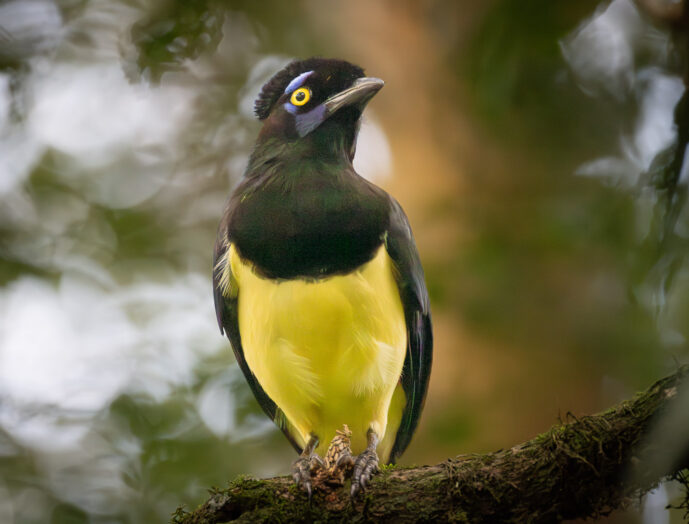
The Plush-crested Jay (*Cyanocorax chrysops*) is a striking and highly intelligent songbird native to the subtropical forests of South America, instantly recognizable by the dense, velvety tuft of short black feathers atop its head that gives the species its name. This medium-sized corvid displays a bold color palette, featuring a deep black face and breast that contrasts sharply with a creamy-white underbelly and vibrant violet-blue wings and tail. Its most arresting feature is its piercing yellow iris, which is beautifully framed by bright blue spots both above and below the eye, lending the bird a look of constant, keen alertness. Beyond its physical beauty, the Plush-crested Jay is known for its remarkable social complexity and vocal mimicry, often traveling in boisterous family groups and utilizing a wide array of calls to communicate within the dense canopy.
Habitats & Distribution
Its geographical range extends across central-southern South America, encompassing southwestern Brazil, eastern Bolivia, Paraguay, Uruguay, and northern Argentina. Within these regions, it is a versatile inhabitant of diverse ecosystems, primarily favoring subtropical or tropical moist lowland forests and gallery forests.
It is frequently observed in semi-open woodlands, forest edges, and scrublands, often showing a high degree of tolerance for human-altered landscapes. This adaptability allows it to thrive in plantations, suburban gardens, and heavily degraded former forests, where it can find sufficient cover and diverse food sources.
Behaviours & Reproduction
These birds are highly social and typically move in family groups consisting of seven to ten individuals. They exhibit complex vocalizations and cooperative behaviors, often working together to forage or mob potential predators. Within these groups, a clear social hierarchy exists, yet members maintain strong bonds through mutual preening and communal territorial defense, moving through the forest canopy with synchronized agility.
Reproduction is characterized by a monogamous mating system and a sophisticated cooperative breeding strategy. While a dominant pair produces the eggs, non-breeding group members—often offspring from previous seasons—act as helpers. These assistants contribute significantly by helping to construct the cup-shaped twig nest, defending the site, and feeding the chicks once they hatch. This communal approach ensures a higher success rate for the brood by distributing the demands of parenting across the entire social unit.
Diet
The Plush-crested Jay maintains an omnivorous and highly opportunistic diet, consuming a wide variety of food sources found within its forest and woodland habitats. These birds primarily feed on invertebrates such as beetles, grasshoppers, and caterpillars, but they also consume a significant amount of plant matter, including various fruits, seeds, and nuts, with a particular fondness for the seeds of the Paraná pine. Interestingly, they are known to supplement their diet with small vertebrates like lizards, frogs, and even the eggs or nestlings of other bird species. A notable foraging behavior is their tendency to follow groups of monkeys through the canopy to capture insects that are flushed out by the primates' movement. Furthermore, like many members of the crow family, the Plush-crested Jay is a frequent cacher, hiding surplus food items in crevices or underground to be retrieved and eaten during times of scarcity.
Colors
The Plush-crested Jay displays a striking contrast between its velvety black head, neck, and breast and its creamy-white underparts. Its back, wings, and tail are deep violet-blue, with the tail featuring broad, pale yellow-to-white tips. Distinctive markings include vivid blue spots above and below the eyes, a bright blue patch on the nape, and a prominent, stiff crest of dense black feathers on the forehead that gives the species its name.
Fun Facts
These birds are exceptional mimics, capable of imitating other animal calls to deceive predators or coordinate with their noisy social groups. Their signature "plush" crest is a dense mat of velvety feathers that provides a unique texture unlike most other jays. Highly intelligent, they engage in sentinel behavior where one bird stands guard to alert the flock of danger with a piercing cry. They also possess a remarkable spatial memory, allowing them to cache food in various hidden locations and successfully retrieve it months later.