Praying Mantis
Mantis religiosa
Quick Facts
- Scientific Name: Mantis religiosa
- Family: Mantidae
- Known Nicknames: European Mantis, Praying Mantid, Soothsayer
- Average Length: 5–7.5 cm / 2.0–3.0 in
- Average Weight: 0.1–0.5 g / 0.0035–0.017 oz
- Wingspan: 5–10 cm / 2.0–4.0 in
- Key Feature: Raptorial front legs and a highly mobile triangular head capable of 180-degree rotation
- Primary Diet: Carnivore (Insectivore)
- Range: Global; native to Europe, Asia, and Africa, widely introduced in North America
- Habitat: Temperate and tropical grasslands, gardens, and forests
- Social Structure: Solitary and highly aggressive
- Nesting/Breeding: Stems, twigs, or flat surfaces (via a protective ootheca)
- Conservation Status: Least Concern (LC)
- Population Trend: Stable
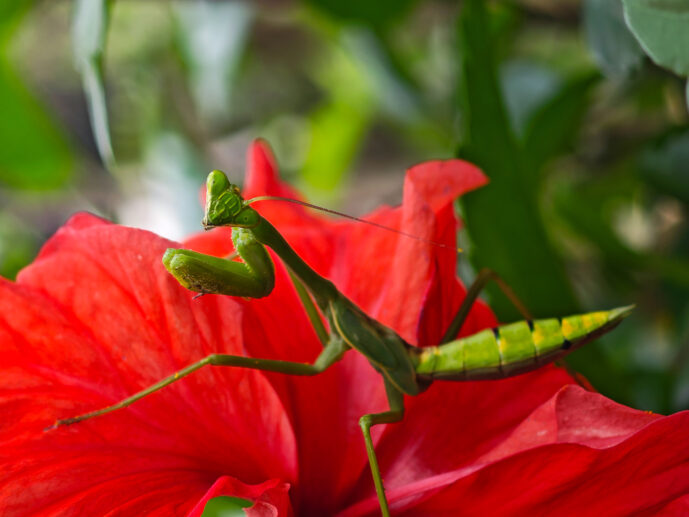
The European Mantis, scientifically known as *Mantis religiosa*, is a master of disguise and a formidable ambush predator recognized globally for its iconic "prayer-like" stance. Characterized by an elongated thorax and a highly mobile triangular head, this insect possesses the extraordinary ability to rotate its neck up to 180 degrees, allowing it to scan its environment with large, bulbous compound eyes that provide exceptional depth perception. Its coloration, typically ranging from vibrant green to earthy brown, provides near-perfect camouflage amidst foliage where it lies motionless for hours. Most notably, its specialized, spiked forelegs—known as raptorial legs—can snap shut with lightning speed to secure prey, ranging from small insects to occasionally tiny vertebrates. With this combination of panoramic vision, stealthy mimicry, and lethal precision, the praying mantis remains one of the most efficient and captivating hunters in the natural world.
Habitats & Distribution
Originally native to Europe, Asia, and Africa, this species has established a broad presence across North America following its introduction in the late 1800s. It is currently found throughout temperate and subtropical zones globally, favoring regions that offer long, warm summers suitable for its developmental cycle and reproductive needs. In these regions, it occupies open, sunny environments such as meadows, grasslands, pastures, and overgrown fields. It is also frequently encountered in domestic gardens and shrublands where dense foliage provides essential cover for ambush hunting. These insects are particularly drawn to dry, well-lit areas with abundant herbaceous vegetation, allowing them to remain camouflaged while perched on stalks or leaves.
Behaviours & Reproduction
These insects are primarily solitary and highly territorial predators that rely on camouflage to ambush prey. Their social structure is non-existent outside of mating encounters, which are characterized by a cautious approach from the male to avoid being perceived as prey. During these interactions, the species is well-known for sexual cannibalism, where the female may consume the male before, during, or after copulation. This behavior provides the female with essential nutrients that significantly increase the quantity and survival rate of the eggs she produces. After successful fertilization, the female deposits her eggs into a protective, foam-like case known as an ootheca, which hardens into a tough shell to shield the offspring from predators and winter temperatures. These egg cases are typically attached to sturdy twigs or stems where they remain until the spring. Upon hatching, hundreds of nymphs emerge simultaneously, immediately displaying predatory instincts. Because they are highly competitive and lack social bonds, these nymphs often engage in sibling cannibalism to reduce local competition and secure their first meal.
Diet
The Praying Mantis (Mantis religiosa) is a strictly carnivorous ambush predator known for its diverse and often aggressive dietary habits, primarily consisting of live insects such as crickets, moths, flies, and grasshoppers. Using their highly specialized, spined raptorial front legs, they strike with remarkable speed to pin prey, which they typically begin consuming while it is still alive. While they mostly target smaller invertebrates, larger mantises are opportunistic hunters capable of capturing and eating small vertebrates, including frogs, lizards, and even small birds like hummingbirds. A particularly famous aspect of their feeding behavior is sexual cannibalism, where a female may consume the male during or after mating to acquire essential nutrients for egg development. Additionally, they are generalist predators that do not hesitate to engage in cannibalism of their own kind, especially when food is scarce or during the nymph stage when siblings emerge together.
Colors
*Mantis religiosa* typically exhibits a solid green or straw-brown coloration that provides expert camouflage within foliage and dry grass. Its most diagnostic marking is a distinctive black spot, often featuring a white center, located on the inner side of the front coxae. This species can adapt its hue to match its specific environment, ensuring it remains nearly invisible to both predators and prey.
Fun Facts
Praying mantises are the only insects capable of rotating their heads a full 180 degrees, giving them a distinct advantage when scanning for prey or predators. They possess a single "ear" located in the center of their chest, which is specially tuned to detect the ultrasonic pulses of bats, allowing them to perform evasive mid-air spirals to avoid capture. These formidable hunters also boast five eyes—two large compound eyes for depth perception and three smaller ones to detect light—and can strike at prey in as little as 30 milliseconds, a speed nearly invisible to the human eye.