Red-breasted Toucan
Ramphastos dicolorus
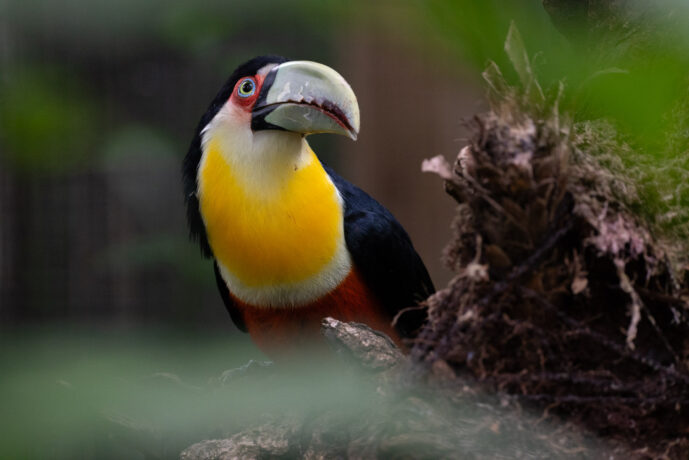
Quick Facts
- Scientific Name: Ramphastos dicolorus
- Family: Ramphastidae
- Known Nicknames: Green-billed Toucan
- Average Length: 40–50 cm / 16–20 in
- Average Weight: 265–400 g / 9.3–14.1 oz
- Wingspan: 50–60 cm / 20–24 in
- Key Feature: Greenish-yellow bill and a large, vibrant red patch on the lower breast and abdomen
- Primary Diet: Primarily Frugivore
- Range: Southern and Eastern Brazil, Eastern Paraguay, and Northeastern Argentina
- Habitat: Atlantic Forest, subtropical and tropical moist lowland and montane forests
- Social Structure: Small groups or pairs
- Nesting/Breeding: Tree hollows
- Conservation Status: Least Concern (LC)
- Population Trend: Decreasing
The Red-breasted Toucan (*Ramphastos dicolorus*), also known as the Green-billed Toucan, is a striking avian jewel native to the Atlantic Forest of South America. Easily distinguished by its vibrant, flame-colored breast and belly, it features a sleek black mantle and a bright yellow throat that frames its expressive face. Unlike many of its larger relatives, this species sports a relatively shorter, pale greenish-horn colored bill that is remarkably lightweight due to its hollow, honeycombed interior. This specialized beak serves as both a precise tool for plucking tropical fruits and a sophisticated thermal radiator, allowing the bird to regulate its body temperature in the humid canopy. Social and agile, the Red-breasted Toucan is a vital seed disperser, enlivening the forest with its rhythmic croaking calls and flashes of brilliant crimson.
Habitats & Distribution
This species is primarily distributed across south-central and eastern South America, spanning southeastern Brazil, eastern Paraguay, and the far northeastern Misiones province of Argentina. Its range is closely associated with the Atlantic Forest biome, making it one of the most southerly distributed members of its genus. It typically inhabits humid subtropical and tropical forests, ranging from lowland coastal areas to montane regions at elevations up to 2,000 meters. While it favors dense primary forests, it is also frequently found in secondary growth, forest edges, and occasionally in wooded urban parks or gardens where fruit is abundant.
Behaviours & Reproduction
These birds are highly social and typically move through the canopy in small family groups or pairs rather than as solitary individuals. They exhibit an active and communal demeanor, often engaging in mutual preening and bill-fencing to maintain social hierarchies and strengthen bonds within the flock. During the breeding season, they become more territorial and defensive of nesting sites, which are typically established in pre-existing tree cavities or abandoned woodpecker holes located high above the forest floor. Courtship involves elaborate displays, most notably the ritual of "fruit tossing," where a pair passes food back and forth to establish and reinforce a monogamous bond. Once the pair has mated, the female lays a clutch of two to four eggs, which both parents take turns incubating for approximately 16 days. This shared parental investment continues after the chicks hatch, as both the male and female use their specialized bills to provide a diet of regurgitated fruit and small protein sources until the young are ready to fledge at about seven to nine weeks of age.
Diet
The Red-breasted Toucan is primarily frugivorous, subsisting on a diverse array of tropical fruits, including palm berries, figs, and various wild drupes. It utilizes its long, serrated beak to delicately pluck fruit from thin branches and then tosses the food toward the back of its throat to be swallowed whole. While fruit constitutes the majority of its intake, this species is also an opportunistic omnivore that supplements its diet with protein-rich sources such as insects, spiders, small lizards, and occasionally the eggs or nestlings of other birds. An ecologically significant aspect of its diet is its role as a key seed disperser; the toucan often regurgitates large seeds after digesting the pulp, which helps maintain the biodiversity of its native Atlantic Forest habitat.
Colors
The Red-breasted Toucan features glossy black upperparts contrasted by a vibrant saffron-yellow throat and an expansive, brilliant red patch covering its breast and belly. Its relatively short, serrated bill is a distinctive greenish-horn color with a dark basal band, while the skin surrounding its eyes is often a pale bluish-grey. This high-contrast plumage serves as social signaling within the Atlantic Forest canopy, while the dark dorsal feathers provide effective camouflage against the deep shadows of the foliage.
Fun Facts
The Red-breasted Toucan is the smallest member of its genus and possesses a specialized tail joint that allows it to fold its tail completely flat against its back while sleeping in cramped tree hollows. To manage social hierarchies, these birds engage in "bill-fencing," a playful ritual where they clatter their beaks together like swords. Their serrated bills are not just for show; they act as precise tools for peeling fruit and are highly vascularized to help the bird regulate its body temperature by radiating excess heat. Additionally, their distinct greenish-yellow bills provide a unique form of camouflage, blending seamlessly into the sun-dappled foliage of the Atlantic Forest canopy.