Rufous-tailed Jacamar
Galbula ruficauda
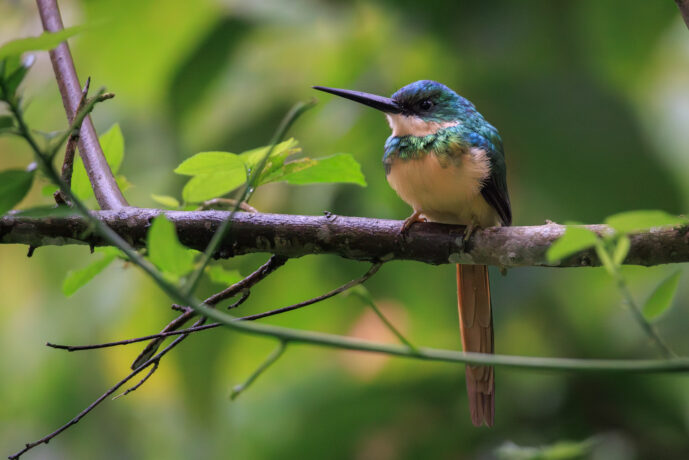
Quick Facts
- Scientific Name: Galbula ruficauda
- Family: Galbulidae
- Known Nicknames: Jacamar colirrufo, Ariramba-de-cauda-ruiva
- Average Length: 22–26 cm / 8.7–10.2 in
- Average Weight: 25–30 g / 0.88–1.06 oz
- Wingspan: 28–32 cm / 11–12.6 in
- Key Feature: Long needle-like bill and iridescent metallic green plumage with rufous underparts
- Primary Diet: Insectivore (specializing in flying insects like butterflies)
- Range: Southern Mexico through Central America to South America (as far south as Brazil and Argentina)
- Habitat: Lowland forest edges, riverbanks, and open woodland
- Social Structure: Solitary or in pairs
- Nesting/Breeding: Burrows excavated in earth banks or termite mounds
- Conservation Status: Least Concern (LC)
- Population Trend: Decreasing
The Rufous-tailed Jacamar (*Galbula ruficauda*) is a dazzling, jewel-like inhabitant of the tropical lowlands of Central and South America, often described as the New World’s ecological equivalent to the bee-eater. This striking bird is characterized by its shimmering, iridescent metallic-green upperparts and a contrasting, deep cinnamon-rufous belly and long tail, all centered around a remarkably elongated, needle-straight black bill. A specialized "sit-and-wait" predator, the jacamar is renowned for its aerial agility, sallying forth from a favorite perch to snatch fast-moving insects—particularly butterflies and dragonflies—with surgical precision before returning to its branch to beat the wings off its prey. Beyond its shimmering plumage, this species possesses the unique habit of excavating its own nesting burrows into earth banks or termite mounds, making it a fascinating blend of avian elegance and specialized predatory skill.
Habitats & Distribution
This species occupies a vast geographical range extending from southern Mexico and Central America throughout much of South America. It is widely distributed across the lowlands east of the Andes, reaching as far south as northeastern Argentina, southern Brazil, and Paraguay, and remains a common sight throughout the Amazon Basin and the Guianas.
Within these regions, it favors semi-open environments such as forest edges, gallery forests, second-growth woodlands, and scrubby areas rather than dense forest interiors. It is frequently observed near watercourses or in sunlit clearings where it can hunt flying insects. For breeding, it depends on vertical surfaces like earth banks, road cuttings, or arboreal termite mounds, where it excavates its nesting burrows.
Behaviours & Reproduction
These birds are primarily solitary or found in monogamous pairs, maintaining year-round territories through persistent, high-pitched vocalizations. As specialized sit-and-wait predators, they spend long periods perched motionless before darting out to catch flying insects, particularly butterflies and dragonflies. A distinctive behavioral trait involves returning to a perch to beat prey against a branch, often stripping away the wings before consumption or feeding their mate during courtship.
During the breeding season, both members of a pair collaborate to excavate nesting burrows, which are typically tunneled into earth banks, road cuttings, or occasionally termite mounds. They lay two to four eggs, and both parents share the duties of incubation and chick-rearing. Notably, the hatchlings are semi-precocial, emerging with a covering of white down and their eyes partially open, which is an unusual trait among cavity-nesting birds that typically produce more helpless, naked young.
Diet
The Rufous-tailed Jacamar is a specialized insectivore that primarily feeds on large, fast-flying insects such as butterflies, dragonflies, bees, and wasps. Perched motionless on a branch, it utilizes a sit-and-wait hunting strategy, darting out with sudden bursts of speed to snatch prey from the air with its long, needle-like bill. One of the most fascinating aspects of its diet is its ability to handle hazardous or unpalatable prey; after a successful hunt, the bird returns to its perch and repeatedly strikes the insect against the wood to remove wings or neutralize stingers before swallowing. Furthermore, these birds are remarkably adept at distinguishing between edible species and those that mimic toxic butterflies, demonstrating a sophisticated visual learning capability that allows them to avoid chemical defenses while exploiting a food source that many other avian predators ignore.
Colors
The Rufous-tailed Jacamar features iridescent metallic green upperparts that camouflage against rainforest foliage, contrasted by a deep rufous belly and tail. Males possess a distinctive white throat patch, while females exhibit a buff-colored throat. Its shimmering emerald and bronze feathers break up its silhouette, while the reddish underside mimics dead leaves when viewed from below.
Fun Facts
These "honorary hummingbirds" are expert aerial hunters that specialize in snatching large butterflies and dragonflies mid-air. To deal with their prey, they perform a distinctive "de-winging" ritual, vigorously thumping the insect against a branch to remove wings and neutralize stingers before swallowing. Remarkably, they are among the few predators capable of safely eating chemically defended butterflies that other birds avoid. When it is time to nest, they use their needle-like bills to excavate deep burrows—sometimes up to 20 inches long—into vertical earth banks or even active termite mounds, providing a secure, subterranean home for their young.