Sea-lion
Zalophus californianus
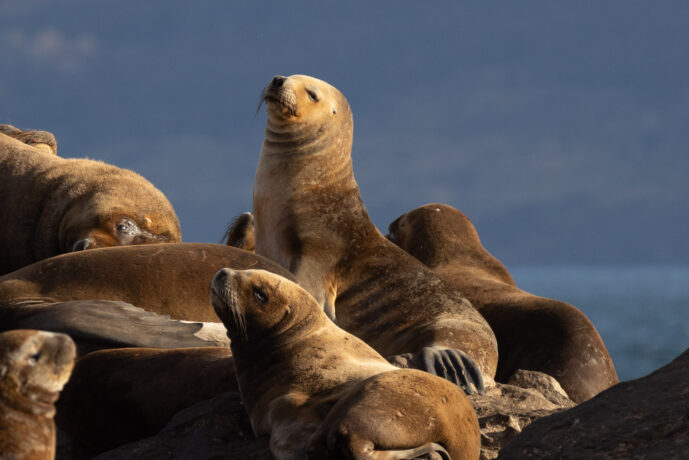
Quick Facts
- Scientific Name: Zalophus californianus
- Family: Otariidae
- Known Nicknames: California sea lion, Barking sea lion
- Average Length: 150–240 cm / 59–94 in
- Average Weight: 50–400 kg / 110–880 lb
- Wingspan: N/A
- Key Feature: External ear flaps and rotating hind flippers for terrestrial locomotion
- Primary Diet: Carnivore (primarily fish and cephalopods)
- Range: Eastern North Pacific coastline from Alaska to Central Mexico
- Habitat: Coastal marine waters, rocky islands, and sandy beaches
- Social Structure: Highly Social (forming large colonies)
- Nesting/Breeding: Terrestrial rookeries on remote islands or beaches
- Conservation Status: Least Concern (LC)
- Population Trend: Increasing
The California sea lion (*Zalophus californianus*) is a charismatic and highly intelligent marine mammal known for its sleek, torpedo-shaped body and remarkable agility both in the water and on rocky shores. Distinguished from true seals by their visible external ear flaps and large, powerful front flippers that allow them to "walk" on land by rotating their hind flippers forward, these pinnipeds typically sport a coat of short, thick fur ranging from chocolate brown to golden tan. Beyond their physical prowess—reaching swimming speeds of up to 25 miles per hour—they are famous for their social nature and loud, rhythmic barking that echoes across coastal colonies. Their playful curiosity and exceptional diving capabilities make them one of the most dynamic and recognizable inhabitants of the Pacific Ocean's edge.
Habitats & Distribution
Their geographical range extends along the western coast of North America, from southeast Alaska through the Pacific Northwest and California to central Mexico, including the Gulf of California. While widely distributed, the majority of the population breeds on offshore islands located between southern California and the southern tip of Baja California. In terms of environment, they occupy shallow coastal waters, rarely venturing far from the continental shelf. They utilize a variety of terrestrial sites for hauling out and breeding, including sandy beaches, rocky ledges, and mudflats. Additionally, they frequently inhabit human-made structures such as piers, jetties, and buoys in urbanized coastal areas.
Behaviours & Reproduction
Highly social and gregarious, these pinnipeds congregate in massive colonies on sandy beaches or rocky shores. During the breeding season, they exhibit a polygynous social structure where dominant males, or bulls, aggressively defend aquatic or terrestrial territories to gain access to a harem of females. This competition involves loud vocalizations, intimidating posturing, and physical combat. Mothers typically give birth to a single pup in early summer and remain onshore to nurse for several days before beginning a cycle of foraging trips at sea, alternating with periods of nursing on land. A defining reproductive strategy is the use of embryonic diapause, or delayed implantation. After fertilization, the embryo remains dormant for approximately three months before attaching to the uterine wall, ensuring that the total gestation period aligns with the annual return to the breeding grounds. This synchronization allows pups to be born during optimal environmental conditions when the mother is safely ashore. The bond between mother and pup is reinforced through unique vocalizations and scent, which allow them to locate each other within the crowded and noisy colony.
Diet
The California sea lion (Zalophus californianus) is an opportunistic and versatile carnivore, primarily preying on a wide variety of fish and cephalopods such as sardines, anchovies, mackerel, squid, and octopus. These marine mammals are known for swallowing their prey whole or tearing larger fish into chunks, as they do not chew their food. An interesting aspect of their dietary habits is that they consume approximately five to eight percent of their body weight daily to sustain their high energy levels. Additionally, sea lions are known to swallow gastroliths—small stones—which are thought to assist in grinding up food or regulating buoyancy while diving. Their foraging behavior is notably clever, as they often follow fishing boats or congregate around commercial nets to scavenge for an easy meal, demonstrating a high level of adaptability in their search for sustenance.
Colors
California sea lions possess a sleek, uniform coat that ranges from chocolate brown in adult males to a lighter tan in females and juveniles. Their fur appears nearly black when wet but dries to a lighter shade, lacking distinct spots or stripes. They utilize countershading—a darker back and slightly paler underside—as camouflage to blend with the ocean's depths and surface light, while mature males often develop a prominent, lighter-colored sagittal crest on their foreheads.
Fun Facts
California sea lions are the only non-human mammals proven to have a sense of rhythm, capable of bobbing their heads in time with a musical beat. They exhibit a unique thermoregulation behavior called "rafting," where they float in groups with their flippers poked out of the water to soak up the sun or cool down. Their sensitive whiskers, or vibrissae, are so precise they can detect the movement of a single fish from hundreds of feet away in pitch-black water. Unlike true seals, these agile pinnipeds can rotate their hind flippers forward to "gallop" on land, a mobility that has even led the U.S. Navy to recruit them for detecting underwater mines and recovering equipment.