Southern Crested Caracara
Caracara plancus
Quick Facts
- Scientific Name: Caracara plancus
- Family: Falconidae
- Known Nicknames: Southern Caracara, Carancho, Common Caracara
- Average Length: 50–65 cm / 20–26 in
- Average Weight: 0.9–1.6 kg / 2.0–3.5 lb
- Wingspan: 120–132 cm / 47–52 in
- Key Feature: Bare orange-yellow facial skin (cere) and a prominent black shaggy crest
- Primary Diet: Opportunistic Omnivore (Carrion, small vertebrates, and insects)
- Range: South America, south of the Amazon River to Tierra del Fuego
- Habitat: Open and semi-open landscapes, including pampas, savannas, and pastures
- Social Structure: Solitary or in pairs; gregarious around abundant food sources
- Nesting/Breeding: Large stick nests in trees, palms, cacti, or on the ground
- Conservation Status: Least Concern (LC)
- Population Trend: Stable
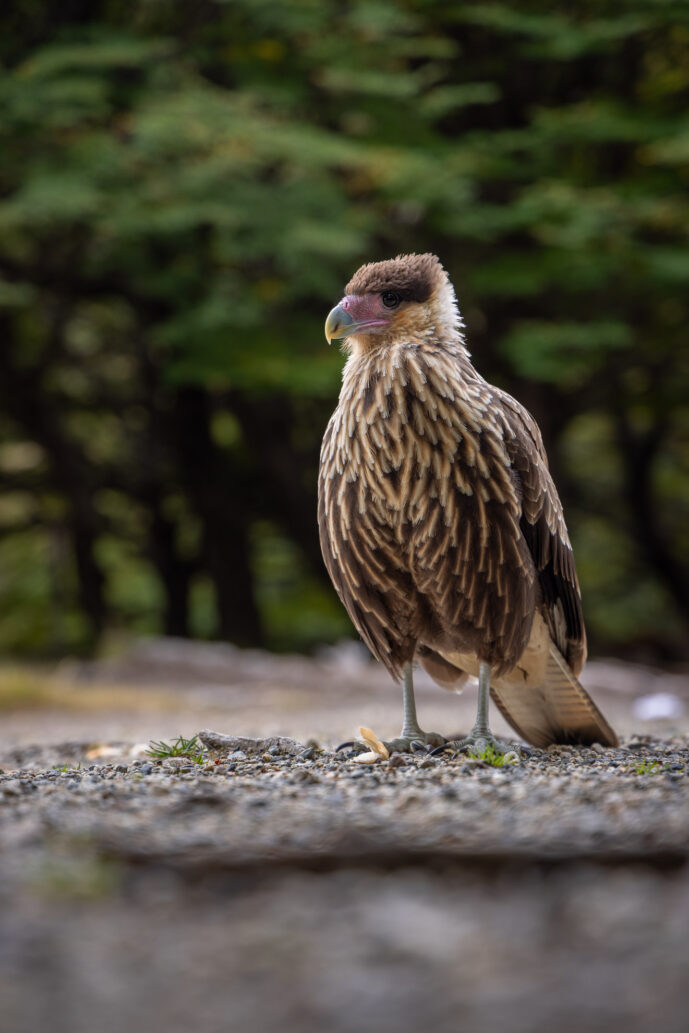
The Southern Crested Caracara (*Caracara plancus*) is a striking and versatile bird of prey native to the open landscapes of South America, often described as a "falcon that acts like a vulture." Unlike most of its aerial relatives, this charismatic raptor possesses long, yellow legs specialized for walking and running on the ground, where it frequently scavenges or hunts for small prey. Its appearance is truly unmistakable, featuring a dark-capped crest, a stark white neck, and intricate black-and-white barring across its breast and back. Perhaps its most remarkable feature is its bare facial skin, which can rapidly flush from a vibrant orange-red to a pale yellow when the bird is agitated or excited. Combining the grace of a raptor with a bold, opportunistic nature, the Southern Crested Caracara is a master of adaptation in the southern plains.
Habitats & Distribution
This species is widely distributed throughout central and southern South America, with a range extending from the Amazon River basin southward to Tierra del Fuego and the Falkland Islands. It is a highly adaptable bird that favors open and semi-open landscapes, particularly grasslands, savannas, pastures, and agricultural fields. In addition to these terrestrial habitats, it is frequently found in marshes, along coastal regions, and in scrublands. It generally avoids dense, humid forests, preferring areas with sparse vegetation that allow for efficient ground-based foraging and scavenging along roadsides.
Behaviours & Reproduction
These birds are highly opportunistic and versatile, often observed foraging on the ground where they walk and run with ease. While they are frequently solitary or found in mated pairs, they may gather in larger, loose groups at abundant food sources like carrion. Their social structure is characterized by a bold and aggressive temperament, often displacing other scavengers. They communicate through a distinctive rattling call, performed while throwing their heads back until they touch their shoulders, a behavior used for both territorial defense and reinforcing pair bonds. Typically monogamous, they maintain long-term bonds and work together to construct large, bulky stick nests in the crowns of tall trees or palms. A clutch usually consists of two to three eggs, which both parents take turns incubating for about a month. Both adults are deeply involved in brooding and feeding the chicks, which remain dependent on their parents for several months after fledging. This extended period of parental care and the cooperative defense of the nesting territory are key strategies for ensuring the survival of their offspring in competitive environments.
Diet
The Southern Crested Caracara is a highly versatile and opportunistic generalist, consuming a wide-ranging diet that primarily consists of carrion, which it often locates by patrolling highways for roadkill or monitoring the movements of other vultures. Unlike most other falcons, this species spends a significant amount of time foraging on the ground, where it walks or runs to hunt small mammals, reptiles, amphibians, and large insects. Its diet is remarkably diverse, encompassing bird eggs, nestlings, and even occasional vegetable matter like palm fruits. An intriguing aspect of its feeding behavior is its tendency toward kleptoparasitism, frequently harassing other raptors or waterbirds to steal their prey. Furthermore, these intelligent birds are known to follow brush fires to snatch up displaced animals or dig into the soil to unearth turtle eggs and worms, showcasing a dietary flexibility that allows them to thrive in varied environments across South America.
Colors
The Southern Crested Caracara displays a black cap and crest against a bare, reddish-orange face and long yellow legs. Its neck and breast are buff-colored with fine black horizontal barring, while the body and wings are primarily dark brown. Distinctive white patches mark the wingtips in flight, and the tail is pale with dark bars ending in a broad, black terminal band.
Fun Facts
These birds exhibit a remarkable "head-tossing" display, tilting their heads back until they touch their shoulders while producing a unique rattling sound. Unlike most raptors, they are highly terrestrial and will frequently run across the ground to hunt prey or scavenge. A particularly striking adaptation is their ability to change the color of their bare facial skin from bright red to pale yellow in seconds, reflecting shifts in their mood or stress levels. Additionally, they are bold kleptoparasites that often harass larger birds of prey and vultures to steal their food, proving that their opportunistic intelligence is just as sharp as their talons.