Southern Tamandua
Tamandua tetradactyla
Quick Facts
- Scientific Name: Tamandua tetradactyla
- Family: Myrmecophagidae
- Known Nicknames: Lesser Anteater, Collared Anteater
- Average Length: 93–147 cm / 37–58 in (including tail)
- Average Weight: 1.5–8.4 kg / 3.3–18.5 lb
- Wingspan: N/A
- Key Feature: Prehensile tail and a distinctive dark 'vest' pattern on the torso
- Primary Diet: Insectivore (specializing in ants and termites)
- Range: South America, east of the Andes, from Venezuela and Trinidad to northern Argentina and Uruguay
- Habitat: Tropical and subtropical forests, savannas, and thorn scrub
- Social Structure: Solitary
- Nesting/Breeding: Hollow logs or abandoned burrows
- Conservation Status: Least Concern (LC)
- Population Trend: Stable
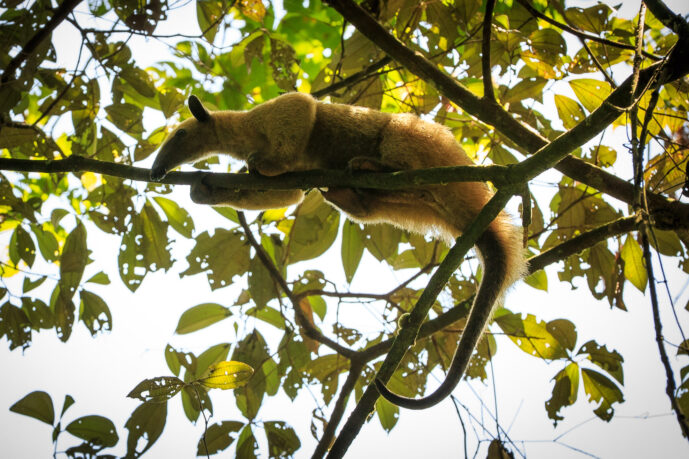
The Southern Tamandua (*Tamandua tetradactyla*), often called the lesser anteater, is a specialized arboreal mammal native to South America, easily recognized by its striking "black vest" markings set against a coat of golden-tan fur. Perfectly adapted for a life spent both in the trees and on the ground, this toothless insectivore uses its long, tapered snout and a 16-inch sticky tongue to extract thousands of ants and termites daily. Its most formidable tools are the four powerful claws on its front feet—the inspiration for its scientific name—which it uses to tear into tough insect mounds or to defend itself in a tripod-like stance when threatened. Enhancing its agility in the canopy is a strong, prehensile tail that acts as a fifth limb for gripping branches. Beyond its physical prowess, the Southern Tamandua is famously known as the "stinker of the forest" for its ability to release a pungent musk from its anal glands, a unique chemical defense that keeps even the most persistent predators at bay.
Habitats & Distribution
The Southern Tamandua is widely distributed across South America, living east of the Andes from Venezuela and Trinidad southward to northern Argentina, Paraguay, and Uruguay. It is highly adaptable and occupies a variety of habitats, ranging from dense tropical rainforests and humid gallery forests to more arid environments like dry forests and the scrubby savannas of the Cerrado. Within these regions, it frequently selects environments near water, such as streams and rivers, where vegetation is dense enough to provide cover and support its semi-arboreal lifestyle. Whether in primary forests or disturbed secondary growth, it utilizes both the forest floor and the canopy for foraging and resting, making it a versatile inhabitant of diverse South American landscapes.
Behaviours & Reproduction
Primarily solitary and active during both day and night, these mammals occupy overlapping home ranges and avoid social interaction except during the breeding season. They are well-known for their defensive posture, standing on their hind limbs and using their powerful, curved claws to fend off predators while leaning against a tree for support. Communication is heavily reliant on scent marking from their anal glands, which emit a potent odor to signal their presence to others and define territorial boundaries. Mating occurs year-round, as females do not have a fixed breeding season and are polyestrous. Following a gestation period that typically lasts between 130 and 190 days, a single pup is born. A unique aspect of their reproductive strategy is the intensive maternal care; the mother carries the offspring on her back for several months, providing both protection and transportation as the young matures. This juvenile remains with the mother until it is nearly a year old, ensuring it is well-prepared for a solitary life.
Diet
The Southern Tamandua is a specialized insectivore whose diet consists almost exclusively of ants and termites, which it locates primarily through its keen sense of smell. Lacking teeth entirely, this arboreal anteater utilizes its powerful, curved front claws to rip open nests and uses its elongated, sticky tongue—which can extend up to 40 centimeters—to extract thousands of insects a day. An interesting aspect of its feeding strategy is its selective and efficient nature; it typically spends only a few minutes at a single mound to avoid the painful bites of soldier insects and to ensure the colony survives for future foraging. Furthermore, because it cannot chew, the tamandua possesses a specialized, muscular stomach that acts much like a gizzard, grinding the insects to facilitate digestion after they are swallowed whole.
Colors
The Southern Tamandua typically displays a dense coat of tan, cream, or golden fur, most notably marked by a striking black "vest" that extends from the shoulders across the back. This high-contrast pattern acts as disruptive camouflage in the dappled light of the forest canopy, though some individuals in the Amazonian region may appear entirely uniform in color. A hairless, mottled underside on its prehensile tail and subtle dark markings around the eyes further characterize its unique appearance.
Fun Facts
The Southern Tamandua is a master of defense, often rearing up on its hind legs in a "tripod" stance using its prehensile tail for balance to deliver a powerful, clawed hug to any perceived threat. Known as the "stinker of the forest," this mammal can release a pungent odor from its anal glands that is significantly stronger than a skunk's to deter predators. Despite having no teeth, it possesses a specialized tongue that can extend up to 16 inches, coated in sticky saliva to vacuum up thousands of ants and termites daily. Interestingly, they are also excellent swimmers and spend much of their lives in the canopy, using their powerful, curved claws to navigate branches and tear into tough insect nests with ease.