Spotted Apatelodes moth
Apatelodes torrefacta
Quick Facts
- Scientific Name: Apatelodes torrefacta
- Family: Apatelodidae
- Known Nicknames: Spotted Apatelodes
- Average Length: 2.0–3.0 cm / 0.8–1.2 in
- Average Weight: N/A
- Wingspan: 3.2–4.2 cm / 1.25–1.65 in
- Key Feature: Grayish-tan forewings with dark brown spots and a distinctive upward-curled abdomen when at rest
- Primary Diet: Herbivore (Larvae: Deciduous leaves; Adults: Do not feed)
- Range: Eastern North America, from Southern Ontario and Maine to Florida, west to Texas and Wisconsin
- Habitat: Deciduous forests and mixed woodlands
- Social Structure: Solitary
- Nesting/Breeding: Deciduous host plant leaves (oviposition) and soil (pupation)
- Conservation Status: Not Evaluated (NE)
- Population Trend: Stable
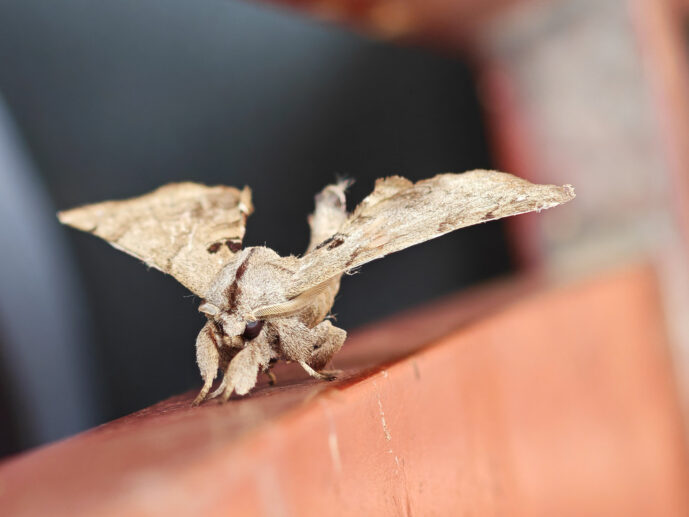
The Spotted Apatelodes moth (*Apatelodes torrefacta*) is a master of mimicry, often mistaken for a withered, crumpled leaf when at rest due to its unique posture and earthy coloration. This medium-sized moth features velvety, ash-gray to tan wings adorned with delicate, dark wavy lines and a distinctive small white spot near the outer tip of the forewing. One of its most striking behaviors is its tendency to curl the tip of its abdomen upward over its back, a quirky stance that sets it apart from most other nocturnal fliers. While the adult is elegantly subtle, its larval stage is equally remarkable—a fluffy, neon-white or yellow caterpillar covered in dense hairs with long, black "hair pencils" protruding from its ends. Found throughout deciduous forests in North America, this member of the Apatelodidae family is a fascinating example of how nature blends soft beauty with clever camouflage.
Habitats & Distribution
This species is widely distributed across eastern North America, with a geographical range extending from southern Ontario and Maine southward to Florida, and reaching as far west as Texas and Wisconsin. Within this territory, it is a common inhabitant of deciduous forests and mixed woodlands, where it thrives in environments rich in its preferred host plants. It is frequently found in forest edges, parks, and suburban areas that feature a variety of broadleaf trees, such as maples, oaks, cherries, and ashes. The presence of these specific tree species is crucial, as they provide the necessary resources for the larvae to develop and for adult populations to remain stable within their localized ecosystems.
Behaviours & Reproduction
As solitary insects, these moths interact primarily during the breeding season, which occurs in one or two broods depending on the latitude. Females use potent pheromones to attract males during the night, and because the adults possess vestigial mouthparts and do not feed, their brief adult lives are dedicated entirely to locating a mate and ovipositing. There is no social structure or parental care; once mating is complete, the female deposits her eggs on the undersides of leaves from a wide variety of deciduous host trees, including maple, oak, and cherry. The survival strategy of this species is most evident in its larval stage, where the caterpillars are covered in dense, hair-like setae and distinctive long black "lashes" that may serve as a deterrent to predators. When the larvae reach maturity, they exhibit a unique behavioral shift by crawling down from the canopy to pupate in the soil or leaf litter. This subterranean pupation is a critical reproductive strategy, as it provides protection from environmental extremes and predators during the vulnerable transition into adulthood. The resulting adults rely on crypsis, holding their wings at an unusual angle to mimic the appearance of a dried, curled leaf.
Diet
The Spotted Apatelodes moth exhibits a stark dietary contrast between its life stages, as the larvae are the only phase that actively consumes food. As caterpillars, they are generalist herbivores that forage on the leaves of various deciduous trees and shrubs, frequently favoring host plants such as maples, oaks, cherries, ashes, and birches. A particularly fascinating aspect of their biology is that the adult moths have non-functional, reduced mouthparts and do not eat at all during their short lives. Consequently, the adults must rely entirely on the energy reserves accumulated during their larval stage to sustain themselves while they search for mates and reproduce. This reliance on stored nutrients means the caterpillar's success in feeding directly dictates the reproductive potential and lifespan of the subsequent adult moth.
Colors
The Spotted Apatelodes moth displays pale gray to tan wings marked by wavy, dark brown transverse lines and a distinctive dark spot near the outer wing tip. A prominent dark brown patch sits at the base of the forewings, while the moth's unique resting posture—with hindwings protruding and wings curled—combines with its earthy tones to perfectly mimic a dead, crumpled leaf for camouflage.
Fun Facts
This moth is a master of architectural mimicry, frequently resting with its abdomen curled sharply upward to perfectly imitate a shriveled, dead leaf. While the adults blend into the forest floor, their caterpillars are famously flamboyant, resembling tiny, walking wigs covered in dense white or yellow fuzz with distinctive long black "hair pencils" that they can twitch. In a bizarre biological twist, the adult moths possess no functional mouthparts and never eat, living their entire mature lives fueled solely by the fat reserves they accumulated as ravenous larvae.