Tennessee Warbler
Leiothlypis peregrina
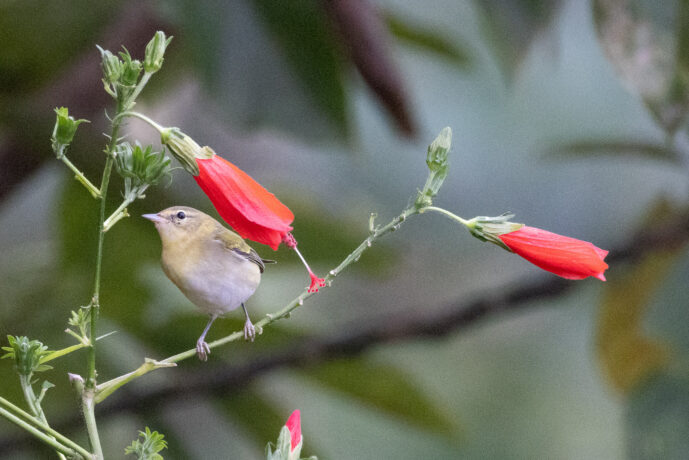
Quick Facts
- Scientific Name: Leiothlypis peregrina
- Family: Parulidae
- Known Nicknames: Swamp Warbler
- Average Length: 10–13 cm / 3.9–5.1 in
- Average Weight: 8–13 g / 0.28–0.46 oz
- Wingspan: 19–20 cm / 7.5–7.9 in
- Key Feature: Thin, very pointed bill and short tail; breeding males display a prominent gray crown and white underparts
- Primary Diet: Primarily Insectivore (specializes on spruce budworm; also consumes nectar and fruit in winter)
- Range: Breeds across the Boreal Forest of Canada and northern USA; winters in Central America and northern South America
- Habitat: Boreal coniferous and mixed forests (breeding); tropical forest edges and shade-grown coffee plantations (wintering)
- Social Structure: Solitary or territorial pairs when breeding; highly social in winter, joining mixed-species flocks
- Nesting/Breeding: Well-concealed cup nest on the ground, often in Sphagnum moss or at the base of a shrub
- Conservation Status: Least Concern (LC)
- Population Trend: Stable
The Tennessee Warbler (*Leiothlypis peregrina*) is a petite, energetic songbird known for its understated elegance and remarkable migratory journey. Despite its name, this warbler is merely a traveler through Tennessee, breeding in the boreal forests of Canada and wintering in the coffee plantations of Central and South America. Breeding males are characterized by a crisp gray crown, a sharp white stripe over the eye, and vibrant olive-green wings that contrast against a clean white underbelly. A defining feature of this species is its exceptionally thin, needle-like bill, which it uses with surgical precision to glean insects from foliage or probe tropical flowers for nectar. Lacking the bold wing bars or tail spots common to many of its relatives, the Tennessee Warbler is best identified by its sleek silhouette and its loud, accelerating three-part trill, which serves as a soundtrack to its vital role as a primary predator of forest pests like the spruce budworm.
Habitats & Distribution
During the breeding season, this species inhabits the northern boreal forests of Canada, Alaska, and the northernmost United States, particularly favoring cool, damp coniferous or mixed woodlands. It is frequently found in areas with dense thickets of alder, willow, or larch, often near bogs, swamps, or forest clearings. During migration and wintering, it utilizes a broader range of environments, including tropical forest edges, second-growth scrub, and shade-grown coffee plantations.
Its distribution follows a long-distance migratory pattern, spanning from its northern breeding grounds down through the eastern and central United States to its wintering range in Central America and northern South America. While it is primarily associated with the northern reaches of the continent in summer, its winter range extends from southern Mexico through Panama and into Colombia and Venezuela.
Behaviours & Reproduction
During the breeding season, these birds are primarily solitary and territorial, though they become notably gregarious during migration and on their wintering grounds, where they often join mixed-species flocks. They exhibit specialized foraging behaviors, such as gleaning insects from the undersides of leaves and consuming nectar from flowering trees during the winter. Their population dynamics are closely tied to the environment, frequently showing irruptive patterns that track outbreaks of the spruce budworm, a primary food source for their young.
Mating is generally monogamous, with the female constructing a well-concealed cup nest on the ground, often tucked into sphagnum moss or dense grass. She typically lays a clutch of four to seven eggs and performs all incubation duties, which last about 11 to 12 days. Once the eggs hatch, both parents share the responsibility of feeding the chicks. The young develop rapidly and fledge within eight to ten days, an evolutionary adaptation that allows them to take full advantage of the brief but productive northern summer.
Diet
The Tennessee Warbler is primarily an insectivore with a diet that fluctuates significantly based on the season and its geographical location. During the breeding season, it is a specialized predator of the spruce budworm, and its local population density often rises and falls in tandem with budworm outbreaks. It forages with high energy, gleaning caterpillars, beetles, and spiders from the outer foliage of trees. A fascinating aspect of its diet emerges during the winter months in Central and South America, where it transitions into a nectar specialist. To aid in this, the bird possesses a unique, semi-tubular tongue with a brush-like tip specifically adapted for lapping up nectar from tropical flowers. This dietary versatility is further highlighted by its behavior of nectar robbing, where it occasionally pierces the base of a flower to access the liquid without providing pollination services.
Colors
Tennessee Warblers feature a crisp gray cap, a prominent white eyebrow, and a dark eye line contrasting with vibrant olive-green upperparts. Their underparts are notably unstreaked and white, though females and immatures often display a uniform yellowish-green wash. This plain, bi-colored plumage provides effective camouflage within dense forest canopies, allowing them to blend seamlessly into dappled light and foliage.
Fun Facts
Despite its name, this bird only visits Tennessee during migration and actually breeds in the boreal forests of Canada. It possesses a specialized, brush-tipped tongue used to lap up nectar during its winters in Central and South America, where it often acts as a "nectar thief" by piercing the base of flowers to bypass pollination. During the breeding season, its population levels are famously tied to spruce budworm outbreaks; when these insects surge, the warbler’s numbers can skyrocket. Additionally, it is one of the few warblers known to drink juice from grapes and other fruits, making it a frequent visitor to tropical coffee plantations.