Turkey Vulture
Cathartes aura
Quick Facts
- Scientific Name: Cathartes aura
- Family: Cathartidae
- Known Nicknames: Turkey buzzard, Buzzard, John Crow
- Average Length: 62–81 cm / 24–32 in
- Average Weight: 0.8–2.41 kg / 1.8–5.3 lb
- Wingspan: 160–183 cm / 63–72 in
- Key Feature: Red featherless head and ivory-colored hooked bill
- Primary Diet: Scavenger (Necrophage)
- Range: Southern Canada to Tierra del Fuego, South America
- Habitat: Open and semi-open areas including forests, shrublands, and deserts
- Social Structure: Gregarious, social
- Nesting/Breeding: Caves, hollow logs, cliff ledges, or thickets
- Conservation Status: Least Concern (LC)
- Population Trend: Increasing
The Turkey Vulture (*Cathartes aura*) serves as one of nature’s most vital cleanup specialists, easily identified by its massive wingspan, dark brownish-black plumage, and the iconic, featherless red head of the adult. While soaring, it is distinguished by a "V" shaped dihedral wing position and a characteristic teetering flight style as it rides warm air thermals in search of carrion. Unlike most birds, the Turkey Vulture possesses an extraordinary sense of smell, allowing it to detect the faint scent of decay from miles away even through dense forest canopies. These resilient scavengers are equipped with remarkable biological defenses, including a highly acidic stomach capable of neutralizing lethal pathogens like anthrax and botulism, and the unique habit of urohydrosis—cooling their legs with their own waste. Lacking a syrinx, they cannot sing, instead communicating through primeval hisses and grunts, embodying a rugged yet essential role in maintaining the health of their ecosystems.
Habitats & Distribution
This species maintains a vast geographical range that extends from southern Canada through the continental United States and Central America to the southernmost tip of South America. While populations in the northernmost reaches are migratory and move south for the winter, those in more temperate and tropical regions are generally year-round residents. This extensive distribution makes them one of the most widespread avian scavengers in the Western Hemisphere.
They inhabit a diverse array of environments, favoring open and semi-open areas such as shrublands, pastures, deserts, and subtropical forests. They are particularly common along roadsides, near landfills, and in agricultural landscapes where carrion is readily available. For nesting and communal roosting, they require secluded spots such as rocky cliffs, hollow logs, or dense thickets, preferring landscapes that allow them to utilize thermal updrafts for efficient soaring.
Behaviours & Reproduction
These scavengers are highly gregarious, often gathering in large communal roosts at night to share information and regulate temperature, though they typically forage independently using an acute sense of smell. They exhibit unique survival behaviors, such as urohidrosis—excreting on their own legs to cool down—and projectile vomiting to deter potential threats. While they lack a syrinx and communicate only through low hisses or grunts, they maintain a social hierarchy, particularly when congregating at carcasses to feed.
Reproduction involves long-term monogamous pair bonds and courtship rituals characterized by "follow flights," where one bird mirrors the intricate aerial movements of its partner. They do not construct typical nests, instead laying their eggs in secluded spots like hollow logs, thickets, or caves. Both parents participate equally in incubating the eggs and feeding the chicks through regurgitation, providing extended care until the young are fully fledged and capable of foraging on their own.
Diet
The Turkey Vulture is an obligate scavenger that feeds almost exclusively on carrion, preferring the remains of small to medium-sized mammals, birds, and reptiles. Unlike most other birds, it possesses an extraordinary sense of smell, allowing it to detect the faint scent of ethyl mercaptan—a gas produced by the beginnings of decay—from high altitudes even through dense forest canopies. While they are often associated with rotting carcasses, these birds actually prefer relatively fresh meat and will typically avoid food that has reached an advanced state of putrefaction. Their digestive system is remarkably specialized, featuring stomach acid so highly corrosive that it easily neutralizes lethal pathogens such as anthrax, botulism, and cholera, which would be fatal to most other animals. Although they rarely hunt live prey, they provide a vital ecological service by efficiently removing decomposing organic matter from the environment.
Colors
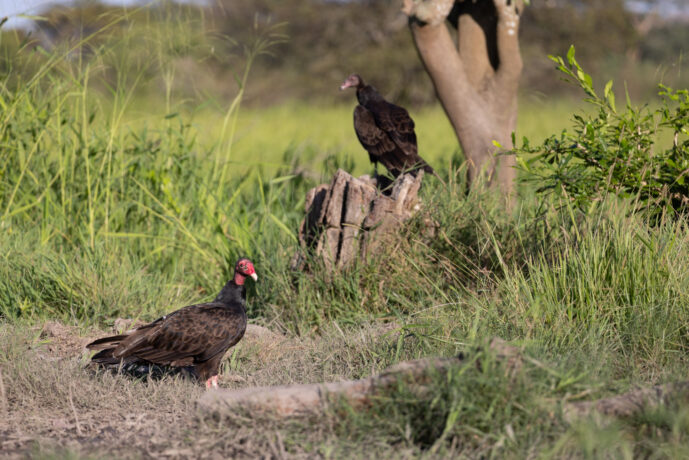
Adult turkey vultures possess dark brownish-black plumage contrasted by a stark, featherless red head and an ivory-colored beak. Their wings feature a distinctive two-toned underside, with silvery-gray flight feathers set against darker leading edges. This bald head is a specialized adaptation to maintain hygiene while scavenging, while the dark feathers assist in thermoregulation during flight.
Fun Facts
Turkey vultures possess an incredibly keen sense of smell, allowing them to detect gases from decaying carcasses from miles away. When threatened, they utilize a repulsive defense mechanism by projectile vomiting putrid, acidic stomach contents to deter predators. To stay cool during hot days, they practice urohidrosis, which involves excreting waste onto their own legs to lower their body temperature through evaporation. Despite their grim diet, their highly acidic stomach acid allows them to safely ingest pathogens like anthrax and botulism that would be lethal to most other creatures. Furthermore, they lack a syrinx—the avian vocal organ—meaning they cannot sing or whistle, communicating instead through primitive hisses and grunts.