Vermillion Flycatcher
Pyrocephalus obscurus
Quick Facts
- Scientific Name: Pyrocephalus obscurus
- Family: Tyrannidae
- Known Nicknames: Mosquero cardenal, Scarlet flycatcher
- Average Length: 13–14 cm / 5.1–5.5 in
- Average Weight: 11–14 g / 0.39–0.49 oz
- Wingspan: 24–25 cm / 9.4–9.8 in
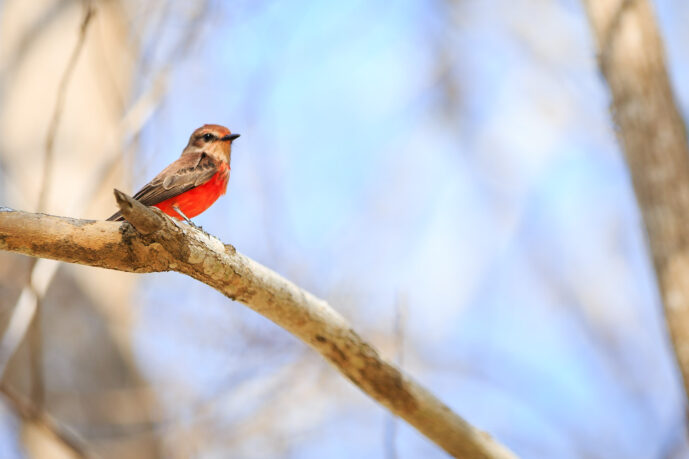
- Key Feature: Brilliant scarlet-red crown and underparts on males, contrasting with a dark brown mask and back
- Primary Diet: Insectivore
- Range: Southwestern United States, Mexico, Central America, and South America down to Argentina
- Habitat: Riparian woodlands, desert scrub, savannas, and open parks near water
- Social Structure: Solitary or in pairs; highly territorial during breeding
- Nesting/Breeding: Shallow cup nests built in horizontal tree forks
- Conservation Status: Least Concern (LC)
- Population Trend: Decreasing
The Vermillion Flycatcher (*Pyrocephalus obscurus*) is a small, breathtaking songbird celebrated for the adult male’s radiant, fiery-red plumage, which creates a stunning contrast against its dark, charcoal-colored wings and eye mask. While females and juveniles display a more understated elegance with grayish-brown upperparts and a soft peach or salmon wash on their bellies, the species is universally recognized for its "sallying" hunting style, where it perches conspicuously before darting into the air to snatch insects with a sharp snap of its bill. A truly captivating feature of this bird is the male’s elaborate courtship display; he puffs out his brilliant feathers and crest until he appears nearly spherical, fluttering high into the air while delivering a trilling song to attract a mate. Primarily found in open habitats near water sources across the southwestern United States down to central South America, this vibrant flycatcher acts as a living gem of the arid landscape, easily identified by its glowing coloration and characteristic rhythmic tail-wagging.
Habitats & Distribution
This species thrives in open environments, particularly arid scrublands, deserts, and savanna-like areas, often favoring locations near water sources such as riparian corridors. It is frequently found in agricultural fields, parks, and golf courses where scattered trees provide essential perching sites for hunting. In more tropical regions, it inhabits open woodlands and pastures, consistently seeking out edges where vegetation meets clearings. Its geographical range extends from the southwestern United States—including parts of California, Arizona, New Mexico, and Texas—southward through Mexico and Central America to central Argentina. It also occupies various regions of the Galápagos Islands. While many populations remain sedentary year-round, those at the northernmost fringes of the range often migrate south during the winter months to escape colder temperatures.
Behaviours & Reproduction
Primarily solitary and fiercely territorial, these birds use prominent perches to monitor their domain and hunt for flying insects. During the breeding season, males perform a dramatic courtship display known as a "butterfly flight," where they puff out their vibrant plumage, hover high above the canopy, and descend in a fluttering zig-zag while singing. Although generally monogamous, males often engage in "gift-giving," presenting potential mates with insects to establish a pair bond and demonstrate their hunting prowess. The female is responsible for constructing the cup-shaped nest, often using spiderwebs and lichen to secure and camouflage it within the fork of a tree. While she alone incubates the two to four eggs, the male diligently provides her with food throughout the incubation period. Once the chicks hatch, both parents share the responsibility of foraging to feed the brood. Their reproductive success is heavily tied to aggressive territorial defense, as males will chase away rivals and even much larger birds to protect the nesting site.
Diet
The Vermilion Flycatcher is primarily an insectivore, sustaining itself on a diverse array of flying insects such as flies, beetles, wild bees, wasps, and grasshoppers. It employs a sit-and-wait hunting strategy, perching prominently on low branches or fences to scan for movement before darting out to snatch prey mid-air with remarkable agility. An interesting aspect of its feeding behavior is its tendency to return to a perch and vigorously beat larger insects against a hard surface to kill them or remove wings before consumption. Additionally, much like birds of prey, these flycatchers regurgitate small pellets containing the indigestible chitinous exoskeletons of their prey, and they have been observed occasionally consuming honeybees, skillfully handling the insects to avoid being stung.
Colors
Adult males display a brilliant scarlet-red crown and underparts contrasted against a dark charcoal-brown mask, back, wings, and tail. Females and juveniles exhibit more cryptic coloration for camouflage, featuring grayish-brown upperparts and a pale, streaked breast that transitions into a soft salmon or peach-colored wash on the belly. This dramatic sexual dimorphism allows males to stand out during territorial displays while providing females with essential concealment within desert scrub and riparian environments.
Fun Facts
The Vermillion Flycatcher is a romantic at heart; males often present potential mates with "gifts" of colorful butterflies or other insects during courtship rituals. To build their sturdy, cup-shaped nests, they utilize sticky spiderwebs as a natural adhesive to bind twigs and lichens together. These birds are also known for a spectacular "flutter-flight" display, where the male puffs out his brilliant chest feathers and hovers nearly 50 feet in the air while singing to defend his territory. Despite their fiery appearance, they are patient hunters that practice "hawking," sitting perfectly still on a low branch before darting out to snatch a meal mid-air and returning to the exact same spot.