white-bearded Manakin
Manacus manacus
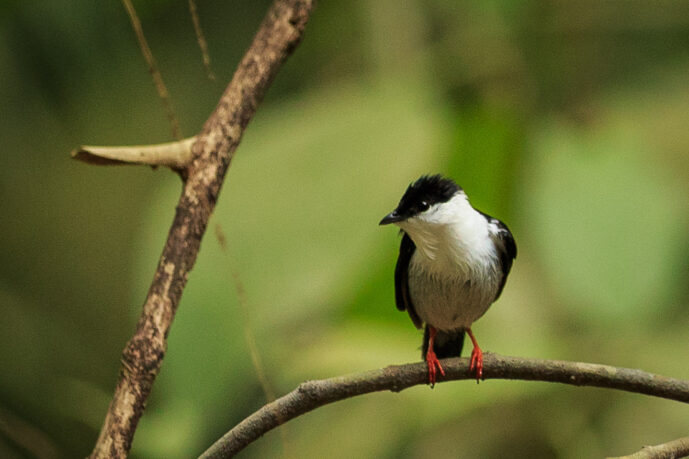
Quick Facts
- Scientific Name: Manacus manacus
- Family: Pipridae
- Known Nicknames: White-bearded Manakin, Bearded Manakin
- Average Length: 10.2–11.0 cm / 4.0–4.3 in
- Average Weight: 15.0–20.0 g / 0.53–0.71 oz
- Wingspan: 17.5–19.5 cm / 6.9–7.7 in
- Key Feature: Elongated white throat feathers forming a prominent beard and black crown in males
- Primary Diet: Primarily Frugivore
- Range: Northern South America to Northern Argentina, including the Amazon Basin and Trinidad
- Habitat: Tropical lowland rainforest understory and secondary growth
- Social Structure: Polygynous Lek-breeding System
- Nesting/Breeding: Shallow cup nest built in the fork of a horizontal branch
- Conservation Status: Least Concern (LC)
- Population Trend: Stable
The white-bearded manakin (*Manacus manacus*) is a small, charismatic bird of the Neotropical forests, renowned for its explosive energy and extraordinary courtship rituals. Males are visually striking, sporting a velvety black cap and wings that contrast sharply with a brilliant white "beard" of elongated throat feathers and a snowy collar, while females remain a camouflaged olive-green. These birds are most famous for their communal breeding displays, or leks, where males perform high-speed acrobatic jumps between saplings. During these performances, they produce startling, firecracker-like snapping sounds—not with their voices, but by rapidly clapping specialized, thickened wing feathers together. This remarkable combination of mechanical music and high-velocity dance makes the white-bearded manakin one of the most captivating avian performers in the rainforest canopy.
Habitats & Distribution
This species is widely distributed across northern and central South America, with a range extending from Colombia and Venezuela through the Guianas and southward into Brazil, eastern Peru, and northern Argentina. It is also found on the island of Trinidad. Its presence is most common in the Amazon Basin and the Atlantic Forest regions, where it occupies a variety of lowland environments.
The preferred habitat consists of humid tropical forests, particularly in areas characterized by dense undergrowth and secondary growth. It is frequently found along forest edges, in thickets, and near swampy terrain or streams. These birds typically remain in the lower levels of the forest canopy and are most often observed at communal display sites, or leks, situated on the forest floor. They generally inhabit elevations below 1,000 meters, avoiding high-altitude mountain ranges.
Behaviours & Reproduction
Males exhibit a complex social structure centered around communal display grounds known as leks, where dozens of individuals congregate in the forest understory. Each male meticulously clears a small patch of the forest floor to create a "court," which serves as his stage. To attract females, they perform high-energy acrobatic displays, darting rapidly between saplings while producing loud, firecracker-like snaps. These sounds are mechanical, created by specialized wing feathers that are knocked together at high speeds. The males also puff out their elongated throat feathers, or "beards," during these synchronized performances to signal their fitness and dominance within the hierarchy.
The mating system is strictly polygynous, with females visiting the lek solely to observe the displays and select a mate. After choosing a male based on the intensity and precision of his performance, copulation occurs quickly on the cleared court. Once mated, the female assumes all parental responsibilities, departing the lek to build a shallow, cup-shaped nest in nearby vegetation. She typically lays two eggs and handles incubation and chick-rearing independently, while the males remain at the lek throughout the breeding season to continue competing for additional mating opportunities.
Diet
The white-bearded manakin is primarily a frugivorous bird, subsisting on a diverse array of small fleshy fruits and berries, particularly those from the Melastomataceae family. While fruit makes up the bulk of its nutritional intake, it also opportunistically consumes small insects and spiders to supplement its protein levels, especially during the breeding season. An interesting aspect of its feeding behavior is the "sallying" technique, where the bird plucks fruit mid-air while hovering briefly rather than perching directly on the fruiting branch. Furthermore, these manakins possess an incredibly rapid digestive system, often processing fruit and expelling the seeds in as little as 10 to 20 minutes. This efficient digestion makes them vital seed dispersers within their tropical habitats, as they effectively distribute viable seeds across the forest floor while moving between their elaborate display grounds.
Colors
The male white-bearded manakin displays a striking black crown, wings, and tail contrasted by a brilliant white throat, breast, and nape, with elongated throat feathers forming a prominent "beard." It features greyish lower underparts and vibrant orange-yellow legs. In contrast, females and juveniles are a uniform olive-green, providing essential camouflage within the dense tropical foliage.
Fun Facts
These birds are masters of "sonation," using specialized wing feathers to create loud, firecracker-like snaps by hitting their wings together behind their backs at speeds faster than a hummingbird’s wingbeat. To prepare for their elaborate courtship dances, males act as forest janitors, meticulously clearing "courts" on the forest floor by removing every leaf and twig to ensure their bright orange legs stand out to watching females. During these high-energy displays, they puff out their throat feathers into a stiff, white "beard" and perform rapid-fire leaps between saplings that are often too fast for the human eye to track. Remarkably, they also possess one of the fastest digestive tracks in the avian world, capable of processing fruit and dispersing seeds in as little as 12 to 15 minutes.