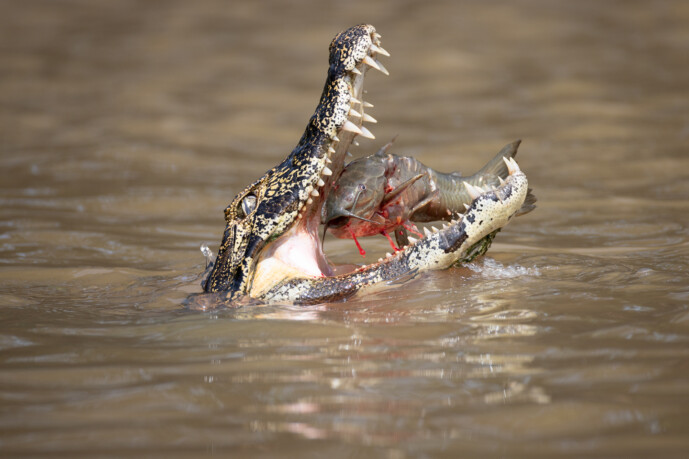
Yacare Caiman
Caiman yacare
Quick Facts
- Scientific Name: Caiman yacare
- Family: Alligatoridae
- Known Nicknames: Piranha Caiman, Red Caiman, Jacaré, Paraguayan Caiman
- Average Length: 1.5–3.0 m / 4.9–9.8 ft
- Average Weight: 40–60 kg / 88–132 lb
- Wingspan: N/A
- Key Feature: Prominent lower teeth that can protrude through the upper jaw and distinct bony ridges between the eyes
- Primary Diet: Carnivore (primarily fish, aquatic snails, and crustaceans)
- Range: Central South America, including Brazil, Bolivia, Paraguay, and Argentina
- Habitat: Freshwater wetlands, rivers, lakes, and seasonally flooded savannas such as the Pantanal
- Social Structure: Gregarious; known to congregate in high densities, particularly during the dry season
- Nesting/Breeding: Mound nests constructed from soil and decaying organic vegetation
- Conservation Status: Least Concern (LC)
- Population Trend: Increasing
The Yacare Caiman, often nicknamed the "piranha caiman," is a medium-sized crocodilian primarily found in the lush wetlands of South America’s Pantanal region. It is easily distinguished by its dark olive-brown scales and the prominent black blotches along its lower jaw, which house sharp teeth that often remain visible even when its mouth is closed. A key feature of this species is the "spectacled" bony ridge between its eyes, a characteristic it shares with its close relatives, though the Yacare is uniquely celebrated for its incredible population density and role as a keystone predator. Highly adapted to its aquatic environment, it primarily feeds on fish and snails, using its powerful tail and streamlined body to navigate waterways with prehistoric grace. Whether seen basking in massive, sun-drenched groups along riverbanks or gliding silently through the marsh, the Yacare Caiman remains a resilient symbol of the wild South American landscape.
Habitats & Distribution
This species is native to central South America, with a range that encompasses southwestern Brazil, eastern Bolivia, Paraguay, and northern Argentina. It is most famously associated with the Pantanal, one of the world's largest tropical wetland systems, though its distribution also extends throughout the drainage basins of the Paraguay and Paraná rivers. It primarily inhabits freshwater environments, including slow-moving rivers, lakes, marshes, and lagoons. Highly adaptable to seasonal fluctuations, it frequently moves into flooded savannas during the wet season and retreats to more permanent water bodies during periods of drought. It shows a strong preference for habitats with abundant aquatic vegetation, which provides essential cover for both hunting and protection.
Behaviours & Reproduction
Typically congregating in large numbers during the dry season, these crocodilians exhibit a complex social hierarchy, particularly among dominant males who compete for territory and mates through vocalizations and water-slapping displays. During the rainy season, females construct large mound nests from soil and decaying vegetation. These mounds act as natural incubators, where the internal temperature determines the sex of the developing embryos. A single clutch usually consists of 20 to 40 eggs, which the female guards vigilantly against predators throughout the incubation period. Once the hatchlings emerge, they emit high-pitched chirps to signal the mother, who assists them by excavating the nest and carrying them to the water in her mouth. This species is known for its significant maternal care and the formation of communal nurseries, or crèches, where multiple females may collectively protect a large group of juveniles. This cooperative strategy enhances the survival rate of the young in high-predation environments, ensuring that the hatchlings remain protected during their most vulnerable months.
Diet
The Yacare Caiman is a generalist carnivore with a diet that evolves as it matures, primarily consisting of aquatic invertebrates like snails and crustaceans when young, and transitioning toward larger prey as an adult. It is famously nicknamed the "piranha caiman" because piranhas constitute a significant portion of its intake, making the species a vital natural regulator of piranha populations in South American wetlands. Beyond fish, this opportunistic predator consumes various reptiles, birds, and small mammals that venture near the water's edge. Interestingly, their feeding patterns are heavily influenced by the seasonal cycles of the Pantanal; during the dry season, they take advantage of receding waters to feast on fish concentrated in shrinking pools, demonstrating a highly efficient and adaptable hunting strategy.
Colors
Yacare Caimans feature a brownish-green or olive dorsal hide that transitions to a pale yellow or creamy underside. They are characterized by distinctive dark blotches along the lower jaw and prominent dark bands across the tail. This muted, earthy coloration provides excellent camouflage, allowing them to blend seamlessly with murky water and dense wetland vegetation.
Fun Facts
Often called the "piranha caiman," this reptile is famous for its specialized diet and a unique dental arrangement where its long lower teeth can actually poke through holes in its upper jaw. They are incredibly social compared to other crocodilians, frequently seen basking in massive congregations of hundreds along riverbanks, looking like a scaly traffic jam. To survive the murky waters of the Pantanal, they use a translucent "third eyelid" as built-in goggles for underwater hunting, while a reflective layer behind their retinas causes their eyes to glow a brilliant, eerie red when caught in a flashlight at night.