Yellow-backed Oriole
Icterus chrysater
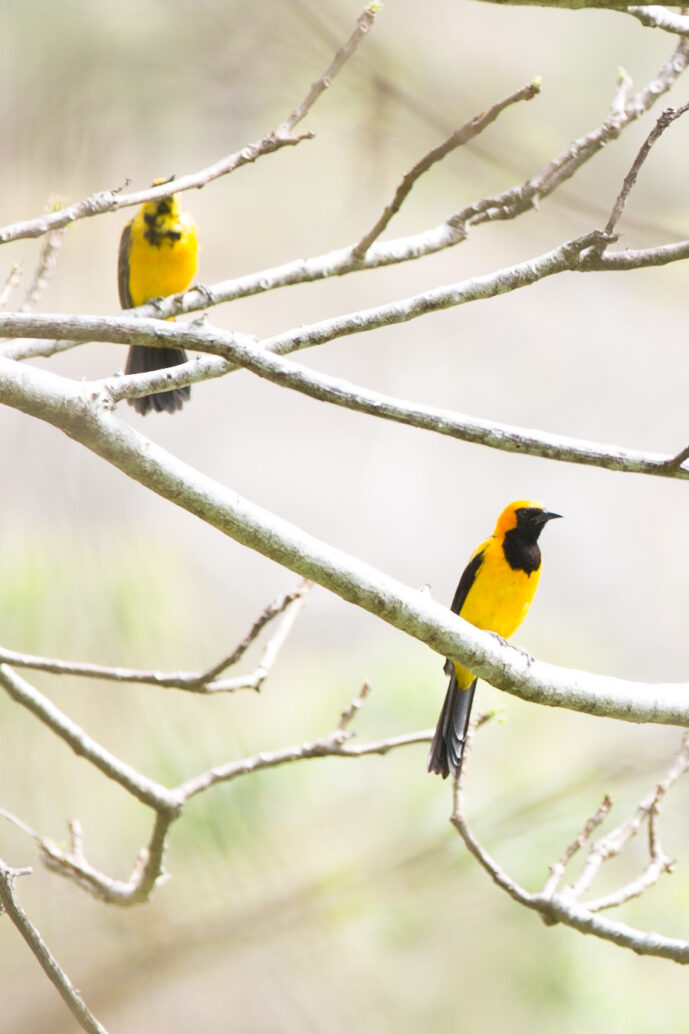
Quick Facts
- Scientific Name: Icterus chrysater
- Family: Icteridae
- Known Nicknames: Turpial de dorso amarillo
- Average Length: 20–24 cm / 8–9.5 in
- Average Weight: 40–50 g / 1.4–1.8 oz
- Wingspan: 30–35 cm / 12–14 in
- Key Feature: Bright yellow back and crown contrasting with a black facial mask, throat, wings, and tail
- Primary Diet: Omnivore (Insects, nectar, and fruit)
- Range: Southern Mexico through Central America to Northern Colombia and Venezuela
- Habitat: Humid forest edges, open woodlands, and plantations
- Social Structure: Solitary or in pairs; occasionally small family groups
- Nesting/Breeding: Long, pendulous woven nests suspended from tree branches
- Conservation Status: Least Concern (LC)
- Population Trend: Stable
The Yellow-backed Oriole (*Icterus chrysater*) is a striking songbird native to the humid forests and open woodlands of Central and South America, instantly recognizable by its saturated, golden-yellow plumage that contrasts sharply against its jet-black wings, tail, and facial bib. Unlike many other oriole species, the Yellow-backed Oriole is sexually monomorphic, meaning both males and females boast the same brilliant "bandit mask" and vivid coloration. Renowned for its rich, liquid whistling song, this bird is also a master architect, weaving impressive, pendulous nests that can hang over two feet long from high tree branches. Whether foraging for insects, fruit, or nectar, this medium-sized icterid serves as a vibrant flash of sunshine within the tropical canopy, combining bold aesthetics with remarkable nesting ingenuity.
Habitats & Distribution
This species is found across a broad geographical range extending from southern Mexico through Central America and into northern South America. Its distribution includes countries such as Guatemala, Honduras, Nicaragua, Costa Rica, and Panama, with its southernmost reach extending into Colombia and Venezuela. It is generally a resident bird throughout these regions, though some local movements may occur based on seasonal resource availability. It typically inhabits subtropical or tropical moist lowland forests and montane woodlands, showing a particular affinity for pine-oak forests and humid forest edges. The species also frequently occupies semi-open landscapes, including secondary growth, clearings, and agricultural areas with scattered trees. While adaptable to various wooded environments, it generally avoids the deep interior of dense, unbroken rainforests in favor of more open or transitional habitats.
Behaviours & Reproduction
Usually found in pairs or small family groups, these birds exhibit a socially monogamous structure and maintain territories throughout the year. They are active foragers, moving through the canopy to feed on a diet of insects, fruit, and nectar. Their social behavior is more gregarious than many other oriole species, as they often remain in close-knit units even outside the peak breeding season. Reproduction is characterized by the construction of elaborate, pendulous nests that can measure up to 60 centimeters in length. These hanging pouches are woven from tough plant fibers and suspended from the tips of high branches to protect against arboreal predators. The female typically lays two to three eggs and performs most of the incubation, though the male plays a significant role in defending the nest site and feeding the young. In some populations, they may engage in cooperative breeding, where additional family members assist the primary pair in raising the chicks.
Diet
The Yellow-backed Oriole maintains an omnivorous diet that primarily consists of insects, fruits, and nectar. It forages actively in the middle and upper layers of the forest canopy, where it hunts for a variety of invertebrates such as caterpillars, beetles, and grasshoppers. In addition to its insectivorous habits, this bird consumes various tropical fruits, including berries and figs, and is frequently seen visiting flowering trees to feed on nectar. An interesting aspect of its feeding behavior is its use of "gaping," a technique where the bird inserts its sharp, pointed bill into a fruit or flower and then forcibly opens its mandibles to create a hole, allowing easier access to the juices or pulp inside. Furthermore, the Yellow-backed Oriole is known to be quite opportunistic, occasionally visiting artificial nectar feeders meant for hummingbirds or joining mixed-species foraging flocks to more efficiently locate food sources throughout its woodland habitat.
Colors
The Yellow-backed Oriole displays a vibrant golden-yellow body contrasted by a jet-black face mask, throat bib, wings, and tail. Its namesake yellow back and shoulders distinguish it from similar species, while fine white margins often edge the black wing feathers. Both sexes possess this bold, high-contrast coloration, prioritizing species recognition over camouflage within its tropical forest habitat.
Fun Facts
The Yellow-backed Oriole is a master architect, weaving intricate, sock-like nests that can dangle more than two feet from the tips of high branches to protect eggs from climbing predators. Unlike many of its more solitary relatives, this species is notably social and frequently forages in tight-knit family groups, maintaining constant communication through a series of melodious, liquid whistles. They also employ a specialized feeding technique known as "gaping," where they thrust their sharp bills into fruit or bark and use strong jaw muscles to pry the material open, exposing hidden insects and nectar that other birds cannot reach.